“We're going,” they said, “to the end of the world.” So they stopped the car where the river curled, And we scrambled down beneath the bridge On the gravel track of a narrow ridge.
We tramped for miles on a wooded walk Where dog-hobble grew on its twisted stalk. Then we stopped to rest on the pine-needle floor While two ospreys watched from an oak by the shore.
We came to a bend, where the river grew wide And green mountains rose on the opposite side. My guides moved back. I stood alone, As the current streaked over smooth flat stone.
Shelf by stone shelf the river fell. The white water goosetailed with eddying swell. Faster and louder the current dropped Till it reached a cliff, and the trail stopped.
I stood at the edge where the mist ascended, My journey done where the world ended. I looked downstream. There was nothing but sky, The sound of the water, and the water’s reply.
To listen to many foresters, you would think the threat to trees is limited to the bark beetle epidemic in the American West - even though all species of trees, all over the world, are dying from absorbing ozone and exposure to reactive nitrogen from industrial processes. The pictures below, of Saguaro National Park, are from the US Park Service. Bark beetles aren't a factor in this very obvious reduction of health and vigor. Yet the condition of the cacti reflects the decline of the largest specimens of vegetation - which is occurring in every biome on earth. You would think some savvy researcher would realize that it is no coincidence, and look for the common factor, which is the toxic composition of the atmosphere. The reduction in air quality isn't any mystery - just compare the wild mountain slopes in 1935 to the proliferation of buildings in 2010, with accompanying roads and pollution.
Below are olive trees in Corsica, dying of a pathogen that is expected to infect the rest of Europe. I will have much more next week about the death of forests, but for now, what follows is the transcript from this week's Dispatch from the Endocene at Extinction Radio.
Thanks Gene, and welcome listeners to the 21st Dispatch From the Endocene.
Each time when I prepare this program I find there is a multitude of new evidence that our species, called sapiens, or wise, would be better named Homo Eradicatus.
Following are a few reports which in their diversity remind us of the myriad and unexpected ways that we are eradicating other species on our planet.
First, some ecologists are warning that one third of the world’s freshwater fish are at risk if the dozens of dams being planned are ever built. Despite the reputation hydroelectric generation enjoys for being a source of clean energy, it is anything but. I will leave a link on my blog to the excellent movie “Damnation”, which looks at consequences in the US. This latest report refers to government intentions to construct 450 dams in places once considered too remote to access - in the Amazon, Congo, and in Asia. We apparently have learned nothing from the disasters that have already been built.
One of the most amazing recent studies tells us that melting ice means more than rising sea levels and loss of albedo. Thick ice blocks light from reaching the water below, and the creatures that inhabit that unique environment are not adapted to the light that will increasingly penetrate the depths. Researchers are attempting to model what the change will mean if algae displaces invertebrate communities, and what impact that will have in turn for fish populations such as herring, capelin and mackerel. The bottom line is no one knows exactly how this will interact with stratification of fresh and salt water as the ice melts, acidification, and warming temperatures. What IS crystal clear is that the reach of Homo Eradicatus extends even to places we have never actually been.
But perhaps this is irrelevant, as we are emptying the seas, according to a report published in the journal Nature Communications. The researchers analyzed the global fish catch and determined that between 1950 and 2010, more than 35 billion tons of fish were caught than was reported. Around nine percent is discarded as unwanted bycatch from mass trawlers looking for more marketable products like shrimp. This illegal or unregulated plunder is reflected in the difficulty now encountered in locating healthy populations to fish. Many species are on the brink of collapse which is resulting in what one of the authors called the “luxurization” of, for example, the once common cod.
Many people live their entire lives without ever seeing a bat and perhaps without giving them a thought, even though they are vital pollinators, seed dispersers and consumers of insect pests. According to an article published by the Climate News Network, there are more than 1,100 types of bat that many under threat from human activities ranging from wind turbines to drought from global warming. Researchers suspect warming may interfere with their ability to detect prey. Populations have been decimated by a fungal disease, and it is unknown what stress has caused them to become so vulnerable.
A comprehensive study of mass mortality events, handily acronymed as MMEs, looked at 727 published reports around the globe and found a major intensification for numerous animal species. First consider the enormous magnitude of an episode that qualifies for the designation:
“…removing more than 90% of a population, resulting in the death of more than a billion individuals, or producing 700 million tons of dead biomass in a single event.”
The abstract states:
“…the increase in MMEs appears to be associated with a rise in disease emergence, biotoxicity, and events produced by multiple interacting stressors…In addition, MMEs with the largest magnitudes were those that resulted from multiple stressors, starvation, and disease.”
That study is from 2014, and as recorded in an article in the Washington Post recently, the MMEs are continuing to increase. You can read about sea birds, bees, whales, antelope, and corals, and more - including of course, trees.
I noticed that Sam Carana posted in his Arctic News blog that “Annual mean carbon dioxide levels measured at Mauna Loa, Hawaii, grew by 3.17 ppm in 2015, a higher growth rate than in any year since the record started in 1959.”
This is despite the global slowdown in the economy, and it is exactly what you would expect when trees are being poisoned by pollution and the forests are in decline around the world, subject to opportunistic attacks from epidemics of insects, disease and fungus.
Perhaps this impending scarcity of trees explains why no fewer than dozens of companies in Spain have been digging up thousand year old olive trees for the last two decades, and selling them to wealthy foreigners who want them as garden ornaments in northern Europe and even in places as far off as the US and the United Arab Emirates. This despite they often don’t survive the journey, and if they do, often die prematurely. To top it off, a pathogen has been killing olive trees in Italy and is expected to spread across Europe. Strains of the bacteria are able to infect forest trees such as oak, sycamore, ornamentals like oleander, and orchard crops like citrus, cherry, almond, grapefruit, and peach. As usual, foresters blame recent invasive species instead of pollution, even though bacteria spores have been found to literally travel on the wind.
An article in Smithsonian explains that “recent research suggests that microbes are hidden players in the atmosphere, making clouds, causing rain, spreading diseases between continents and maybe even changing climates.
A NASA scientist was astonished when he sampled air collected in Oregon and found living bacteria and fungus that originated in Asia.
"I regard the atmosphere as a highway, in the most literal sense of the term," he was quoted in the article. "It enables the exchange of microorganisms between ecosystems thousands of miles apart, and to me that’s a more profound ecological consequence we still have not fully wrapped our heads around."
Thanks for listening to Dispatch from the Endocene - at the close of the hottest year in human history, and the beginning of what NASA anticipates will be an even hotter 2016. Links:
“Nature, Mr. Allnut, is what we are put in this world to rise above.”
~ Katherine Hepburn, as Miss Rose Sayer, in The African Queen, 1951
Following is the transcript for my segment this week on ExtinctionRadio, which can be heard at the website.
Thank you Gene, and welcome listeners. I would like to dedicate this 20th Dispatch from the Endocene to David MacPhail, a much respected member of a Facebook group called The Panic Room. He passed away in November, in his adopted country of Nicaragua.
David typically chose, almost daily, a photograph of an endangered or extinct species to post online with a brief description.
To honor his effort to commemorate each lost creature or plant, from the most majestic whale to the most humble snail, in its own unique diversity and splendor, I thought I would focus this episode on just one species, the lion.
It would be impossible to mention with any depth even a small fraction of the instances in human history when lions have occupied a prominent role of cultural significance.
The earliest drawings are found in the Chauvet Cave of southern France, from some 30,000 years ago.
Lions are depicted in the ancient Egyptian sphinx, and contemporary value is still placed on beaded manes and tails collected by Maasai hunters.
Across time and continents, lions have symbolized courage and bravery, and the power of both nature and man.
Lions have been sculpted and painted. Their image adorns fine Limoges porcelain, golden cups, pottery vases, hand-woven rugs and iron gates.
Lions are on the coat of arms of England, while the pair known as Patience and Fortitude flank the stairs to the New York Public Library.
Lions are sacred as guardians in China even though they aren’t indigenous.
Around the world lions are part of timeless myths - we see them at the movies as a Hollywood studio mascot, and in a beloved Disney cartoon and Broadway show.
The Lion is, well, lionized in literature from Nietzsche’s Thus Spoke Zarathustra, to the Wizard of Oz, and Narnia.
The Greeks gave us the lion as a constellation, and in the Bible the lion represents Christ as the son of God.
The four bronze Barbary lions, now extinct, that guard Nelson’s column in Trafalgar Square stand mutely in rebuke to humans, who can and do annihilate that which what we most revere.
The following passage is from an article about a genetic study of extinct lions:
“Lions once roamed across the world. Until relatively recently, various sub-species could be found across Africa and all the way from the Indian subcontinent, through the Middle East and into modern day Greece and Turkey. Visitors to the British Museum in London can see engravings from Assyria (in modern day Iraq) made as recently as 635 BC of large scale lion hunting by the local people."
"Sadly these hunts, and others like them, were rather too successful. Along with increasing human encroachment on their habitats, persecution has resulted in the virtual extinction of lions outside of sub-Saharan Africa. The Asian lion lives on only through a small and highly endangered Indian population of approximately 400 individuals; all other lions outside of sub-Saharan Africa are extinct.”
Although the hunt in Assyria mentioned in that quote was by no means unique, it is remarkable because images of the slaughter were meticulously and absolutely gorgeously recorded in limestone bas relief. Archaeologists excavated the walls from the great palace in Nineveh, located in present-day Iraq. You can find photos and an astoundingly exquisite short video of the carvings on my blog, Wit’s End.
The rest of this dispatch are excerpts taken from a blogpost I came across while researching these now-extinct lions. The author, Geoff Micks, first viewed the carvings in the Museum at the age of seventeen. In hindsight, he expresses some poignant observations that reflect the visceral beauty and savage barbarity in the artwork. He begins:
“The lion’s expression of suffering –of great dignity struck low– was so palpable that I felt compelled to sit down and sketch it.
“At the time of this frieze’s construction, the Assyrians ruled over the entire Fertile Crescent, the Holy Land, and much of Egypt.
As might be expected from a powerful militaristic monarchy, the Assyrian Kings were avid hunters when not campaigning. Ashurnasirpal II claimed in one of his epithets: “I killed 30 elephants with the bow. 257 powerful wild bull I killed them from my war chariot. I killed 370 strong lions just by spear like birds in a cage.”
While all men and beasts were prey to the Assyrian nobility, lions were the particular sport of kings, symbolizing the ruling monarch’s duty to protect and fight for his people as well as his dominion over everything within his borders. The palace of the new capital at Nineveh was decorated with these sculpted reliefs to illustrate the prowess of the last great Assyrian king, Ashurbanipal (668-631 BC). That’s him thrusting a sword into the belly of a wounded lion, an image he duplicated for his royal seal.
The hunt itself was highly organized and orchestrated. The animals were collected ahead of time and kept in cages in the royal menagerie. When the King had time to indulge in his sport the cages would be transported out of the city by his soldiers. Infantry would serve as beaters to keep the prey within a level killing field, and cavalry would drive the lions towards the royal chariot, where the King would use arrows and spears to wound the lions before dispatching some with his sword. Although little was left to chance, much of the sport was based around how dangerous the wounded lions were, and the friezes show a number of scenes where the lions are mauling the backs of retreating chariots.
I’m afraid the pictures I’ve found don’t really convey the true feeling of the frieze. The room in the British Museum is set up much as it would have been in Nineveh: A great hall, with life-sized scenes of the hunt all around you. The bas reliefs weren’t just for the edification of the King. Embassies and visitors would have walked past these scenes while waiting for a royal audience. The power and authority of the King is obvious even more than two and a half thousand years later.
I took a course of Greek sculpture in university, and it talked a lot about pathos: The conveying of emotion and suffering through art. I didn’t know the term at the time, but you could feel it, coming out of the rock. The Assyrian artists gave great dignity to their suffering subject matter.
The lions are shown with every sinew in their legs and paws straining; face after face is twisted in a rictus of pain; most of them bristle with arrows, and many vomit up blood from punctured lungs.
You can almost hear the roars and snarls, the thunder of hooves, the curses and cheers in a language lost to time. It’s magnificent and horrifying, all at the same time.”
This is an essay by a friend of mine, Shaheer. He documents his exploits into the world of climate change and activism, and relates the state of climate change as we stand today.
My introduction to climate change came from Al Gore, in his 2006 award winning An Inconvenient Truth. I became aware of the issue, but never gave it much more thought. It wasn’t until I heard former head of NASA's Institute for Space Studies, James Hansen, on CBC in 2009 that I became really interested in the issue, and started researching it online and reading avidly about it on The Economist. Over the next 3 years I would read over 100 books on climate, energy and related, and countless websites. For my favorite books and documentaries see my blog bio.
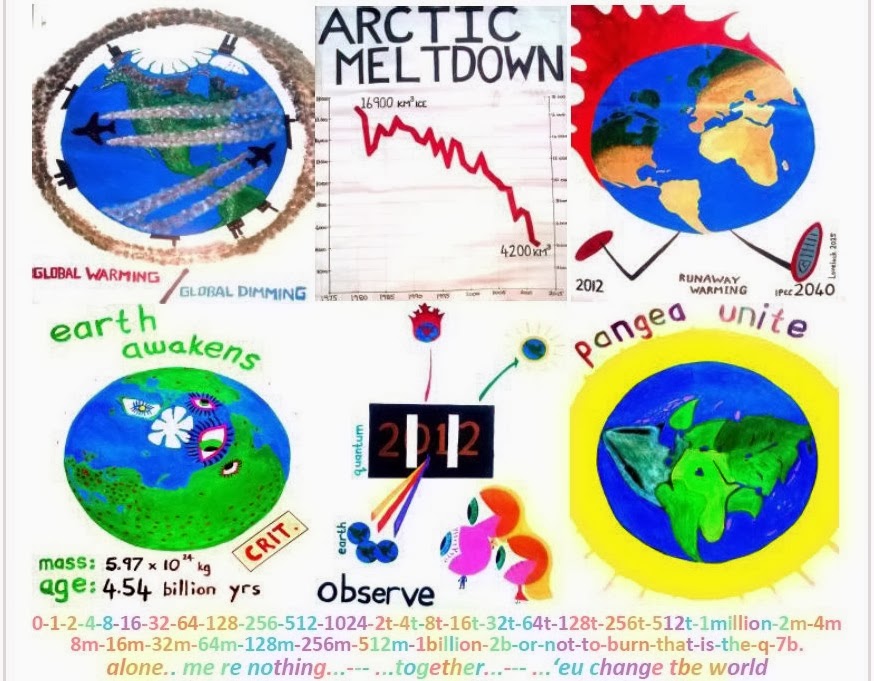
The books that hit me hardest was James Hansen’s Storms of My Grandchildren, James Lovelock'sThe Vanishing Face of Gaia, and Tim Flannery'sThe Weather Makers. Of countless documentaries, the best were The Age of Stupid, 6 Degrees Could Change The World, and Collapse by Jared Diamond. I was flabbergasted. The injustice! We were screwed. There was little to no hope. Serious scientists were predicting famine and war caused by climate change in the near term. In his books, James Lovelock presented evidence that the IPCC is highly conservative, and what they're predicting for 2040 might well come by 2025. This spells disaster for Africa. My family lives there. Then the Occupy movement erupted in 2011. I was ecstatic. Change! I met tons of great fellow activists there and made life long friends. I finally had a place to express my activism. I’d do activism with the Occupy group but sometimes I’d also go alone to the university and show off my climate artwork. These were full size 1 metre tall paintings.
Some students stopped to look, others didn't. It didn't matter, activism was the only thing giving me hope and in mind felt like the only thing that mattered. One dayProfessor Andrew Weaverwalked by and stopped to look at my artwork and quotes. He was impressed and chatted with me. I was ecstatic – I got to talk to Andrew Weaver! Suddenly it was all worth it. To do more climate activism, and get a sense of accomplishment, I intended to cycle across Canada in 2011, and made it from Victoria to Calgary with flyers and a trailer that advertised climate change, but I fell incredibly hard and injured myself when I raced downhill without holding the handlebars. My dogs in the trailer flew overhead and I crashed hard into the rocky roadside. There were tons of cars on the highway so I'm glad I or my dogs didn't topple into traffic. Lesson learned - hold the handlebars! I didn't hand out any flyers because I didn't like what I had to say, and also I'm quite shy to approach people.
I saw my puppies fly.
In 2012 a particularly disturbing piece of news arrived, the discovery of thousands of methane plumes, some over a km in diameter, erupting from the East Siberian Arctic Shelf. This can be seen here. I, and many of the people on the forums I went to, genuinely believed we were at the start of runaway climate change, and if you asked me today, i'd still say there is strong evidence that we may have multiple passed tipping pointsthat will trigger runaway climate change, the biggest being the Arctic sea ice albedo change, the snowline albedo change, and the subsea methane hydrates. Some within the climate movement argue there is no danger of large methane releases. These people include David Archer and Gavin Schmidt. We must remember that these two are climate modelers, making theoretical models on computers. People like Natalia Shakhova, Igor Semiletov, and Peter Wadhams have been in the Arctic and East Siberia the past ~15 years via ships and submarines, studying the conditions, and they have observed great changes and are warning society about it. Their warning come not on models but through physical observation. Before the ozone hole was discovered, modelers too claimed an ozone hole wasn't possible. Once James Lovelock invented the tool to detect CFCs a hole was discovered above Antarctica that proved modelers wrong. In the near future, large methane releases will prove the methane modelers wrong.
Anyway, in 2012 I wanted to start up the idea that we should shoot for not an earth hour or earth day, but an earth year, a year in which everyone on earth devotes their attention to solving the crises of climate change, pollution, deforestation, over-fishing, ect. I once again attempted to cycle across Canada. I left with the Occupy group walking across Canada, but soon broke off to hit Camosun college. Again, I didn't have any success handing out flyers. My bicycle broke down soon after so I walked home. I became ill from stress and spent some time in the hospital psyche ward.
Me, at the start of my trip. Victoria, BC, Mile 0.
Summertime Arctic sea ice is in rapid decline and could be gone by the end of the decade. When the Arctic sea ice is gone this is known as a blue ocean event. Heat a pot of water with ice in it and you will see the temperature hovers around 0 while there is still ice, then rapidly warms up once the ice is gone. It takes an enormous amount of energy to melt ice. This is because of ice's energy of fusion. This means things get very hot very fast once that ice is gone, and this can lead to methane hydrate destabilization. The result of this according to Peter Wadhams (eminent world expert on sea ice) is an abrupt climate change that civilization could not withstand. The blue ocean event will only last a few weeks at first, and within a decade or two might be year-round. Under such circumstances, it is inconceivable how methane hydrates will stay locked up on the Arctic ocean floor. According to Paul Beckwith, (Professor at the UofOttawa doing his PhD in abrupt climate change) this process could raise temperatures to 6 C by 2025-2035, unless geoengineering is applied. Paul describes us as being at the beginning of an abrupt climate change phase that could continue rising to 10 or 11 C. New Zealand's pre-eminent climate scientists Jim Salinger says we are now in abrupt climate change. Temperature rise might not stop at 6 C, and might continue to rise to 8 C and beyond by 2200, according to Hans Schellnhuber (directer at the Potsdam Institute for Climate Impact Research) which would mean hydrogen sulfidication of the atmosphere and oceans, and complete extinction of land mammals. Hans Schellnhuber assumes a slow release of methane in his calculations. According to Malcolm Light, sea ice loss and methane hydrates could push temperatures to 4C by 2030 and 8C by 2050. It might not stop there. There are such massive methane reserves below the Arctic Ocean floor (more than 5000 billion tons of methane carbon) that they represent around 100 times the amount that is required to cause a Permian style major extinction event, should about one percent of the sub-sea Arctic methane be released into the atmosphere.
According to Malcolm Light a 50-90% emission reduction by 2020 and a variety of geo-engineering techniques can dramatically slow down or even reverse the extinction process. Even if we believe the highly conservative IPCC's targets of 85% reduction by 2050 to have a 50% chance of limiting warming above 2 degrees, it's still a tall order. And it`s certain the IPCC is wrong. The IPCC is a highly conservative organization in their predictions, and their "carbon budget" is heavily influenced by special interests. We can't burn anymore fossil fuels. We have to stop today. Once you pass 2 degrees, positive feedbacks that cause a runaway climate are sure to occur in full force. They are occurring right now at 0.85 C. Another problem, global dimming, caused by sulfur released during coal burning and bunker fuel burning, reflects sunlight and so temporarily combats global warming. Over the past 15 years, China has so massively increased their coal burning sulfur pollution that global dimming is masking the full effect of global warming by about 1.2 degrees, so we're already well past 2 degrees C if civilization suddenly stops industry and doesn't replace the aerosols with geoengineering. And aerosols only stay in the air for months, while CO2 stays for tens of thousands of years. Recently the IPCC chair Rajendra Pachauri said parts of Africa will lose 50% of their crop production by 2020. Seriously? This is a disaster. But is it really too late? Is doing something better than doing nothing? Is activism still worth it? I believe the near term climate collapse argument but I also believe we will geo-engineer in desperation, and it will somewhat work, buying us precious years. The proof is in global dimming. Sure there will be losers, but maybe the world will come together, people will eat vegetarian, and there will be enough food to spare to the starving countries. Maybe I'm just dreaming. Is Jeremy Rifkin right that we are an Empathic Civilization? Or are we crude, selfish, short-sighted, and greedy? If i'm 99% sure that we’re going to experience an extinction event in the coming decades, can I live off 1% hopium? Don’t take my hopium away. James Lovelock, you took our collective hopium. You left us bare and naked. And then you have the gall to retract your two books, saying you, Tim Flannery, Al Gore, and whoever else were alarmist? Did you retract because you genuinely believe things will progress slower than you predicted in your alarming books, or because you feel bad about making people hopeless? Are the recent death plunges in Arctic sea ice, and methane erupting from the East Siberian Arctic Shelf not evidence that things are progressing much faster than expected?
Earth burns and species extinct. Denver Airport murals.
A happier ending? People turn in their weapons and world peace.
Canada will be one of the most favorable places in the world to experience climate change, and Africa one of the least favorable. As James Lovelock would say, "move north young man". I wish I could find a way for my African family to migrate. Mostly likely, they will remain stuck behind when Africa collapses. Nonetheless, if society collapses because of a 3-4 degree C rise in temperatures, or does not massively engage in geoengineering, everyone will most likely die. We are only buying time. According to Dr. Ira Leifer world carrying capacity is predicted to be just a few thousand at 4 degrees C. Do we really want to test his prediction? And don't think we will revert to hunting and gathering in the Arctic and Antarctic - most large edible animal species will be dead and the hydrogen sulfide coming out of the oceans will be poisonous to breathe.
Packing up and migrating, leaving old friends behind, is hard work. Those people who are heavily invested in the land will probably stay behind and suffer first from climate change. Those with nothing to lose and are willing to travel, will survive the longest. The world isn't going to fall apart overnight. But the time to move is now. Abrupt climate change is now. Natalia Shakhova,Igor Semiletov, Peter Wadhams, Sam Carana, Paul Beckwith, Malcolm Light, James Lovelock, David Wasdell, Guy McPherson and AMEG can't all be full of shit. It would be really easy to simply paint their work as shit. The prediction of a50 billion ton pulse of methane releasing from the East Siberian Arctic Shelf any time after 2008 was posited from decades of research. Peter Wadhams, Natalia Shakhova and Igor Semiletov describe it as a high probability event. It's not simply shit. What would be the immediate effect of a 50 Gt release? Well over the short term it would have the power of 5000 Gt of CO2. For comparison, humans emit about 30Gt of CO2 a year. The methane will be localized to the Arctic initially, causing abrupt arctic warming and the release of more methane hydrates.
“I think we are just insects, we live a bit and then die and that’s the lot. There’s no mercy in things. There’s not even a Great Beyond. There’s nothing.”
~ John Fowles, The Collector
Following is the transcript to my 19th Dispatch from the Endocene which aired on the Extinction Radio episode of Friday, January 1, 2016. Happy New Year!
Thanks Gene and greetings listeners. Welcome to the 19th Dispatch from the Endocene, a new epoch in Earth’s history when life is on the verge of ending. We conscious wanderers find ourselves in a time of extreme cognitive dissonance - when material luxury is juxtaposed with abject deprivation and hunger; when the myriad glories of nature are accessible on smartphones but are overshadowed by images of unimaginably violent storms; and a temporary abundance is stalked by grotesque desecration. For me, it’s a time of grief and gratitude…and occasionally, suffocating guilt and stark terror.
In one of the many paradoxes that engulf modern civilization, science is becoming ever more fabulous - and simultaneously woefully inadequate. The ability of research to specialize in minutiae unveils more mysteries of chemistry and biology and physics every day; but it also compartmentalizes each subject into extreme isolation. Too often, our expanding base of knowledge resembles the blind describing different parts of an elephant with no concept of the whole animal. One field lacks substantive relevance to the others.
This trend was discerned years ago and discussed in a wonderful essay titled “Whatever Happened to Ecology”. You’ll be able to find a link to that article and all other references in this Dispatch posted with a transcript on my blog, Wit’s End.
The author, Edward Goldsmith, wrote: “The science of Ecology has been taken over by the cult of scientific reductionism and has become a weapon in the war on the living world being waged by industrial man.”
Thus we see that recent research traces a reduction of trees and forest carbon storage to the extirpation of large mammals being hunted as sport or bushmeat. But this is really nothing new, because a vast transformation and degradation of tree diversity occurred many thousands of years ago, when humans hunted the megafauna to extinction as we migrated to continents and islands around the globe. The persimmon, pawpaw and osage orange trees barely survived through clonal root reproduction, while many other species of tree that relied on large herbivores for seed dispersal disappeared. Their predators also went extinct, and other vast ecological disturbances occurred as a result.
Another new study examines an ancient transformation of the structure of plant and animal communities by analyzing fossils. It revealed what is described as a “dramatic switch” in diversity that is linked directly to human influence, even at low levels of agricultural activity.
From an article quoting co-authors of the study:
“The pattern of co-occurring species remained stable through the evolution of land organisms from the earliest tetrapods through dinosaurs, flowering plants and mammals,” said Anna K. Behrensmeyer, co-director and paleobiologist… “This pattern didn’t change because of previous mass extinctions or ancient climate variability, but instead, early human activities 6,000 years ago suddenly began resetting a basic property of natural communities. Isolating species has consequences — it can catalyze evolutionary change over hundreds of thousands to millions of years, but it also makes species more vulnerable to extinction.”
A member of the team of 29 scientists explained:
“Human impact on the environment has intensified deeply since that early-Holocene transition, but it is important to understand that we began altering ecosystems long ago…I think that modern human-driven forces, like climate change and pollution, are orders of magnitude more destructive than what early humans were doing,” she said. “But more and more, research into the Holocene and the Pleistocene is showing that when humans started migrating around the globe, they started having major, unprecedented impacts.”
Another observed: “We humans have influenced the landscape, but perhaps for a lot longer than we had previously recognized. When we look at landscapes and say, 'this is pristine or unaltered,' that's not necessarily true. We may have changed the rules over a much larger scale than we appreciate."
An underwater fossil site discovered in a flooded sinkhole by a scuba diver in the Bahamas yielded yet more unequivocal evidence that the arrival of humans, and not even extreme climate change with attendant changes in flora and sea level, led to mass extinctions. This is most starkly clear on islands as it has occurred in conjunction with the arrival of humans whether it occurred 2,000 or 10,000 years ago.
For the earliest times, the devastating consequences of such changes, known in ecology as a trophic cascade, were most likely completely inadvertent, and ultimately inevitable once our ancestors discovered they could control fire and with it, much else. However, we continue blundering towards the obliteration of the biosphere and ruination of our own health - even when it has become perfectly obvious we are doing so.
In particular, we are creating trash and pollution with reckless abandon. I encourage you to visit the Waste Atlas, an interactive website that has amazing visualizations of the staggering volume of garbage of various sorts. As for the air, it continues to worsen almost beyond belief. Cities from Beijing to Rome have declared states of emergencies and restricted vehicular traffic due to levels of pollution so high that places like Madrid become shrouded in perpetual darkness, while Delhi has given up trying to restrict traffic even though their air quality is horrific. Researchers suspect other regions may be even worse, but there is simply a lack of monitoring in remote locations such as Africa and parts of the Mid-east.
Meanwhile medical research is inching closer to declaring air pollution the main cause of Alzheimer’s disease, a burgeoning epidemic that will join cancers, heart disease, and asthma as collateral damage from contemporary pollution. Even children and dogs exhibit cognitive impairment, and it is also linked to reduced fertility, low birth weight babies, and obesity.
The death toll, estimated by WHO in Europe to be 500,000 people yearly, is actually much worse because NO2 emissions from diesel aren’t factored into that figure.
Usually when we hear of premature deaths in heat waves, the news reports leave out the really scary part. But in a book, The Climate Bonus: Co-benefits of climate policy, IPCC contributing scholar Alison Smith explains:
“In the first 2 weeks of August 2003, Europe was hit by an extreme heat wave and drought. Record high temperatures up to 40°C were reached, and slow air movement from the east allowed extra pollution to drift into Western Europe and the UK. In the UK, ozone levels were more than twice the air quality target. The poor air quality was estimated to account for around 700 of the 2,000 heat-wave-related premature deaths over a 7-day period. The UK deaths were concentrated in the London area and South East England, where ozone levels were highest…
“The high ozone levels were partly related to the effect of the high temperatures on vegetation. Plants respond to heat stress by producing large amounts of isoprene, which is a volatile organic compound and ozone precursor. High isoprene levels were thought to be responsible for around a third of the UK ozone production during the heat wave…
“Across Europe, temperatures and ozone levels were even higher, resulting in an estimated 45,000 extra deaths, of which around a third were probably due to air pollution. In the Paris area, the death rate doubled; and on the worst day, mortality was six times higher than normal, with half of these deaths attributed to high ozone levels.”
Similar to human mortality, we are seldom advised that it is a toxic gas and not a warmer temperature that is lethal to trees. Although it’s no secret that pollution is damaging to the ecosystem and crops as well as human health, researchers overwhelmingly tend to ignore it completely when assessing forests.
When I first started writing about trees drying around the globe, I was ridiculed and ostracized as being an hysteric. Scientists and foresters unanimously told me I was imagining the symptoms of an alarming decline. Merely pointing out the consequences to carbon storage was enough to antagonize virtually everyone from obscure peak oil preppers like John Michael Greer to prominent climatologists like Gavin Schmidt. Mostly I was ignored by everyone from journalists like George Monbiot to the physicist blogger Joe Romm.
Now, however, the swathes of dead trees are too ubiquitous to deny. The Ecological Society of Australia claims that “climate change is killing our trees”. Science Magazine devoted their August issue to forests, which is summed up by one overview article as “Every forest biome on Earth is actively dying right now”.
Since it has become widely acknowledged that trees are threatened and dying prematurely, researchers persist in blaming drought. One widely distributed study predicting that drought is going to cause massive tree mortality in the Southwest US bases it on the distant year of 2050, which is ludicrous since trees are demonstrably dying right now. Another equally limited survey reveals that up to 58 million trees in California are estimated to have experienced water loss due to drought. Unfortunately, that survey only looked back four years, to 2011 - had they bothered to look earlier, they would have found damage prior to the drought.
There is no question that megadroughts and higher temperatures will eventually kill forests. Climate change is irreversible, and accelerating far too fast for trees to adapt. However, they are dying ahead of predictions AND in places not in drought. Indeed, trees dying from pollution are themselves contributing to drought. Consider that researchers who predicted trees dying from pine beetle attacks would cause increased stream flow, found out the exact opposite has occurred. And it has been established that ambient ozone reduces stream flow, as well, “…due to an enhanced water loss via the leaf pores.” - and nobody has any idea just how bad the combined effects of elevated ozone and enhanced nitrogen deposition from fertilizers and combustion will be. But it’s not auspicious.
Meanwhile an iconic tree species faces imminent extinction in Hawaii, and it’s being blamed on a rampant fungus. Interestingly, the article notes that the trees play a crucial role in absorbing water.
There have been three significant studies published recently that highlight this discrepancy between the purported cause of vegetative decline - drought - and the more likely influence, of ozone.
First, scientists are perplexed having discovered that the Arctic, which had been steadily greening with warming temperatures, is now suddenly and inexplicably turning brown. The scientists at NOAA who produce the annual Arctic Report Card are at a loss as to why.
“In one of the more surprising parts of the Report Card, the authors say that Arctic tundra greenness − a measure of the productivity and biomass of live vegetation such as grasses, sedges, mosses, lichens, and shrubs − had been increasing over the past two to three decades, as shown by the satellite record. But, “for reasons that remain to be identified, tundra greenness has been declining, or browning, consistently for the past two to four years.”
This is the directly contradicts what was predicted, especially since the Arctic is wetter. “We're looking at, depending on where in the Arctic, a two- to four-year consistent drop in vegetation. It's something that's actually just gotten on our radar from a terrestrial ecology perspective," said Howard Epstein, an environmental scientist at the University of Virginia.
Second, a most instructive example of decline that is unrelated to drought is that of sugar maples in the Adirondacks, which is described by new research using tree ring analysis. The pattern the researchers discovered is described as one of “…poor vigor, regeneration failure, and elevated mortality across much of its range” and that the “majority of sugar maple trees exhibited negative growth trends in the last several decades, regardless of age, diameter, or soil fertility…Such growth patterns were unexpected, given recent warming and increased moisture availability, as well as reduced acidic deposition, which should have favored growth.”
This was all the more remarkable because most of the 242 trees sampled were between 75 and 125 years of age, the prime growth interval for a species that typically can live for 300 to 400 years.
The lead author said: “Reduced growth rates are completely unexpected…It's not supposed to happen.”
Since the scientists can’t explain this by blaming any of the usual suspects - insects, climate, soil acidification, disease, fungus, etc - they conclude “further study is needed”, despite the fact they didn’t even examine the influence of ozone, which is elevated in the entire Northeast. They also didn’t seem to notice that, in an enormous coinkydink, ALL OTHER SPECIES in the region are also in decline, as are all species in the UK and northern Europe - another area that is wetter, not drier, from climate change.
I sent the authors a letter, as yet unanswered, in which I pointed out that ozone is well known to be the most poisonous phytotoxin to vegetation, and that the damage from background concentrations is cumulative over time.
I sent them a link to a 2012 paper published by the Swedish EPA examining tree growth in Europe which found that ozone reduces carbon sequestration by 10%, AND that it can induce a shift in resource allocation into height growth at the expense of diameter growth, resulting in spindly, weak branches.
It sources a US paper documenting that "In the San Bernardino Mountains, reduction in the volume growth due to chronic ozone exposure of up to 60% has been documented for Ponderosa Pine".
Further support is in the findings of a report from the Centre for Ecology and Hydrology to the Working Group of Effects of the Convention on Long-Range Transboundary Air Pollution which concludes:
"Whereas peak concentrations of ozone have declined in recent decades in some (but not all) parts of Europe, an increase in background concentrations at the same time has contributed to no change in median or average ozone concentrations across Europe. The rise in background concentrations can contribute significantly to impacts of ozone on vegetation…
Ozone pollution in Europe in the future is critically dependent on changes in regional emissions and global transport of ozone precursors."
In yet another and third surprise to scientists, a study comparing modeled expectations for increased net primary productivity GLOBALLY found a major discrepancy when compared to actual satellite data. The researchers guess this could be due to unanticipated climatic feedbacks and/or nutrient constraints. Too bad it didn’t occur to them that our era of the sixth mass extinction most closely resembles the Great Dying of the Permian, when emissions from erupting volcanic traps released toxic gases and poisoned vegetation - just as our cars, ships, planes and smokestacks are poisoning it now.
The scientific consensus is that damage occurs to plants when ozone levels reach 40 ppb, a level that has become close to the persistent background everywhere on earth. With the EPA’S ozone standard lowered from 75 to 70 ppb in the US as of this fall, still well above that threshold, more counties and National Parks are in noncompliance. According to US News, “the biggest violator is Dinosaur National Monument…on the Colorado-Utah border. Its ozone level is 114 ppb. The runner-up at 90 ppb is the 631-square-mile Sequoia National Park in Northern California, a pristine forest boasting 3,200-year-old trees that are among the tallest in the world.”
You almost have to feel sorry for states like Texas filing suit over the tighter standards. They actually are correct - it is unfeasible to reduce ozone levels and continue business as usual, particularly with so many precursors traveling around the world from coal and transportation, plus agricultural burning and wildfires. The emissions from fires in Indonesia alone, the worst ever in 2015, are spectacular.
I will end this Dispatch by quoting from a comment written by Paul Kingsnorth, author of Confessions of a Recovering Environmentalist and founder of the Dark Mountain project. This was his response to Wen Stephenson, a climate activist who was dismayed by Paul’s apparent nihilism. It is well worth reading the entire thing, which can be found at the second link on this post.
“I am not yet 40 but I have seen things that my children will never see, because they are already gone. This is my fault, and yours, and there is nothing that we have been able to work out that will stop it…How do we live with this reality? Politics is not going to do anything about it, Wen, because politics is the process of keeping this Machine moving. What do we do? I don’t know. The reality is that we have used the short-term boost of fossil fuels to give us a 200 year party, which is now coming to an end in a haze of broken bottles, hangovers and recrimination. We have built a hugely complex society which now can’t be fuelled and is, in any case, responsible for a global ecocide. Living with this reality — living in it, facing it, being honest about it and not having to pretend we can ‘solve’ it as if it were a giant jigsaw puzzle — seems to me to be a necessary prerequisite for living through it. I realise that to some people it looks like giving up. But to me it looks like just getting started with a view of the world based on reality rather than wishful thinking.”
Thanks for listening. Bonus Video - links follow below: