A visit to his website is probably essential, but maybe an even quicker introduction can be found in a post ABOUT him, at Wibble titled Time to Wake Up. Oddly, it turns out I had read that, back in October, and even commented on it. I had forgotten all about it until I somehow came across Chefurka's website in recent days, and recognized it as familiar. Wondering how I could have miscalculated the significance last fall was a bit reminiscent of that conversation in the "Wizard of Oz" movie when Dorothy, upon being told by Glinda that she had possessed the power to fulfill her dream to go home all along, at any time she so desired, asked "But, why didn't you tell me?"
"Because," said Glinda, "You wouldn't have believed me. You had to learn it for yourself."

- Modern industrial civilization is intrinsically unsustainable. This means that it will inevitably collapse.
- Any effort spent trying to prevent that collapse is pointless and misguided. It would serve only to prolong civilization’s death throes and the continued destruction of the natural world.
- Industrial civilization is created and supported by institutions that have a vested interest in maintaining the status quo, at virtually any cost.
- Any effort spent trying to bring it down is pointless and misguided. It will be met with massive resistance from civilization’s guardian institutions – our corporations, politicians, police, schools and mass media – and will foster unnecessary violence.
- Since collapse is inevitable, adapting to that change is the only sensible approach.
- We cannot count on the institutions of civilization to help us adapt to this change – it’s simply not in their interest to do that. Even worse, they can’t even comprehend the idea.
- That leaves individuals and small communities (aka tribes) as the only historically proven agents of adaptation.
- As individuals, the single most effective thing we can do to prepare and adapt is to awaken.
Although my feet still ache, I don't regret going to the May Day demonstration. Just like the first glimmerings of Occupy in September, press coverage has been obscenely inadequate. There were swarms of reporters there all day and late into the night, but whatever photos, videos, and articles they produced apparently didn't get past their editors' desks. When I arrived at Bryant Park there were hardly more people there than on a normal day, and I was a bit worried that it heralded an ignominious end to the movement. But by the time we surged into Battery Park at the southernmost limit of Manhattan Island, our numbers were astronomical and we were feeling rather invincible. The march overtook the entire width of Broadway, a sea of banners, drummers, signs, balloons and chanting throngs, much further than an eye on the ground could see.
I had been hoping to join up with whatever more environmentally-themed action I could find, but the crowd was far too gigantic to navigate and besides the drummers' circle was the most exciting place to be. I bumped into one and then two others of my jailmates during a break at Union Square, so we had a bit of a reunion (we'll be having another, June 4, in court), and I learned that a behind-the-scenes video of our act of civil disobedience on Friday had been posted at the Occupy site to promote the march (no wonder the turnout was so impressive, well into the tens of thousands...it must have been the Matron Brigade Escapade that inspired such enthusiasm! haha).

I had been hoping to join up with whatever more environmentally-themed action I could find, but the crowd was far too gigantic to navigate and besides the drummers' circle was the most exciting place to be. I bumped into one and then two others of my jailmates during a break at Union Square, so we had a bit of a reunion (we'll be having another, June 4, in court), and I learned that a behind-the-scenes video of our act of civil disobedience on Friday had been posted at the Occupy site to promote the march (no wonder the turnout was so impressive, well into the tens of thousands...it must have been the Matron Brigade Escapade that inspired such enthusiasm! haha).

Despite that, the next morning I woke up on the crabby side of the bed. Perhaps some of it derived from walking, in mostly quiet solitude, back to the PATH train at the World Trade Center. I was a little lost, wending my way through the dark caverns, deserted except for the police lining the metal barricades. I left early because I had the uneasy feeling the NYPD was deliberately funneling everyone into a trap and indeed, I have since read there were many arrests and beatings later on. Plus, I had to catch the train home. I had never been to this part of the Financial District before, and I was pleasantly surprised at how much of the old character, from the days before skyscrapers, is preserved in this tiny section. Suddenly I came upon one narrow historic block, Stone Street, which is closed to traffic and lined with bustling restaurants.
They now have twinkling lights stretched above the cobblestones, where tables and chairs were filled with diners, having late night dinners, talking and laughing. I doubt the patrons here are ever curious about the trees and farms that produce the food they are eating - or even had a suspicion that just a few blocks away, masses of profoundly disgruntled citizens had passed by, demanding revolution, social justice, and a reversal of the growing income gap.
 I next crossed by the ornate edifice of Delmonico's, of which I have heard legends but never before laid eyes on, and I thought about the many famous, influential powerbrokers who must have enjoyed luxurious, expense-account-paid business lunches there...and I suppose still do. This article in the New York Post from January 2011, describes the abject remorse that is even more commonly exhibited by financiers today...you know, like Jon Corzine:
 "We had eight Street guys in here the other day celebrating good news on their bonuses -- and they just started popping the bottles open like crazy."
 |
| source |


"Last weekend, one broker, who confided...how he had pocketed a tremendous bonus this year, ordered a $600 bottle of 2004 Harlan Estate Cabernet from the Napa Valley, as he proudly sat for dinner with his wife and two children."
On Monday, the day before the protest, I went to the nearest mall to buy a toy drum. The parking lot is planted with dozens and dozens of trees, mostly honey locust, which has been widely utilized by developers, as it was expected to be "tolerant" of the adverse conditions found around asphalt.
 Last spring and this, I've been looking at their spring foliage with something like revulsion because it's a horrific, acid yellow that doesn't seem normal to me.
 It wouldn't be odd because ozone interferes with the ability of foliage to photosynthesize and produce chlorophyll, but I haven't mentioned it previously because, who knows, perhaps my reaction is just due to an excess of ozono-phobia. While I was at the mall I decided to get a closer view.


It turns out, there ARE some with what I would consider a normal green - so that putrid yellow is NOT normal. The tree in the center below is the yellow I'm talking about - on the left is a companion, of the same species, but with leaves that retain a normal green.

When you venture closer, it's plain to see that their bark is indicative of some sort of distress,

in that, it's peeling off the trunk. The lichen is making its presence felt.

Without any more ado, here is a lesson in tree physiology for the day, about epicormic branching, which is a symptom of impending death, from wikipedia. Epicormic branching is when side shoots pop out from the main trunk. This is normally suppressed by hormones, which can be disrupted when there is damage higher up, where growth should occur - whether from deliberate pruning, accidental breakage, or dieback of terminal shoots at the tips from absorbing ozone.
"Epicormic buds lie dormant beneath the bark, their growth suppressed by hormones from active shoots higher up the plant...In plant physiology, apical dominance is the phenomenon whereby the main central stem of the plant is dominant over (i.e., grows more strongly than) other side stems; on a branch the main stem of the branch is further dominant over its own side branchlets."


"Typically, the end of a shoot contains an apical bud, which is the location where shoot growth occurs. The apical bud produces IAA, an auzin that inhibits growth of the lateral buds further down on the stem. When the apical bud is removed, the lowered IAA concentration allows the lateral buds to grow and produce new shoots, which compete to become the lead growth. Pruning techniques such as coppicing and pollarding make use of this natural response to damage to direct plant growth and produce a desired shape, size, and/or productivity level for the plant."

 Lots of the trees are even more obviously dying or dead. The mall just can't keep up with all the trimming,
 pruning amputation, removal and replacement. Within the past few years at least two other malls - ShopRite in Chester and King's in Mendham, they ripped out every single tree and replaced them.
 It's interesting that I didn't notice so many symptoms of trees dying until 2008 - although in areas such as the Appalachian and Catskill mountains, and among the live oaks in California - some certainly were. But not ALL, everywhere - and that seems crucially significant, because it points to some recent new influence whether ethanol or methane - or, a critical crossing of a rising threshold in persistent background levels. Either way, I got some interesting corroboration for this notion when a new study came out claiming that heat increases the growth of tree seedlings by a very considerable amount.
 It seemed to be very carefully constructed experiment with many samples of red oak measured, ruling out variables that could have influenced the results. At first I thought, hm, trees growing faster in the warmer environs of New York than out in the cooler rural areas doesn't fit in with trees being affected by ozone... and then I thought, betcha the data is old. So I wrote to the author, who sent me the original pdf of her study and guess what? The data collection for the study was finished in...2008!

The most astonishing thing is that these trees aren't just producing epicormic branches - they're producing epicormic reproductive buds. That would imply some desperation.


Conifers are known for overproducing cones when they are dying, which is probably why those locust trees are making so many seeds as well.


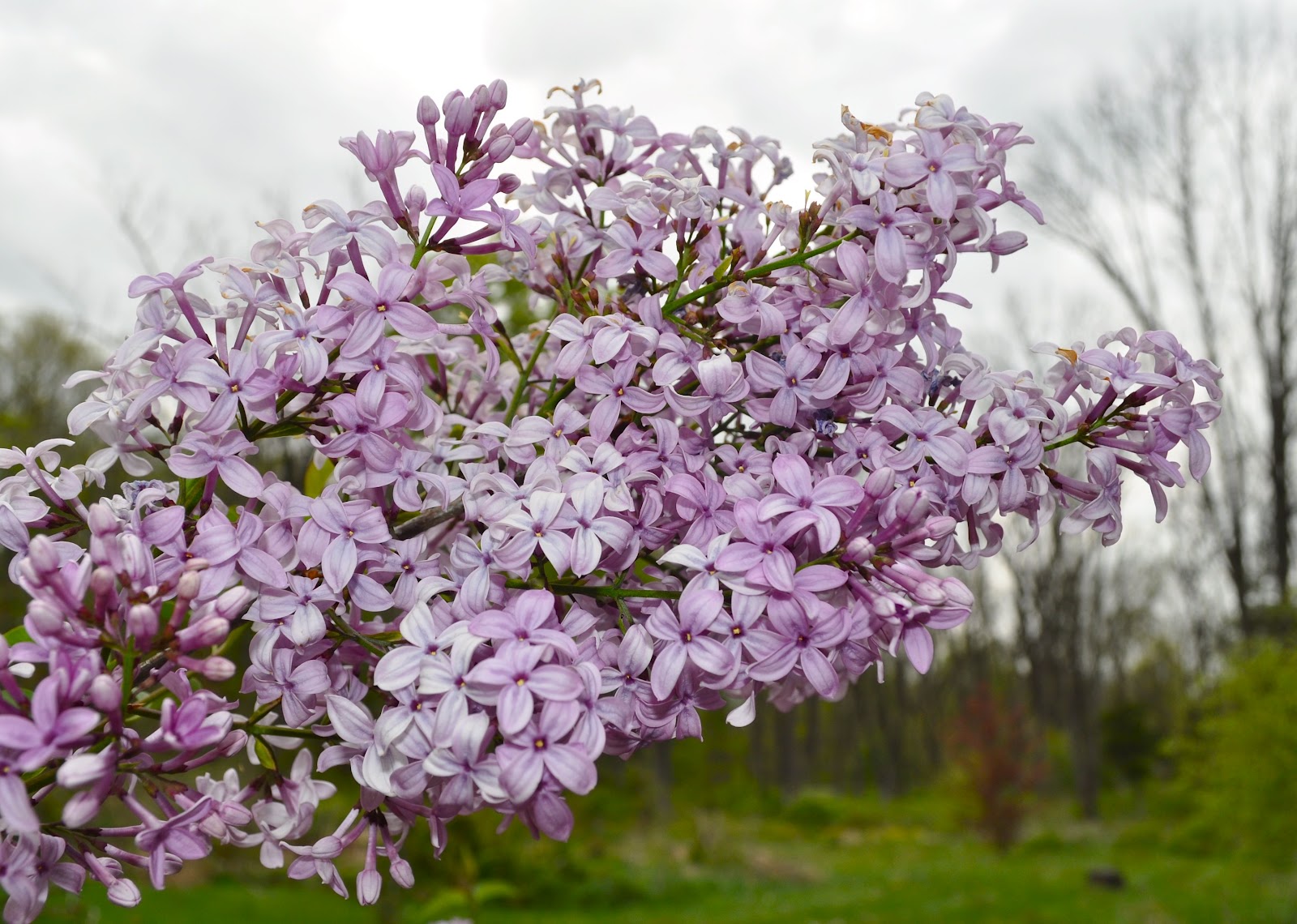


The very first time I saw this crazy fungal growth was about three years ago. Obviously, it existed before, but in small enough amounts that it wasn't obvious. Now, the trees are festooned with bright orange like they are decorated for Christmas. Thus I was completely lacking in patience when I read yet another piece, this time at Climate Progress, about how bark beetles are killing trees. Instantly I thought about this fungus, and all the other pests and diseases around the world that have co-existed with trees - but never killed them before.

As I just posted, even Craig Allen, a forester who prefers to blame that other red herring, drought from climate change, has finally understood that SOMETHING is giving trees a compromised immunity that is the equivalent of AIDS.
This is a special edition of Wit's End because we get a second lesson, all about the fascinating life cycle of Gymnosporangium juniperi-virginianae, from Wikipedia.
"On the apple tree, the infections occur on leaves, fruit and young twigs. The brightly colored spots produced on the leaves make it easy to identify. Small, pale yellow spots appear on the upper surfaces of the leaves, usually during late April or May on the eastern seaboard of the United States. These spots gradually enlarge and turn orange or red and may show concentric rings of color. Drops of orange liquid may be visible on the spots. Later in the season, black dots appear on the orange spots on the upper leaf surface. In late summer, tube-like structures develop on the undersurface of the apple leaf. Infected leaves sometimes drop prematurely, particularly during drought conditions or when the tree is under additional stress. Infections on fruit are usually near the blossom end and are somewhat similar to the leaf lesions."

"On the Eastern Red Cedar host, the fungus produces reddish-brown galls from 1/4 to 1 inch in diameter. These galls can be mistaken for cone structures by the uninitiated. After reaching a diameter of about 1/2 inch, they show many small circular depressions. In the center of each depression is a small, pimple-like structure. In the spring these structures elongate into orange gelatinous protrusions or horns. The spore-bearing horns swell during rainy periods in April and May. The wind carries the microscopic spores to infect apple leaves, fruit and young twigs on trees within a radius of several miles of the infected tree."

"On other species of juniper more common in landscaping and bonsai, the sizes of the infections are reduced. Early in the infection, the galls are small bumps on the woody portions of the plant. They maintain the orange gelatinous form after the first warm rains of spring but generally on a greatly reduced scale."

"On the eastern seaboard of the United States, at the first warm rain of spring, the spore horns become gelatinous masses and produce their teliospores. Wind carries the spores to apple leaves at about the time that apple buds are in the pink or early blossom stage. Upon reaching apple buds or leaves, the spores attach themselves to the young leaves, germinate, and enter the leaf or fruit tissues. Infection takes place in as little as four hours under favorable conditions. Yellow lesions develop in one to three weeks.In July and August, spores from the apple leaves are produced. The wind carries the spores back to Eastern Red Cedars, completing the infectious cycle. The spores land on cedar needle bases or in cracks or crevices of twigs. There, they germinate and producing small, green-brown swellings about the size of a pea."


It now is hideously barren. The shaded walk up to the General Store will now be roasting hot in the summer and bitterly windswept in the winter without their shelter.

I supposed the people felt they had to take them down, because the trees are mostly rotting inside.

Maybe they could tell the trees have become hazards from the way the bark was corroded and peeling - it's certainly a lethal symptom I recognize.

Or maybe they just didn't like the way their roots were distorting the stone retaining wall, and were surprised when they found the trunks are hollow, if they even noticed.

Does everyone remember our lesson today about epicormic branching? Because here is one of the slaughtered maples, rotting within, trying to branch from the base.


"BBC weather forecaster Ian Fergusson said exposed parts of the county had sustained gusts approaching 50mph. 'This has led to trees falling down and some structural damage to buildings,' he said. 'The wind is really exceptional for this time of year and so is the north northeasterly wind direction. In this part of the world the prevailing wind is southwesterly so trees tend to brace themselves for that. When it comes from the opposite direction and the trees are coming into full leaf this can add considerable stress to branches and trunks,' Mr Fergusson added."

Please! 50 mph is not that much of a wind. If trees were meant to blow down in wind of that force, there wouldn't be any intact standing trees at all, let alone trees that have survived for hundreds of years.

That's not the only article I saw where wind coming from the "wrong direction" was blamed. Since when do trees "brace themselves"? Have you ever noticed how a tree growing in the open is beautifully symmetrical? It's quite amazing that forecasters feel obliged to simply make things up. When hundreds of trees fell over during a windy episode in Los Angeles last December, it was said that so many came down because their roots are shallow since they are growing in paved areas - even though the worst hit was a large, wild parkland outside the city, with no pavement whatsoever.

Also just as clearly, many of the trees that fell weren't anywhere near "coming into full leaf" yet, in fact quite a few of them had NO leaves evident at all, like this one:


As long as we're visiting the eccentric English, here's a novel idea that never occurred to me in quite such vividly imagined saturation...although I have considered hanging signs on trees that say something along the lines, "Help Me, I'm Dying!"

"Henry Bruce, 35, wanted to raise awareness of an infection which is affecting trees across the country. So he spent two weeks working on the 21-metre high oak tree which is suffering from decay in the grounds of the Delamore Estate in Cornwood, Devon. The tree is part of an art and sculpture exhibition by Mr Bruce in the Devon village."
"He said: 'I am passionate about raising awareness of the phytophthora problem, which will affect many landowners.'"
"Delamore founder Gavin Dollard also wants the bizarre project to highlight the issues of phytophthora. Mr Dollard added: 'Landowners across the South West are felling seven square miles of Japanese Larch to combat the tree killing fungus which was discovered in 2002.' Nearly 1,000 acres of infected larch have been removed by the Forestry Commission, while private landowners have been ordered to fell 4,000 acres of timber by March, some 300,000 tons."


I could grab screenshots of these all day long and be content, so I tried to restrain myself with just a few, to sort of decorate this report posted by DesdemonaDespair.

A new study found, by studying salinity in the ocean, that global warming as expected is causing wet areas to be wetter and dry areas drier. Even though I'm somewhat dubious that the behavior of precipitation over land can be extrapolated from the ocean as done in this research, it still begs the usual question here at Wit's End - how come scientists and foresters insist that drought from climate change is the primary driver for widespread tree death when only SOME areas are drier?

These scientists "..found that the water-rich had indeed been getting richer and vice versa. High-latitude and equatorial parts of the oceans, where greater precipitation keeps surface waters less salty than average, became even less salty; the central regions of ocean basins, where evaporation dominates and turns water saltier, became even saltier. Because 80% of the water cycle operates over oceans and much of the water falling as rain over land comes from the ocean, the water cycle over land no doubt is behaving the same way."

"...no doubt behaving the same way" seems to be a limited view of the incredibly complex interplay of factors that causes, or impedes, precipitation. Mark Jacobson presents a more nuanced analysis in a paper published back in 2007 linking pollution, wind speed, and rain.

"The more pollution, the greater the reduction of wind speed," Jacobson says. Aerosol particles may be responsible for the slowing down of winds worldwide. Wind supplies about 1 percent of global electric power, according to Jacobson. Slow winds may hinder development of wind power in China, where it's a needed alternative to dirty coal-fired plants."

"Aerosols' reduction of the wind also may explain the reduction in the Asian seasonal monsoon and 'disappearing winds' in China, observations found in other studies. Moreover, slack air currents may hurt energy efficiency in Europe, where countries like Denmark and Germany have made major wind-power investments. Slower winds evaporate less water from oceans, rivers and lakes. Furthermore, the cooling of the ground provoked by the aerosol particles reduces the evaporation of soil water."

"What's more, the accumulation of aerosol particles in the atmosphere makes clouds last longer without releasing rain. Here's why: Atmospheric water forms deposits on naturally occurring particles, like dust, to form clouds."

"But if there is pollution in the atmosphere, the water has to deposit on more particles. Spread thin, the water forms smaller droplets. Smaller droplets in turn take longer to coalesce and form raindrops. In fact, rain may not ever happen, because if the clouds last longer they can end up moving to drier air zones and evaporating."

I suppose what it boils down to is that we are messing with carefully calibrated (if only by time) patterns, by injecting the previously nonexistent influence of global pollution into the atmosphere, causing incalculable disruptions.

Another dangerous effect of vegetation dying from pollution is bound to be more landslides, so I keep an informal (okay, anecdotal) lookout for them in the news. Yesterday, the Coming Crisis reported on just such an event in the protected Shennongjia forest, in central China.


It's worth mentioning this incident for the quote from an article in the Chinese press, about the plight of the residents. Logging, which had been a mainstay of employment and income, was banned in 2000, leading to even greater impoverishment. An attempt was made to recoup the loss, as described in a local article:
"During China's 2009 parliamentary meetings in March, Qian Yuankun, officer of Shennongjia Forest District, put forward the idea of ecological compensation for Shennongjia, which gave rise to considerable debate."
"Shennongjia Nature Reserve lies between the Yangtze and Hanjiang rivers, with 2,618 square kilometers of forest. According to Qian, every year trees here release over 3 million tons of oxygen and absorb about 300,000 tons of carbon dioxide, 1 million tons of dust and nearly 2 million tons of toxic gases. Additionally, as a natural reservoir, Shennongjia Forest District has water storage capacity of 3 billion cubic meters, all of which makes an enormous and invisible contribution to the surrounding areas. The local officials argue that Shennongjia should therefore receive ecological compensation, as this area has sacrificed many opportunities to improve economic development in order to protect its natural environment."
"During China's 2009 parliamentary meetings in March, Qian Yuankun, officer of Shennongjia Forest District, put forward the idea of ecological compensation for Shennongjia, which gave rise to considerable debate."
"Shennongjia Nature Reserve lies between the Yangtze and Hanjiang rivers, with 2,618 square kilometers of forest. According to Qian, every year trees here release over 3 million tons of oxygen and absorb about 300,000 tons of carbon dioxide, 1 million tons of dust and nearly 2 million tons of toxic gases. Additionally, as a natural reservoir, Shennongjia Forest District has water storage capacity of 3 billion cubic meters, all of which makes an enormous and invisible contribution to the surrounding areas. The local officials argue that Shennongjia should therefore receive ecological compensation, as this area has sacrificed many opportunities to improve economic development in order to protect its natural environment."
I don't know what absorbing 2 million tons of toxic gases is doing to those trees, but I suspect it isn't very good for them. Likewise, although it makes me a little uncomfortable to say this, I've been kind of thinking all along, ever since I noticed ozone is killing trees, that even though scientists say vegetation is more susceptible to its toxic effects that people, I've had to speculate - if it's really getting so bad that trees are dying, then it seems likely there should be a discernable increase on the effects to human health.
Of course, everybody knows that ozone causes cancer, heart disease, asthma and a bunch of other afflictions. There IS a reason the weather reports give warnings for high ozone days, right along with the temperature forecast, and advise "susceptible" individuals like young children and the elderly to stay indoors. Hospital admissions spike during episodes high ozone. In fact it's a pet peeve of mine, as long as I'm making a list, that deaths in heat waves are invariably blamed on temperature and not on pollution. Athletes are routinely advised to avoid exercise at such times, because they breathe more deeply, drawing the ozone into their lungs.
So, I'm not quite prepared to say that this sad story is in any way related - "London 2012 Champion Swimmer Dead at 26" who after all is Norwegian. But oops, he wasn't in Norway when he collapsed, he was training in Arizona at the time. I don't actually need to say anything myself, as it happens, other than copy a few of the comments left on the story:
How the hell are world class athletes and sports people dying from heart conditions. This makes no sense.
Truly tragic, as yet another athlete dies at such a young age. My heart goes out to his family.
NOT ANOTHER ONE RIP
Such sad news, my heart felt thoughts to his family and friends, please please, anyone in sports you all need to be tested before embarking on sports, somethings not right.
Yet another young athletes life over...how sad,maybe he trained to hard, but there's so many young sports people dying so young with heart attacks..
It seems odd that so many top athletes are having cardiac arrests. You would think that those who are going to stress themselves to the limit would have thorough medicals before embarking on training. Every fitness and diet regime I've ever seen advises that you get checked by your doctor before starting. Or are the doctors just thinking, 'he is young...nothing wrong with him' , without doing any tests. ...but in football, where clubs are spending millions, you would think that the doctor would check them properly.
i can't believe so many athletes are passing away at such a young age. RIP.
Another young athlete dead! What on earth is happening to all these young fit people? This is so sad and my condolences go to his famiy and friends who are devasted by his death. RIP young man.
and so on, over 175 of them...
Which brings me reluctantly to an analysis from the Earth Policy Institute. Just like the Occupy Wall Street, you'll never see this prominently featured in the media, even though the implications are about as dire as can be.
"The Arab countries in the Middle East and North Africa make up only 5 percent of the world’s population, yet they take in more than 20 percent of the world’s grain exports. Imports to the region have jumped from 30 million tons of grain in 1990 to nearly 70 million tons in 2011. Now imported grain accounts for nearly 60 percent of regional grain consumption. With water scarce, arable land limited, and production stagnating, grain imports are likely to continue rising."

"Egypt is the largest grain producer in the Arab world, accounting for almost 40 percent of the region’s harvest. Its grain production has doubled over the last 20 years. But because nearly all of the country’s available freshwater and arable land is already used for agriculture, further expansion of the grain harvest is unlikely."


"In the 1980s, Saudi Arabia began pumping fossil water from deep underground, allowing it to farm the desert. By subsidizing wheat production at several times the world price, Saudi Arabia became the second largest Arab wheat producer in the early 1990s. At its peak, Saudi Arabia harvested more than twice the wheat it consumed, exporting the excess. But with the underground water supplies nearly depleted, wheat production has plummeted. By 2016, Saudi Arabia plans to phase out wheat production entirely. In a span of 25 years, the country will have gone from exporting wheat to relying exclusively on imports."


"Across the Arab world, grain production is stagnating, yet grain demand is growing rapidly as population expands. Since 1960, the region’s population has nearly quadrupled to 360 million. By 2050 the region is projected to add another 260 million people, dramatically increasing pressure on already stressed land and water resources."
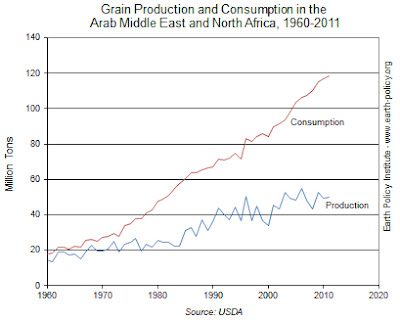

"But population growth is not the only factor increasing demand for grain. With policies in many Arab countries encouraging meat production, the amount of grain used for livestock and poultry feed has soared from less than half a million tons in 1970 to 40 million tons in 2011. Increased meat and dairy consumption have raised grain use per person by 50 percent over that period.
Thus far, grain imports have filled the widening gap between production and consumption. But population growth alone will raise grain demand in the Arab Middle East and North Africa to 200 million tons by 2050, equal to two thirds of current world grain exports. Increased meat consumption would take demand up even higher. Ensuring grain supplies will become progressively more challenging as countries look to import more grain from abroad."
If all the above is not sufficient to induce an overwhelming desire to re-envisage our penchant to continue business as usual, and maybe join a permaculture tribe, consider this one last item: some crazy scientists have been so busy in their laboratories that they neglected their literary education and missed a minor classic, called Frankenstein. Des had this story:
If all the above is not sufficient to induce an overwhelming desire to re-envisage our penchant to continue business as usual, and maybe join a permaculture tribe, consider this one last item: some crazy scientists have been so busy in their laboratories that they neglected their literary education and missed a minor classic, called Frankenstein. Des had this story:
 |
| source |
"Herbicide-resistant superweeds threaten to overgrow U.S. fields, so agriculture companies have genetically engineered a new generation of plants to withstand heavy doses of multiple, extra-toxic weed-killing chemicals."
"It’s a more intensive version of the same approach that made the resistant superweeds such a problem — and some scientists think it will fuel the evolution of the worst superweeds yet...Roundup Ready varieties now account for 90 percent of U.S. soybeans and 70 percent of corn and cotton, and the pipeline for new herbicidal chemicals is mostly empty. But reliance on a single chemical came at a price: Though industry scientists predicted that weeds wouldn’t become resistant to glyphosate, more than a dozen species have done exactly that."
 I'd venture to guess that this Canadian thistle, which now carpets my vegetable garden, is one of those resistant species. Countless seedlings come up before it's too early to even think about preparing the garden for spring planting, and the prickles are so sharp they go right through gloves. Already, they cover the ground with such density that it looks impossible to combat. Somewhere under there is a thick layer of rich, black soil from the Pennsylvania mushroom farms, but not the tiniest straggle remaining of perennial thyme, which can't possibly compete with that monstrous invasion.