

I walked over this bridge to get a look at the wooded hills on the other side.


There were countless up-ended trees from the June 29 derecho that so famously roared across the country's mid-section, leaving thousands sweltering without power for weeks.
 As we shall see, quite a few of the fallen trees exhibited interior rot - plus, devoted Ozonists and Ozonistas know that root systems are shriveled from ozone exposure even before injury is visible above ground. Just yesterday the federal government designated DC a disaster to enable funds for recovery, a status already declared for West Virginia, which was illustrated with the following picture:


If the discoloration of the wood isn't obvious enough, take a look at the part of the trunk left standing, with a large crack from the ground up. Holes and splits are almost universally found on trees now.


before it occurs to people to recall that trees didn't used to fall and branches didn't used to break with this frequency.

The tendency is for people to blame parks and cities for not maintaining trees, but the fact is, EVERY tree is dying and it's impossible to keep up with trimming, even at the White House, above. I can tell just from that picture that not only was the branch rotted, but the bark on the trunk is unnaturally corroded and peeling off. Here's my all time favorite image from this storm, where just about everyone except me and readers at Wit's End blamed high winds and extreme storms from climate change for the countless fallen trees.

Weeks later in Virginia, a 40-ton tree crushed a driver in his Mercedes. The NY Daily News reported:
While many have suggested the tree may have fallen due to recent area storms, the Virginia Department of Transportation’s arborist does not believe inclement weather is to blame, Department communications representative Joan Morris told the Daily News.
Morris said that due to recent bad weather, now would probably be a good time for motorists and homeowners to remember that any tree can be a hazard, and to know some key signs of trees in danger of falling: large holes, cavities, and dead branches are usually telling signs.

As if further evidence is required that trees are falling because they are dying from ozone pollution, note the interesting fact mentioned in an article about wildfires in Catalonia of northeastern Spain, where over 100 people were injured, including many who suffered broken bones and burns, while trying to escape. Horribly, a father and his teenage daughter jumped over a 165-foot cliff to their deaths. It was reported that due to the mountainous topography, wind gusts commonly exceed 100 miles per hour in this region described as "heavily wooded" - and somehow the trees have held fast and continued to grow. Wind speed of the derecho? 80 mph.

"In fact it is so strong that there is a saying, If you have ever been to the northeast region of Spain and found some of the residents there to be a little, um, peculiar, there’s a reasonable explanation for that. The Spanish call it tocat per la Tramontana, which translates to “touched by the Tramontana.” The Tramontana is a strong wind that blows from northeast Spain across the Ampurdan region of Girano in Catalonia near the Spanish-French border. The wind is said to be so forceful that it affects the psyche of those who live in its path, causing them to go a little crazy." [source]

The constant howling is said to have influenced the region's most famous victim, the surrealist painter Salvador Dali.

This is the area where our camp met collectively every morning for Circle and every evening for Spokes Council.

This was the scene the first day I arrived. By the time I left the area was full of tents and cars. Most people who were capable of hiking pitched their tents at much higher elevations.

From that same photo, above is a zoom of the mountain's crest. When individual trees are seen against the light, and not in layers against the earth, their thin crowns are revealed. Slightly lower, the pattern of foliage that has turned brown is consistent with just about every place I saw.

The locust trees in particular have brown, burnt leaves, but others - oaks, sycamores, maples and hickory and tulip poplar - are also having problems.




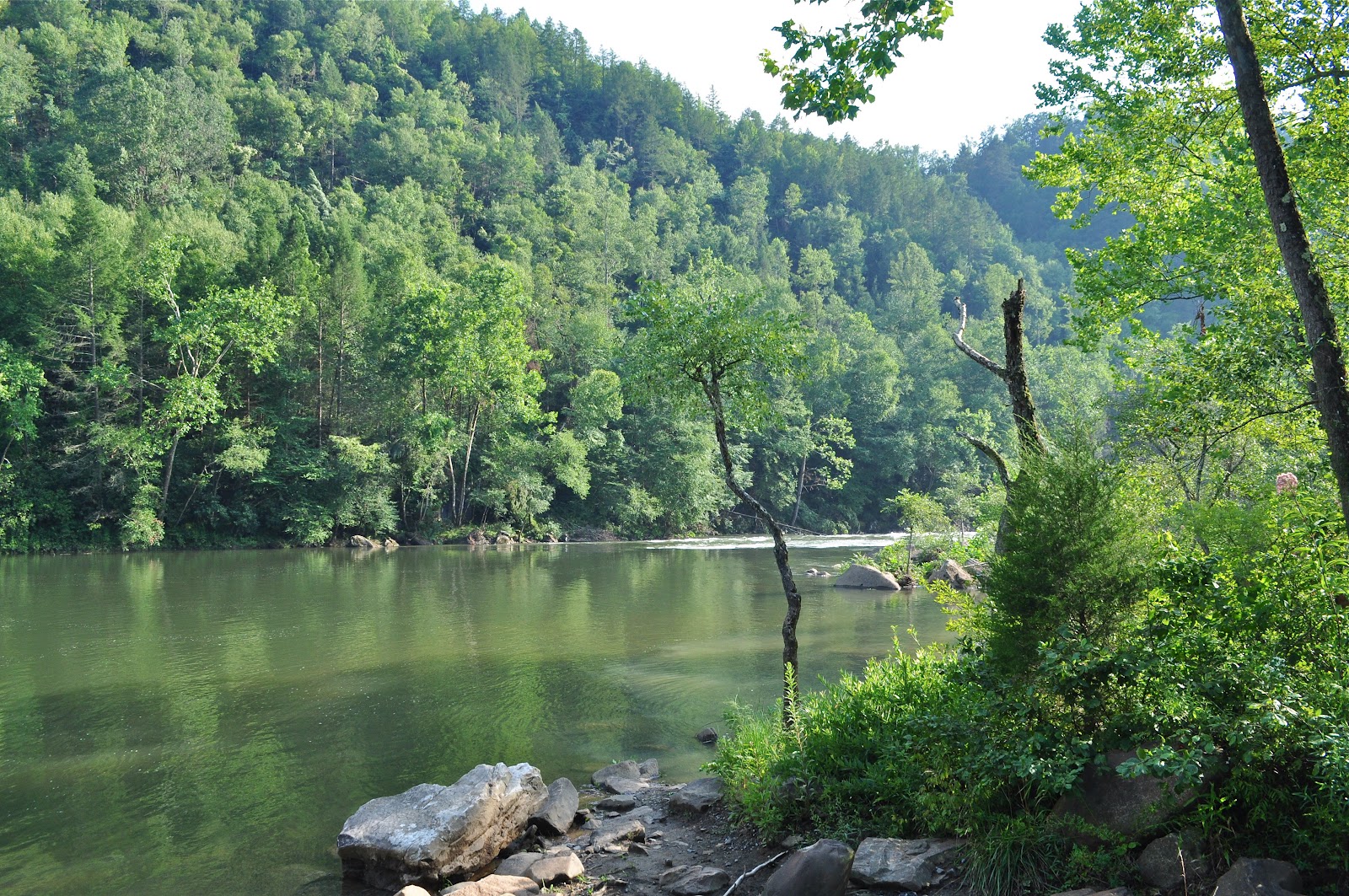
Even though the trees were in sad shape, their leaves abnormally small, and many branches bare, it was a lovely, idyllic spot.

The only structures I passed were this barn, which I didn't go near because it was on the far side of a prickly thicket of brambles, a church, and an abandoned house.


Some likely cracked from the windstorm, but that doesn't explain this sort of speckling:

While the sides of the road were already piled with debris, this particular log with fresh leaves littering the ground was pushed to the side by our camp crew; it had been deliberately cut with a chainsaw along with some other trees by counter-protesters to block our way home after the demonstration.

Here is one of the stumps. Needless to say, this made me even angrier than the shots and the spike strips designed to puncture our tires.


Here is the little church I mentioned. On the right, on an island in the middle of the road, is the remainder of a tree that broke in the derecho. On the left is an oak that lost a branch which is still on the ground beneath it, and behind the church is another, even thinner old oak.

The one in the road that broke was already hollow.

Hm, what did the arborist at the Virginia Dept. of Transportation say were signs of tree decline?

Large holes, cavities and dead branches.

I walked up to a little cemetery behind the church. This is looking back, down the hill, where it's even more clear that the towering oaks have little life left in them.

The arborist might have mentioned fungus as a symptom, too. This is growing out of the oak that lost a branch.

I'm not sure what it means that I felt it was quite an extraordinary experience to be cut off from any cell phone or internet connection for several days. I really enjoyed it, frankly.
It also gave me the opportunity to NOT feel compelled to formulate a response to Bill McKibben's latest mishmash published in the Rolling Stone just before I left New Jersey immediately upon which, predictably, excited progressives and liberals went into their usual self-congratulatory dither. I found to my delight when I resurfaced that someone named Nicholas Arguimbau had expressed my exact thoughts with far greater civility and eloquence than I would have mustered. His response is published in the online magazine CounterCurrents, Bill McKibben is Wrong, We Must Not Forget That "We Have Met The Enemy, And He Is Us". I highly, highly recommend it as an antidote the worse-than-useless choir-preaching that emanates from Gang Green.

Mr. Arguimbau, an excellent writer about ecology, observed in an earlier article that the prevailing emphasis on regulation of CO2 and "renewable alternative" sources of energy has utterly abandoned what we essentially need: fewer people, each using less stuff. He calls on climate activists to demand drastic conservation, individual sacrifice, and radical reductions in the consumption of everything. He talks about the myth of the oxymoronic notion of "sustainable growth", which is promoted with unseemly alacrity by almost all corporate foundation-funded "green" organizations.
Here are some of his concluding thoughts from that essay:
The core teaching of "Civil Disobedience" is, as Martin Luther King saw it, "Noncooperation with evil is as much a moral obligation as is cooperation with good." As consumers and users and financial contributors to the makers of the pollutants that are destroying the earth, its biodiversity, and its agricultural productivity for millions of years to come, we must demonstrate our opposition with noncooperation. Why?
- Because it is a moral duty,
- Because it will "leaven the whole lump,"
- Because nothing else is working at all.
Another important part of Thoreau's teachings is his examination of our ability and responsibility to reduce our material consumption to the core at which we can carry on our lives as principled members of the community without either imposing on others, depriving ourselves of freedom or violating our own moral beliefs. That is Walden, which forces us to understand that consumerism locks us out from living our lives with integrity and freedom. It's a message essential for giving up the material "needs" for which we are destroying the earth.
...Gandhi's self-imposed poverty gives us the same message - that abandonment of material needs is empowerment, not self-sacrifice. It's a view, of course, that is anathema to the global corporations that control our lives through the culture of materialism.

I'm just going to let ya'll (as I've been taught to say) wander through the woods on your own for the rest of this brief stroll - until we get to the wonderful orphaned house. In addition to whole tree damage, there are many examples of leaves that have injured stomates from absorbing pollution, are smeared with black fungus, or exhibit premature senescence - early fall coloring due to an inability to photosynthesize, leading to the loss of chlorophyll.


Above is the fenced pasture adjacent to the old house. It's surrounded by an orchard.

In front of the house is by far the largest apple tree I've seen in my life. I didn't even know they could get that old. It has split apart and in fact, either side by itself is bigger than any apple tree I've ever come across.


I really can't say why but I get quite a thrill from this sort of wreckage. I guess many it's a stand-in for our civilization, and our ecosystem.


This back section was probably the kitchen, and it looked like there had been a fire.


This scene is looking straight out back from the house. What an incredible setting. I can't imagine why anyone would have let this home crumble into uninhabitability.

Far back in that picture animals are grazing.

Some of the windowpanes have turned a gorgeous mottled blue.

It amazes me that something built with such care and skill was subsequently deemed unworthy of salvation.

Rose of Sharon bushes are remnants from a garden, struggling to bloom.


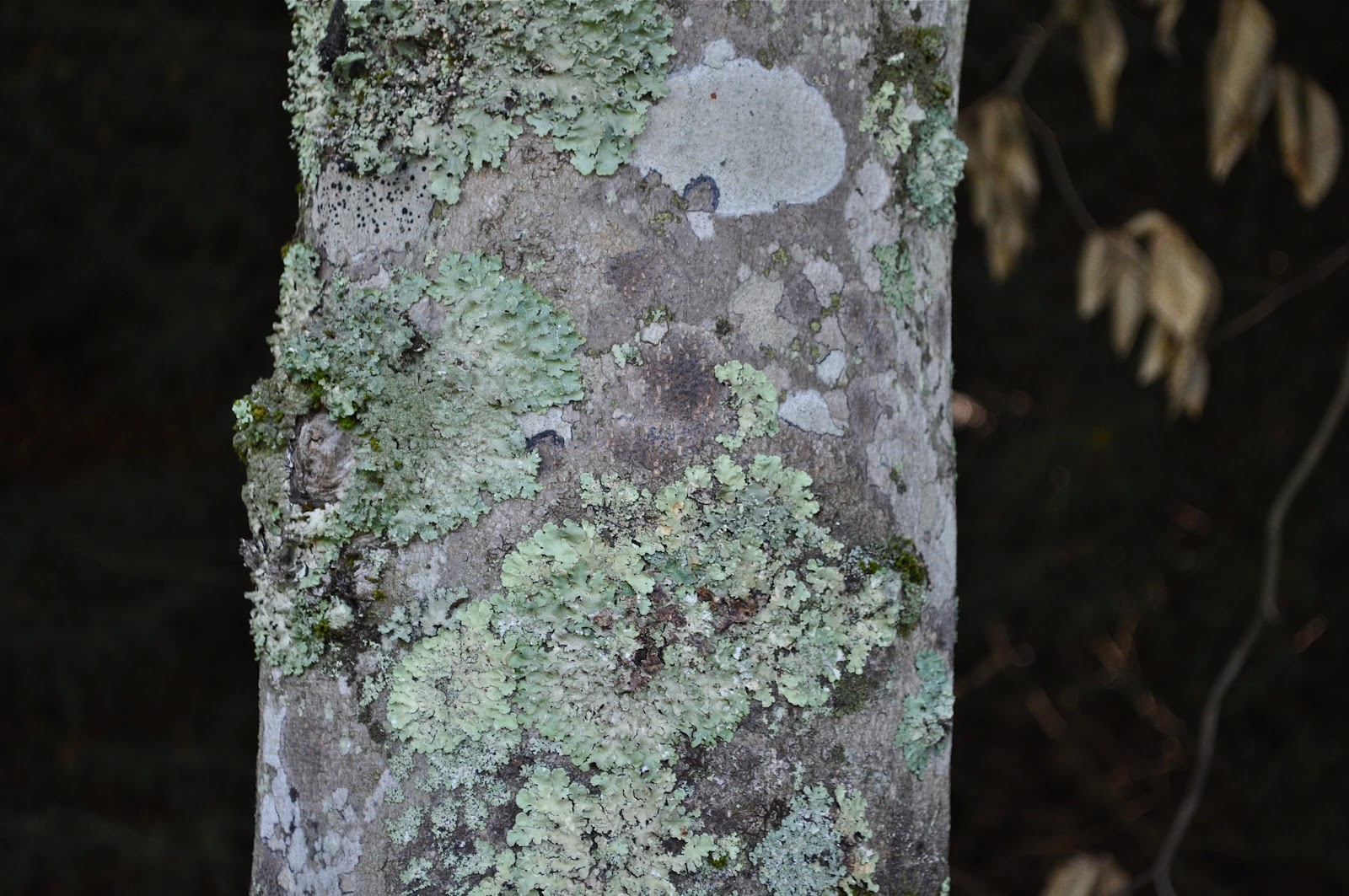
The lichen is even growing on the windowsill.


Stones from the chimney lay on the metal roof.


I peaked in the windows.


The front porch has two stories. This house was lovingly designed for a flow of cool air, and to embrace the beautiful views from every direction.


Although I've prowled around the exteriors of many abandoned barns and houses, I rarely find the temerity to go inside. For one thing, it's never certain the floors are solid. But the stone steps led up to an open door, and I couldn't resist.


I just love the board-and-batten walls, the turned stairway, and the whimsically carved passage to the decrepit kitchen.

Some sort of bone was on the floor of the parlor.

Brazenly I went upstairs to check out the bedrooms.

Even at the top of the hallway, a window overlooked the trees. This sort of aesthetic had to have been something of a luxury for a farmhouse built long ago.


The youngest apple trees are dying too - their bark is splitting off.

After I left the house I continued on for about a half a mile or so - this is what I saw.

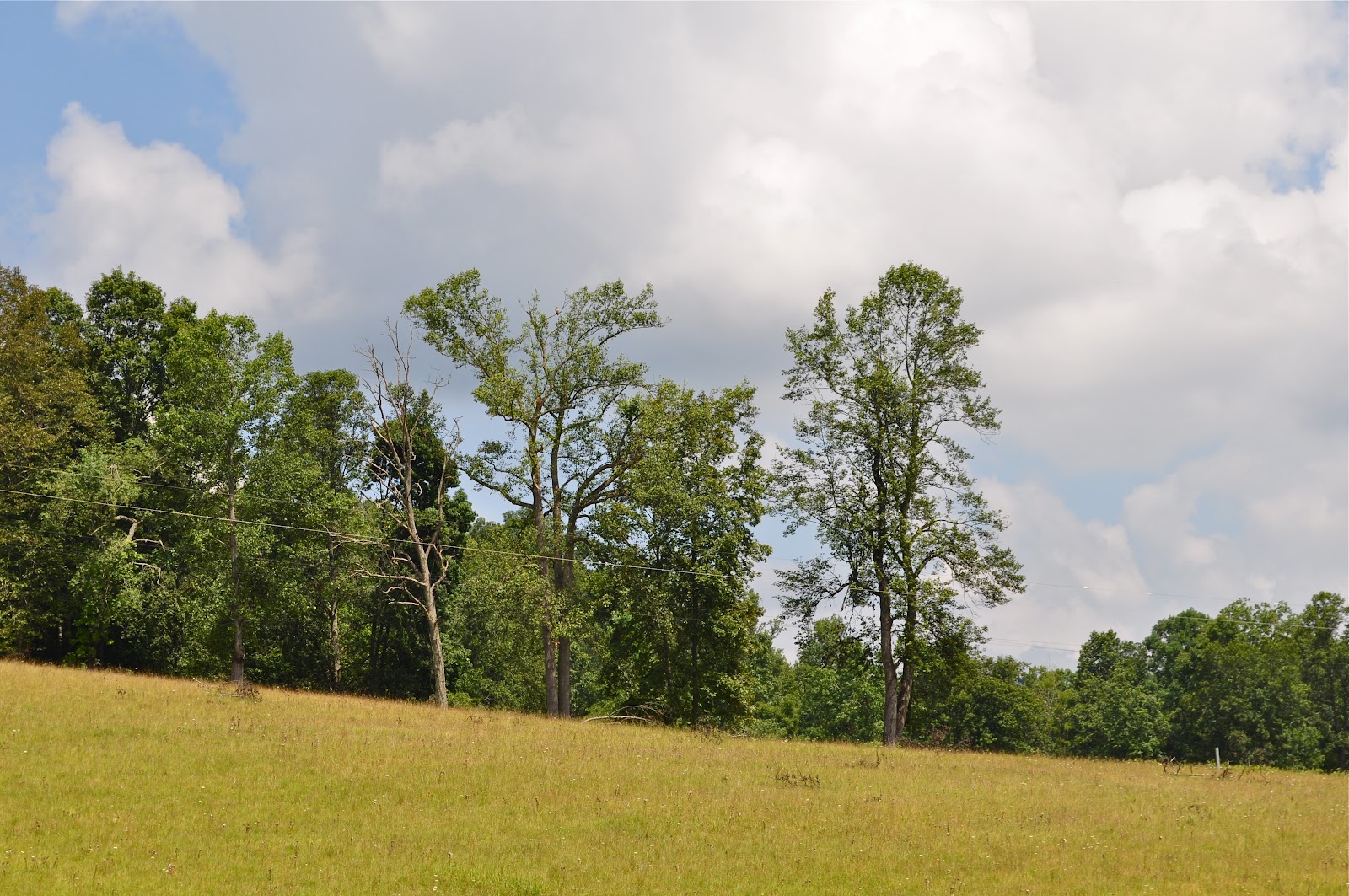


It almost looks like it should be autumn in places.

But it's a trick of the light - the foliage isn't golden or red - it's brown, from marginal leaf burn.


When I left camp after the action on Saturday, I headed to Kentucky to visit middle daughter (now Dr. Sophie), who is spending this year in Lexington as an intern at a huge race horse clinic.

This is the wake of the derecho where swathes of trees were flattened.

The trees are just waiting to fall over however.

And if you think these trees look brown and sick, wait until I upload pictures of the trees in Kentucky.


When I passed this mill it broke my heart to see such huge logs.

The lumberyard was enormous, it stretched beyond both borders of this picture at least as long as what you can see.

I have no idea what this structure is for but I think it would make an excellent garden folly. I would use the top as a high garden and plant flowering vines that would drape gracefully over the sides, softening the harsh lines. Maybe put a little platform up there to have a small dinner party in the summer. Why not?

This cinderblock building almost looks like it was once a jail - the white door has vertical bars on the window.

Now it shelters an ancient car which has a lot of personality.

Good bye trees, and hello invasives.

I for one welcome our new Kudzu overlords. They look sort of benevolent.

Thanks to Michele from Quebec for this video.
Here's the news report about the tree that fell in Virginia:
View more videos at: http://nbcwashington.com.
With regards to my last post, which referred to the notion that there's still time to avert the worst consequences of climate change as "wildly optimistic", it came to my attention that for some people, it looked pretty realistic. So here for the record are the reasons I think it's not:
Starting from with the subtitle: "It's much, much later than you think" - It should read: It's too late. ALL of the important amplifying feedbacks have already begun, and they are unstoppable. That's just the facts, and it would be true even if we completely stopped all greenhouse gas emissions today, which of course, we're not.
So the question remaining is whether we will stabilize at a state where the planetary temperature is merely uninhabitable to human civilization in almost every latitude, or whether we actually go into a Venus effect where virtually all life is extinguished. And of course it's impossible to say how long it will take to transpire.
This part cracks me up, it is the same conceit as Lovelock:
‘Humanity’ may survive this. But what will ‘humanity’ mean in a world where countries which
remain habitable – like Britain –
"like Britain" of course - Britain!!! It's unthinkable that Britain could be one of the places that becomes uninhabitable!! I guess maybe he made that film before the floods hit. Not to mention, one of the effects of climate change is quite likely to be the shutdown of the thermohaline circulation as ice melts and fresh water intrudes particularly into the Gulf Stream from the Arctic and Greenland, meaning Britain is likely to freeze before it burns.
More bullshit: He warns that at the unthinkable 6 degree scenario: "...the world’s ecosystems go into meltdown."
I'm sorry, but the world's ecosystems are in meltdown RIGHT NOW both on land and sea.
Here's another comforting canard he offers:
"Those who came before us didn’t know about this problem, and those who come after will be powerless to do anything about it. But for us, there’s still time!"
First of all, those who came before us DID know perfectly well, since at least the 1980's and in fact, every US President going back to Johnson was told by advisers about climate change. They just kicked the can down the road. This is of significance because the implication in the film is that NOW that we know about it, we can/will do something about it. That's just false, because we DID know and ignored it anyway, and that's what we are going to continue to do.
And there isn't "still time" for us. As I said long ago - catastrophic climate change and mass extinctions are baked in the cake.
Isn't it amazing that I can think this way and still laugh at life?


