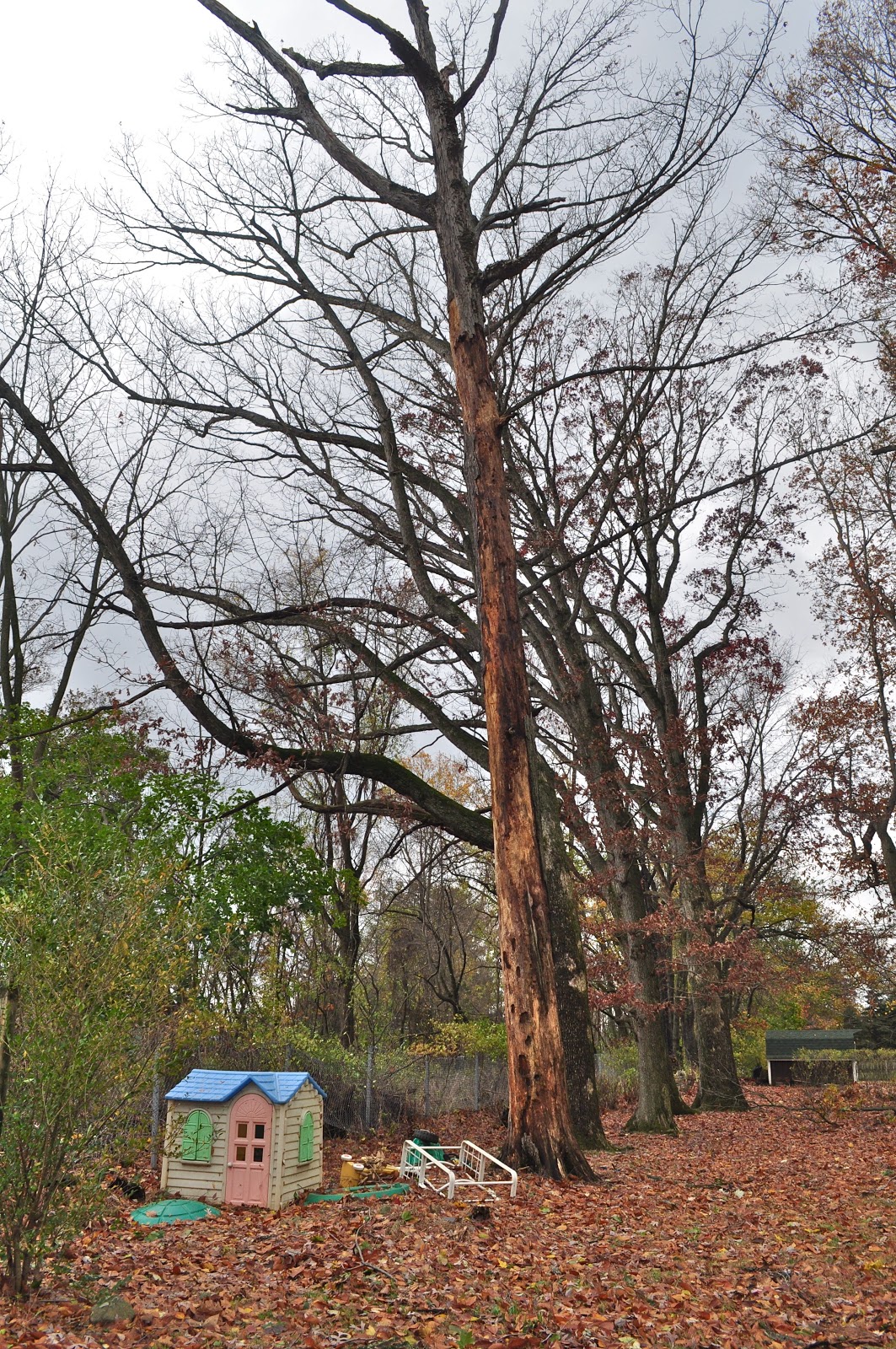
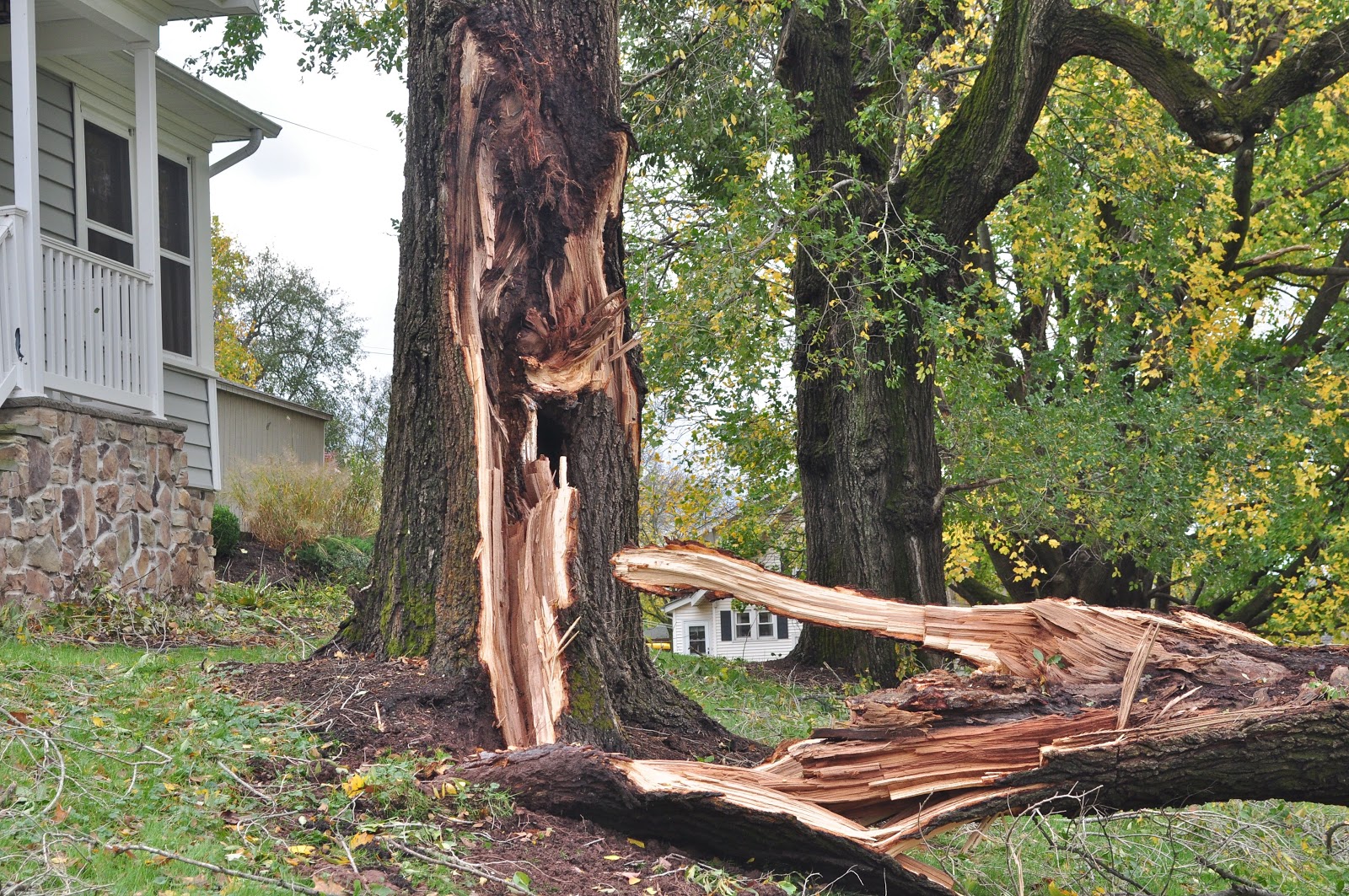
Yesterday when I was on my way to first daughter's farm, Bramblefields, (because she miraculously regained electricity after only 24 hours!) I lost track of how many times I had to retrace my route and try another, because there were so many trees and wires down. Along the way I took pictures of trees that fell over, and their
invariably rotted interiors. Even the air around their torn roots smells rank from the fetid soil. Swathes of them fell.
Remember the Yale Forestry
study that said all species they tested in a mixed hardwood plot - and all others around the world for that matter - are now diseased and afflicted by a fungus rotting their interiors to the point where they are releasing methane in flammable concentrations...the implications of which I recently discussed
here? Well, the trees that fell exposing their interior wood are visible dying proof of that. Following are the photographs of the trees I passed, with closeups of their interiors, their fungus-infested and lichen-covered bark, and their damaged leaves and needles - with a comment I sent to a couple of newspapers which will, no doubt, never see the light of day:
The size of the storm, which, with sea-level rise, created the massive flood surge are obvious signs of climate change.
Let’s hope the people who suffered losses from those things start calling out the deniers that have prevented political action and cultural change that could have averted or at least postponed the tragedy that this storm has become for so many.
On the other hand, one of the worst effects of Sandy for those not on the coast – lost power – is mainly due to falling trees, as are most deaths. And those are NOT from climate change.
Rarely do people even ask the question – why are so many trees of all species falling onto power lines in the first place, at a frequency that isn’t explained by wind speed?
The wind just wasn’t strong enough in either Irene last year, or Sandy this year to account for so many falling trees and branches.
This map of highest recorded wind gusts shows that the area depicted in these photos - around route 78 just west of 287 in central New Jersey - received top gusts of between 50 - 60 mph.
Where was all the structural damage from wind (not flooding) – the torn roofs, overturned trailers, tossed outdoor furniture?
I haven’t seen any, and yet, everywhere in New Jersey roads are blocked and lines are down from fallen trees.
Very few people realize that trees are dying off at a rapidly accelerating rate from air pollution.
Vegetation is even more sensitive to pollution than humans, particularly because ozone causes plants to lose natural immunity to pests, disease, fungus and drought, which are then typically blamed for forest decline, bark beetles and wild fires.
Although peak levels of air pollution have been reduced, especially for SO2, nitrous oxides have continued to increase, and consequently the constant background level of tropospheric ozone has been inexorably rising.
It’s invisible, but it’s there just as are oxygen, nitrogen and CO2. Except it’s toxic.
Over the past few years it has surpassed a threshold that is tolerable to plants.
Annual agricultural yield and quality have declined, and longer-lived trees that absorb it season after season have passed a tipping point and are now dying in droves.
The damage done to vegetation by ozone has been well understood for decades and demonstrated in countless field surveys and controlled fumigation experiments.
Ozone is the real reason that so many trees and branches are falling, and why so many people (including me!) are without power.
If you actually look at the fallen trees, almost all are rotten inside or have injured leaves or needles, which are visible symptoms of ozone exposure.
This is an extremely unpopular idea, because it is very threatening to a life style dependent on burning fuel for energy.
Nevertheless, it is critical for people to understand, since we are also dependent on trees for oxygen and as a CO2 sink, as well as various other products and services, like fruit, nuts and lumber.
It seems people have short memories but the trees never used to come down in huge numbers – let alone fall on people, houses and cars with such regularity – which simply cannot be explained by an expanded population.
I wrote
a book which can be downloaded for free. Other books have been written about this problem but they are generally ignored - one of the best is
An Appalachian Tragedy. It’s a little out of date and focussed on forests from Georgia to Maine, and this is now a global issue, but it explains the phenomena very well.
Climate change isn’t the reason that trees are dying (YET). But dying trees are going to massively accelerate climate change as they become CO2 emitters instead of absorbers, which has already started.
These scenes are from a beautiful wood, with beech, oaks, maples and tulip poplars.
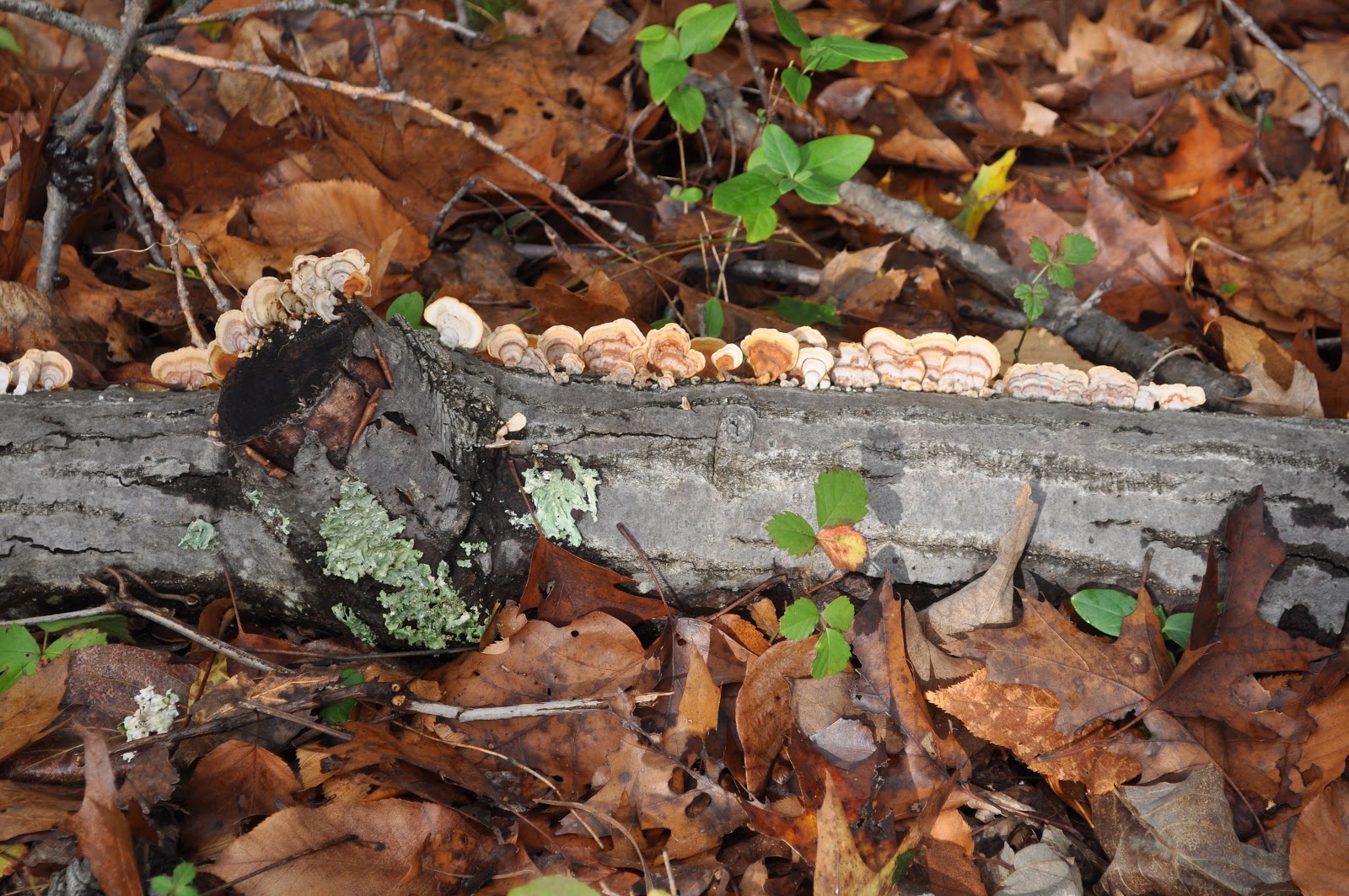
That log on the right has been there for quite a while.
The decline of forests from pollution commenced long ago, but the important point is that in the past few years the trend has accelerated dynamically.
Signs like this festering wound are now to be found everywhere, on trees of all ages.
A
new article in the Guardian nicely ties various isolated reports of tree decline together as a trend in
UK Forests Under Unprecedented Threat From Disease (although it goes on to include fungus and insects). As usual the onslaught is never attributed to ozone but instead the usual suspects with a slightly nuanced perspective - what actually, upon reflection, is rhaather xenophobically perfect: "foreign interlopers". If you want a thorough and detailed explanation as to how fallacious and superficial this flawed analysis is, check
this prior post, Hysteresis and the Vile Conspiracy to Blame the Bugs.
The UK's forests are under "unprecedented threat" from foreign pests and diseases, according to the government department responsible for the protection of the country's forests and woodlands.
The discovery of the ash dieback fungus in East Anglia last week is just the latest invader to pose a serious threat to UK trees, but the government ecologists say that more than 3 million larch trees as well as thousands of mature oaks and chestnuts have been felled in the past three years to prevent similar fatal plant diseases from spreading out of control.
"We are under an unprecedented level of threat from a range of exotic pests and diseases, a lot associated with the international trade in live plants," said the Forestry Commission.
"There are protections in place but the EU plant health regime is no longer fit for purpose. Too many pests and diseases are still getting through."
More than 100,000 ash trees have already been felled to prevent the spread of ash dieback, or Chalara fraxinea, since the disease was identified in March.
But very many more larch trees have had to be cut down in the west country, Wales and Scotland this year to prevent a plant disease called Phytophthora ramorum spreading.
Known as "sudden oak death" in the US, it so far has not infected British oaks, but since its discovery in the wild in 2009 it has been found extensively in larch populations in the south-west, in Wales and in south-west Scotland, resulting in a large number of the trees being felled over a wide area.
"We now have six to eight organisms in the British Isles that are a real concern. In the 1960s and 70s it was Dutch elm disease, which killed 30 million trees; in the 1990s it was a new Phytophthora which devastated alders along riverbanks.
But in the last 10 years we have had as many new diseases as we had in the previous 40 or 50 years," said Joan Webber, principal pathologist at Forest Research, the Forestry Commission's research arm.
Plant experts are particularly concerned about the oak processionary moth, which arrived in west London in 2009 and which has now developed two major populations.
"It has the potential to spread anywhere there are oak trees. It is extending its range and has become established in the Netherlands and Belgium, possibly as a result of climate change and warmer winters," says the Forestry Commission.
Plant pathogens are on the rise globally and Britain is particularly susceptible because of its increasingly warm, wet winters and because it is a centre of world trade.
Easy access to plants from around the world has encouraged gardeners to buy millions of exotic plants, many of which can arrive diseased.
Some plants can only enter Britain with "passports", but the majority of diseases are only identifiable in laboratories.
The diseases and pests can arrive by several routes, say ecologists.
In March, more than 250 live larvae of the Asian longhorn beetle which can kill oak and willows were found in trees in Kent.
More than 2,000 trees had to be felled and burned. It was thought to have entered in the wooden packaging for Chinese stone.
Dothistroma needle blight, which affects a range of conifer species, threatens commercial forests by significantly reducing timber yields in plantation forests.
It has been found in all of the commission's forest districts in England and Scotland, and three out of four forest districts in Wales.
Tony Kirkham, head of the arboretum at Kew Gardens, which has 14,000 trees and has seen many attacked in the past few years, said some of the most serious threats came from the oak processionary moth.
These were first found breeding in 2005 along a stretch of the A40 and in Kew and East Sheen, west London.
The caterpillars can cause serious defoliation of oak trees, and weaken the trees to the point that they are prone to other diseases.
I honestly don't understand why foresters are so fixated on invasive insects, disease and fungus when ozone is well known to render vegetation defenseless against biotic attacks whether foreign or native - and agronomists working for governments are
busily trying (unsuccessfully) to breed "tolerant" genetic strains of annual agricultural crops. The power companies frenetically prune greater and greater easements, the city of New York makes quiet financial settlements for deaths and injuries from falling branches in parks, everyone is warned about extended power loss even when it's just not particularly windy.
I thought at least these leaves look pretty but then I realized the tree is covered in seeds that never matured enough to fall off, those spinning helicopters with their sticky insides that you could attach to your nose.
Many conifers came down.
When they are down you can see how many needles are brown - a classic indication of ozone.
Once upon a tim, pine trees were so thick you couldn't see through them.
You could play hide and seek around one - or climb up and be invisible inside. Now they are all transparent like this one - if they're not completely bare.
Those are just the small branches lying on the ground - the enormous stump is behind them.
There is rot evident in the logs on the ground.
It looks like the trunk was almost hollow.
The tree in the foreground has a large crack going up the trunk.
And the branches from the tree that fell on the house are damaged inside.
Hearing that trees are good because they absorb pollution is a familiar adage - less familiar is the question of what happens to trees. It's similar to smoking tobacco - and we are seeing the results.
Other than the crane on the building on a skyscraper in New York (and the wind is much stronger that high up), I've heard of no structural wind damage at ground level.
I've seen none - no tossed garbage cans, or flower pots, or patio furniture.
I've seen no torn traffic signs or lights, or any other sort of sign, no broken windows or lost roof shingles. At Wit's End, all the odd assortment of gardening equipment left out was intact and undisturbed.
The only objects damaged by the wind that I can find are trees or the things trees fell on.
Leonardo da Vinci did a study demonstrating how trees are resilient in the wind, recently proven mathematically as cited in
this post from last January.
As I got closer to Bramblefields having navigated past many live wires, I went by this nursery.
Most of the leaves have fallen early - others like this one haven't even changed color. It's a landscape that is unfamiliar, and menacing.
Just before the drive a neighbor had expressed her feelings with orange spray paint.
The brown needles indicate that this pine tree was on the verge of death anyway.
In fact the entire yard had remnants of several trees that had already necessitated removal, like this very large stump.
Here is the view from first daughter's kitchen. Every time I glance that way it gives me a start.
She had warned me many of their trees came down but it was shocking to witness anyway.
Last night her husband was in the hospital until midnight, waiting in a crowd for attention.
A chainsaw had grabbed his sleeve and swallowed it, leaving him with a gash requiring 17 stitches.
Even though he's a died-in-the-wool Republican who makes his living operating enormous machinery requiring prodigious amounts of fuel, he admitted that the tree he had been cutting up was dead.
This big old maple will be sorely missed.
From the inside though it's clear it was not going to live out its natural lifespan of 300 or 400 years.
The next time we get hit by a big storm, even more trees will come down, and we will likely have freezing temperatures and snow to contend with too. And that will be much, much worse.


 Vegetation is even more sensitive to pollution than humans, particularly because ozone causes plants to lose natural immunity to pests, disease, fungus and drought, which are then typically blamed for forest decline, bark beetles and wild fires.

 It’s invisible, but it’s there just as are oxygen, nitrogen and CO2. Except it’s toxic.

 Annual agricultural yield and quality have declined, and longer-lived trees that absorb it season after season have passed a tipping point and are now dying in droves.
 The damage done to vegetation by ozone has been well understood for decades and demonstrated in countless field surveys and controlled fumigation experiments.


 If you actually look at the fallen trees, almost all are rotten inside or have injured leaves or needles, which are visible symptoms of ozone exposure.

 Nevertheless, it is critical for people to understand, since we are also dependent on trees for oxygen and as a CO2 sink, as well as various other products and services, like fruit, nuts and lumber.


 But in the last 10 years we have had as many new diseases as we had in the previous 40 or 50 years," said Joan Webber, principal pathologist at Forest Research, the Forestry Commission's research arm.
 Plant experts are particularly concerned about the oak processionary moth, which arrived in west London in 2009 and which has now developed two major populations.
  "It has the potential to spread anywhere there are oak trees. It is extending its range and has become established in the Netherlands and Belgium, possibly as a result of climate change and warmer winters," says the Forestry Commission.


 Some plants can only enter Britain with "passports", but the majority of diseases are only identifiable in laboratories.
 The diseases and pests can arrive by several routes, say ecologists.
  In March, more than 250 live larvae of the Asian longhorn beetle which can kill oak and willows were found in trees in Kent.
  More than 2,000 trees had to be felled and burned. It was thought to have entered in the wooden packaging for Chinese stone.