Monday, January 2, 2012

The WAGES of Sin...an Environmental Scourge

The witchhazel in front of the porch began blooming before Christmas, its heavenly scent perfuming air so warm it feels as though it should be spring - in fact, it still has green leaves!  Global warming feels so close and unnatural, so alien and dangerous, it almost seems quaint to worry about air pollution killing trees.  For instance, this paper, published last month in Nature Geoscience, estimates that HALF of all the warming we have created thus far by contributing greenhouse gases to the atmosphere has been offset by the concurrent production of aerosol pollution, which reflects UV radiation and has a cooling effect.  Presuming that's anything close to the truth, when industrial civilization comes to its inevitable ignominious end through peak oil or ecosystem collapse (as opposed to, say, nuclear war), and all those aerosols cease to be produced and replenished...it's going to get insanely hot, insanely fast.  Oh, and some version of the Joplin tornado will become a localized spectacle, everywhere.
Youngest daughter came home for the holidays from California, where she has been granted permission to pursue a PhD at Santa Cruz, studying the secret lives of sea otters.  She has kept me busy cooking, demanding Osso Buco, which I made with a Parmesan risotto and baby artichokes.  She also likes to knit, so we went to get some yarn.  The two nearest yarn shops have gone out of business we discovered, whether due to the general economic malaise or lack of interest, I don't know, but either way it doesn't bode well.  The essentials of being self-sufficient are waning when they should be resurrected - we will be needing knitters, weavers, and farmers!
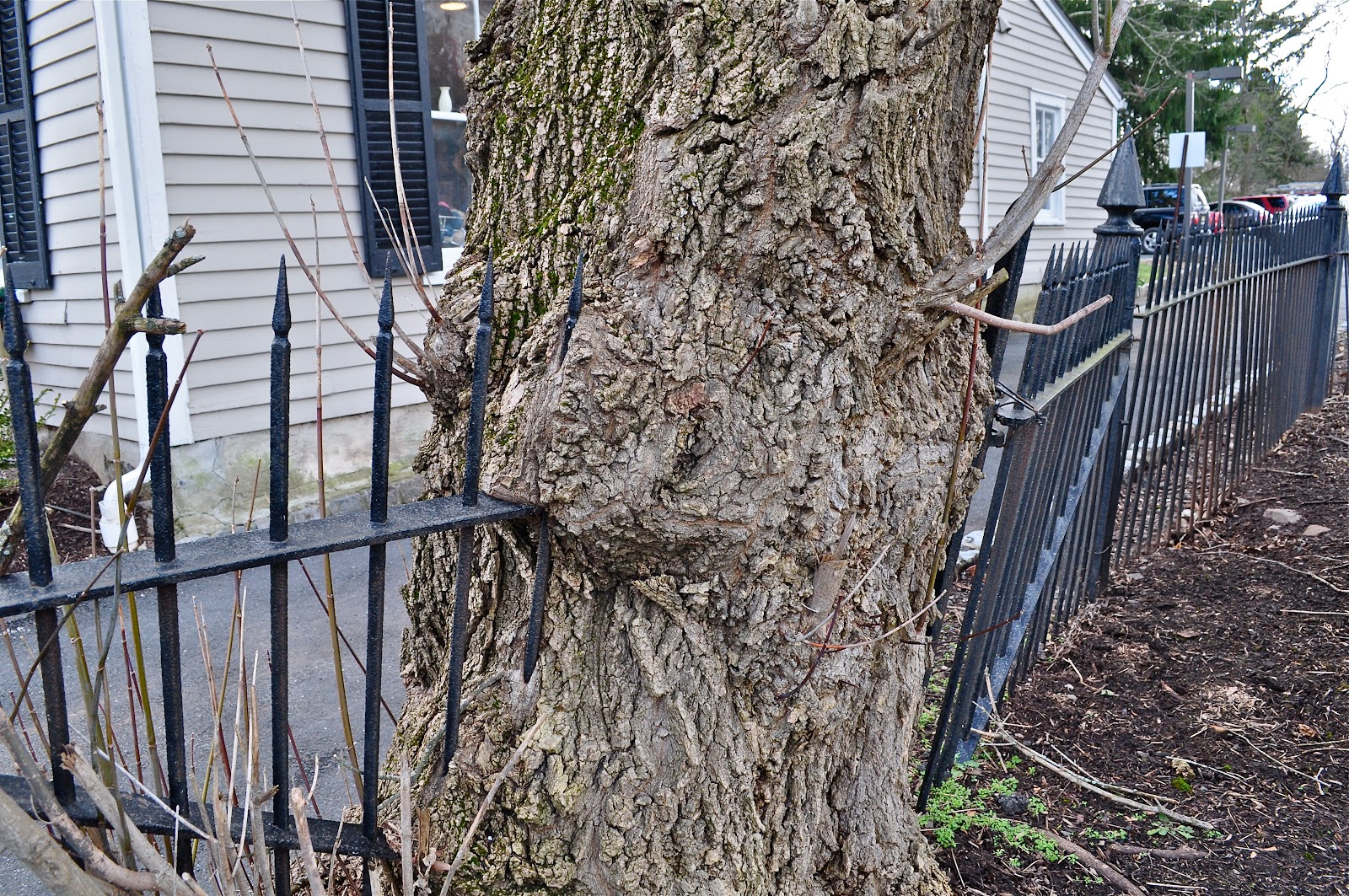
Anyway, this necessitated a trip to the next most convenient yarn shop, in Basking Ridge, an historic town where most of the colonial homes that line the original path for horse-drawn carriages have morphed into mere façades, housing banks, restaurants and stores.  The parking lot is enclosed by an old wrought iron fence, parts of which are physically embedded in a line of trees.  Since the subject of tree tenacity has come up recently in comments at Wit's End, these images seem to be the perfect illustration of that.
The trees are of varying ages.  Below is the largest, and most amazing, because it completely encloses the fence.  It's hard to say how old, but it could be fifty or one hundred or more years old - the buildings are 19th century, and some even earlier.
It's slow growth has distorted the line of the fence, while meanwhile its roots have poured over the Belgian blocks that were added more recently, to line the drive.
Clearly, trees are capable of fantastically incredible feats allowing them to thrive against all odds, and yet...after all the years, even decades, that these particular trees swallowed iron undeterred, they are now being defeated by an invisible threat - air pollution.
Their bark is breaking and falling off, and many of them have opportunistic fungi sprouting from trunks and branches.
It's curious how some of them grew in one dimension.
A few have already died and been removed, as this rotted stump attests.
When I came upon this astonishing sight I was filled with an irrational joy.
I say irrational because even though I was thoroughly impressed at the stoic determination of these trees to thrive, it's impossible not to see simultaneously that for reasons beyond their control, or ability to evolve, they are not long for this world.
For these trees to have come so far only to, in essence, strangle from the fumes of industrial civilization is a cruel prank we have played upon Nature.
I had to take a picture of each one, in tribute.
The tree below isn't close enough to the fence to have started growing around it, but it is in the same poor condition as the others - at the top of the picture bark is cracking, and at the base of the tree, a good portion has fallen off completely.  It's not the fence that is killing them!
This pair, set back from the fence, is smothered in lichen, a sure signal, if not the cause, of impending death.
A decaying foundation is not auspicious where the trunk meets the ground.
The tree on the left of this cluster, further back behind the store, has lost much of its bark.
This is a close-up:
The other trunks are losing bark as well, they're just not as far along.
The fungus is another indication that the trees are dying off.
I took a long loop going home to take photos along the way, which will be interspersed with some of the most recent news and studies, mostly about the cascade of reactive nitrogen pollution.
It was a dark day, with occasionally spectacular clouds, so it was difficult to get bright pictures - but it was the only afternoon this holiday season when I've had time to just wander, so that's what we've got.  Gloom.  As it happens, with the leaves gone now that it's winter (in name if not temperature), it's even more obvious that trees are an endangered species.
This tree in front of Friendly's in Bernardsville is a terrific example because it displays all the symptoms of decline that have become so familiar.  Initiated by damage from ozone, death is often accelerated by - and blamed on - other agents such as insects, disease, fungus, extreme wind and drought.  The crown has lost many major branches.
Oh, and of course it has lichen all over the bark!
Cankers, which are caused by a fungus that is ultimately as lethal as a cancerous tumor, are bulging.  They used to be a rarity but now they are easily to be located, and sometimes there are more than a dozen on a single tree.
There are holes spewing a sort of vomit which over time stains the trunk.
This pattern of fluid staining bark black, white or brown only started, abruptly, a couple of years ago, but now is frequently found everywhere, on all varieties of tree.
And of course, chunks of bark are falling off, revealing the smooth heartwood to insect attack and the elements.  No tree can survive such a loss of protective shield.  Did we miss anything on this specimen?
Remarkably, in 2011, foresters actually admitted that trees are dying all over the world, but they blame it on drought from climate change.  I think it makes more sense to acknowledge that their systems are compromised by ozone, and this makes them more vulnerable to drought from climate change, along with any other threat or synergistic effects.  One reason I think that is because plants grown in nurseries, like these boxwood that should be green, are dying too.  Can this be due to long-term alterations in precipitation from climate change?  Pulease!!  They are being watered, just like they were 20 years ago.  SOMETHING else is killing them - it's not a lack of water, or erratic rainfall.
The rhododendrons are just as bad - they are horribly thin, because their leaves have developed chlorosis - a yellowing because they can't photosynthesize.  They have brown tips, and most have withered and fallen off.
These conifers are at the entrance to the nursery, and they are dying too.  The cedar in the foreground is turning brown, and the two tall white pines are transparent, they have lost so many needles.  The only thing the have in common with the shrubs being irrigated across the drive is the composition of the atmosphere.
When I left the nursery I took a detour past the secluded, exclusive Lake Club in Far Hills...so if the images that follow aren't from a report, they are from that cruise home...a journey down a path of destruction.
It doesn't look nouveau riche, like Donald Trump's Golf course in neighboring Bedminster.  But then, this is an old-money WASP enclave, and it doesn't want or need to advertise with any sort of glitz. 
By way of a quick reminder, or perhaps basic introduction, here is the usual brief description of ozone's influence on plants...this time from Sweden's Air Pollution and Climate Secretariat, because why not?
"Among the air pollutants that cause direct damage to plants, ground-level ozone is by far the most significant. The ozone is formed from nitrogen oxides and volatile organic compounds in the air, under the influence of sunlight."
This is the view across the Lake.  Just a few years ago, you couldn't see any ground beneath the dense canopy, even in winter...only the contour of the topmost treeline.  Now the understory is non-existant and so many pines have died, they lie horizontal on the slopes,  like a game of pick-up-sticks.

"In plants, it has been found that damage can occur at concentrations only slightly higher than current background levels. This has a significance on yields from agriculture and forestry, as well as affecting natural ecosystems."
This little creek runs into the lake; the bark on the trees is splitting and peeling off.


"Measurements that have been in progress since the 1950s show that the levels of ozone in the air over Europe have risen by an average of 2 per cent a year, and that the background level today is two to four times as high as it was in the 1950s. The critical levels, which were presumably only exceeded occasionally at the start of the last century, are now exceeded regularly over almost all of Europe." 

"The limits that have been set to protect people's health are also regularly exceeded by a significant degree. The situation is worst in the Mediterranean countries of Italy, France, Greece and Spain, and in parts of Germany."
"NB. The ozone layer in the stratosphere, at an altitude of 10-40 kilometres, protects us from ultraviolet radiation from the sun and is an essential requirement for all higher life on the Earth. But when ozone is present at ground level it may be harmful to people, animals, plants and materials."
The standing white trunks are dead pines with no needles and no bark.

Without further ado, following are excerpts from the United Nations Economic and Social Council's Executive Body for the Convention on Long-range Transboundary Air Pollution, issued a European Nitrogen Assessment in December at a meeting in Geneva - ahead of planned revisions to the Gothenburg Protocol to be adopted in May.  I won't clutter it with quotations - other than captions for photos, my comments will be [bracketed and italicized].  They begin with a helpful graph:
I. Main messages
Lake Road winds around the shore barely above the level of the water.  Between the barrier and lake itself, there used to be so much vegetation, you could only catch glimpses of the water.  Almost all of the plantlife is simply gone now.

A. Too much nitrogen harms the environment and the economy
If it's drought from climate change that is killing trees, wouldn't you expect those with roots near water to be marginally better off?  Oops...they're not.

• Over the past century humans have caused unprecedented changes to the global nitrogen cycle, converting  atmospheric dinitrogen (N2) into many reactive nitrogen (Nr) forms, doubling the total fixation of Nr globally and more than tripling it in Europe.
• The increased use of Nr as fertilizer allows a growing world population, but has considerable adverse effects on the environment and human health. Five key societal threats of Nr can be identified: to water quality, air quality, greenhouse balance, ecosystems and biodiversity, and soil quality.

• Cost-benefit analysis highlights how the overall environmental costs of all Nr losses in Europe (estimated at €70–€320 billion per year at current rates) outweigh the direct economic benefits of Nr in agriculture. The highest societal costs are associated with loss of air quality and water quality linked to impacts on ecosystems and especially on human health.
[Did you catch those numbers?  Up to 320 billion euros per year!]
Every few feet I stopped and took a picture, in an unbroken progression of decline.

B. Nitrogen cascade and budgets

• The different forms of Nr inter-convert through the environment, so that one atom of  Nr may take part in many environmental effects, until it is immobilized or eventually denitrified back to N2. The fate of anthropogenic Nr can therefore be seen as a cascade  of Nr forms and effects. The cascade highlights how policy responses to different Nr forms and issues are interrelated, and that a holistic approach is needed, maximizing the abatement synergies and minimizing the trade-offs.

• Nitrogen budgets form the basis for the development and selection of measures to reduce emissions and their effects in all  environmental compartments. For instance, the European nitrogen budget highlights the role of livestock in driving the European nitrogen cycle.
The roof of the clubhouse comes into view, under a pine with almost no needles left at all.

C. Policies and management

• Existing policies related to Nr have been largely established in a fragmented way, separating Nr forms, media and sectors. Despite the efforts made over many years to reduce Nr inputs into the environment, most of the Nr-related environmental quality objectives and environmental action targets have not been achieved to date.
The bark of the deciduous tree in front of the pine is breaking off, and holes punctuate the trunk.

• The five societal threats and N budgets are starting points for a more holistic management of Nr. The European Nitrogen Assessment identifies a package of seven key actions for overall management of the European nitrogen cycle. These key actions relate to: agriculture (three actions); transport and industry (one action); wastewater treatment (one action); and societal consumption patterns (two actions).
• The key actions provide an integrated package to develop and apply policy instruments. The need for such a package is emphasized by cost-benefit analysis that highlights the role of several Nr forms, especially nitrogen oxides (NOx), ammonia (NH3) and Nr loss to water, in addition to nitrous oxide (N2O), in the long term.

D. International cooperation and communication
• Tackling Nr necessitates international cooperation. There are various options to implement multilateral environmental agreements; a possible inter-convention agreement on nitrogen needs to be further explored.

• Communication tools for behavioural change should be extended to nitrogen, such as calculating nitrogen “food-prints”.  Messages should emphasize the potential health co-benefits of reducing the consumption of animal products to avoid excess above recommended dietary guidelines.
The Lake Club offers recreational boating, of course, and tennis courts beyond this copse of thinning pines and holey trees.
II. Why nitrogen? Concerns and the need for new solutions

1. Nitrogen is an abundant element on Earth, making up nearly 80% of the Earth’s atmosphere. However, as atmospheric N2, it is unreactive and cannot be assimilated by most organisms. By contrast, there are many Nr forms that are essential for life, but are naturally in very short supply. These include ammonia,  nitrates, amino acids, proteins and many other forms. Until the mid-nineteenth century, limited availability of these Nr compounds in Europe severely constrained both agricultural and industrial productivity.
2. With an increasing population in the late nineteenth century, rates of biological nitrogen fixation were not sufficient for crop needs and Europe became increasingly dependent on limited sources of mined Nr
(guano, saltpetre, coal). At the start of the twentieth century, several industrial processes were developed to fix N2 into Nr, the most successful being the Haber-Bosch process to produce NH3.
3. Since the 1950s, Nr production has greatly increased, representing perhaps the greatest single experiment in global geoenginneering.  Europe’s fertilizer needs have been met, as well as its military and industrial needs for Nr. In addition, high temperature combustion processes have substantially increased the formation and release of NOx. While the Nr shortage of the past has been solved, Europe has stored up a nitrogen inheritance of unexpected environmental effects.
4. Europe remains a major source region for Nr production, with many of the environmental impacts being clearly visible and well studied. There is a wealth of evidence on sources, fate and impacts of N. However, the complexity and extent of the interactions mean that scientific understanding has become scattered and focused on individual sectors.

A parallel fragmentation can be seen in environmental policies related to nitrogen, which are typically separated by media (air, land, water, etc.), by issue (climate, biodiversity,waste, etc.) and by Nr form.

5. While this specialization has advanced understanding, European science and policies related to nitrogen have to a significant degree lost sight of the bigger picture. The occurrence of Nr in many different Nr forms and media means that each component should not be considered in isolation. A more comprehensive understanding of the nitrogen cycle is therefore needed to minimize the adverse effects of Nr in the environment, while optimizing food production and energy use.
The bases of these trees are weeping fluid.
IV. Disruption of the European nitrogen cycle

A. Fertilizers, energy and transport: drivers for increased nitrogen inputs  

Production of Nr is a key input for agriculture and industry, and a persistent side effect of combustion for energy and transport.  Industrial production in Europe of Nr in 2008 was about 34 Tg per year (where 1 Tg = 1 million tons), of which 75% is for fertilizer and 25% for chemical industry (production of rubbers, plastics, and use in electronic, metals and oil industry) [3.5]. The trend in mineral  fertilizer represents the largest change in overall Nr inputs to Europe over the past century.
 
13. The combustion of fossil fuels has allowed a substantial increase in industrial production and transportation, reflected in  the greatly increased emission of nitrogen oxides, which only over the last 20 years have partly been controlled. By contrast, the total contribution of crop biological nitrogen fixation has decreased significantly. 

14. The provision of Nr from the Haber-Bosch process removed a major limiting factor on society, permitting substantial population growth and improving human welfare.  However, accounting for natural sources, humans have more than doubled the supply of Nr into the environment global, and more than tripled this supply in Europe.
Next, a close up of the standing tree on the right, behind the stone wall. 
B. The nitrogen cascade

16. Human production of Nr from N2 causes a cascade of intended and unintended consequences. The intended cascade is that each molecule of Nr contributes to soil fertility and increased yields of crops, subsequently feeding livestock and humans, allowing the formation of amino acids, proteins and deoxyribonucleic acid (DNA). In a well managed system, the intention is for the Nr in manures and sewage to be fully recycled back through the agricultural system.
17. Reactive nitrogen, is however, extremely mobile, with emissions from agriculture, combustion and industry leading to an unintended cascade of Nr losses into the natural environment. Once released, Nr
cascades through the different media, exchanging between different Nr forms and contributing to a range of environmental effects, until it is finally denitrified back into N2. An important consequence of the cascade is that the environmental impacts of Nr eventually become independent of the sources, so that nitrogen management requires a holistic approach. This is important, both to minimize “pollution 
swapping” between different Nr forms and threats, and to maximize the potential for synergies in mitigation and adaptation strategies. 
19.  The budget for 2000 shows that overall human perturbation of the nitrogen cycle is driven primarily by agricultural activities. Although the atmospheric emissions of NOx from traffic and industry contribute to many environmental effects, these emissions are dwarfed by the agricultural Nr
flows.
[This observation raises the possibility that it perhaps fertilizing corn for the production of ethanol is a significant source of the current decimation of plants and trees, although Americans still regard transport as the major source of Nr.]

20. It is important to note the magnitude of the European Nr flow in crop production, which is mainly supported by Nr fertilizers. The primary use of the Nr in crops, however, is not directly to feed people: 80% of the Nr harvest in European crops provides feeds to support livestock (8.7 Tg per year plus 3.1 Tg per year in imported feeds, giving a total of 11.8 Tg per year). By comparison, human consumption of Nr is much smaller, amounting to only 2 Tg per year in crops and 2.3 Tg per year in animal products. Human use of livestock in Europe, and the consequent need for large amounts of animal feed, is therefore the dominant human driver altering the nitrogen cycle in Europe.
There are picnic tables and grills for summertime barbeques.
21. These major intended alterations in Nr flows cause many additional unintended Nr flows. Overall, NH3 from agriculture (3.2 Tg per year) contributes a similar amount to emissions of Nr to the atmosphere as NOx (3.4 Tg per year). Agriculture also accounts for 70% of nitrous oxide (N2O) emissions in Europe, with total N2O emissions of 1 Tg per year. The food chain also dominates Nr losses to ground and surface waters, mainly as nitrates (NO3), with a gross load of 9.7 Tg resulting mainly from losses due to agriculture (60%) and discharges from sewage and water treatment systems (40%).
A closeup of the treetops around the picnic area reveals holes, seeping fluid, and lichen encrusted bark.
22. The comparison between 1900 and  2000 shows how each of these flows has increased, including denitrification back to N2. Denitrification is the largest and most uncertain loss, as it occurs at many different stages during the continuum from soils to freshwaters and coastal seas. Although emissions of N2 are environmentally benign, they represent a waste of the substantial amounts of energy put into human production of Nr, thereby contributing indirectly to climate change and air pollution. This is in addition to the impact on climate change of N2O formed especially as a by-product of denitrification.
  
VI. The key societal threats of excess nitrogen 

34. From a longer list of around 20 concerns, the Assessment identifies five key societal threats associated with excess Nr in the environment:  Water quality,  Air quality, Greenhouse balance, Ecosystems and biodiversity, and Soil quality. Together, these threats can be easily remembered by an acronym as the “WAGES” of excess nitrogen, and visualized by analogy to the four “elements” (water, air, fire, earth) and quintessence of classical Greek cosmology (figure 7). These  five threats provide a framework that incorporates almost all issues related to the longer list of concerns associated with excess Nr.
[WAGES - isn't this cute!?]
B. Nitrogen as a threat to European air quality

38. Air pollution by NOx and NH3 causes formation of secondary particulate matter (PM), while emissions of NOx also increase levels of NO2 and tropospheric ozone (O3). All of these are causes for respiratory problems  and cancers for humans, while ozone causes damage to crops and other vegetation, as well  as to buildings and other cultural heritage.
That is a conifer on the left; no needles.

40. Although NOx emission decreases have reduced peak O3 concentrations, background 
tropospheric O3 concentrations continue to increase. By comparison to the limited progress in reducing NOx emissions, there has been even less success in controlling agricultural NH3 emissions, which therefore contribute to an increasing share of the European air pollution burden.
Apparently there is a perceived need for new trees, but the young trees are losing needles too.


D. Nitrogen as a threat to European terrestrial ecosystems and biodiversity

44. Atmospheric Nr deposition encourages plants favouring high Nr supply or more acidic conditions to out-compete a larger number of sensitive species, threatening biodiversity across Europe. The most vulnerable habitats are those with species adapted to low nutrient levels or poorly buffered against acidification. In addition to eutrophication, atmospheric Nr causes direct foliar damage, acidification and increased susceptibility to pathogens.
I left the Club, heading north, upriver, towards home.  All along the way are trees studded with cankers, if not fallen.
45. Although there are uncertainties in the relative effects of atmospheric nitrate (NO3-) versus ammonium (NH4+), gaseous ammonia (NH3) can be particularly harmful to vegetation, causing foliar damage especially to lower plants. This emphasizes the threat to semi-natural habitats occurring in agricultural landscapes. While uncertain, Nr deposition is expected to act synergistically with climate change and groundlevel ozone.
46. Thresholds for atmospheric concentrations and deposition of Nr components to semi-natural habitats are exceeded across much of Europe, and will continue to be exceeded under current projections of Nr
emissions. In order to achieve ecosystem recovery, further reductions of NH3 and NOx emissions are needed. Due to cumulative effects of Nr inputs and long time lags, rates of ecosystem recovery are expected to be slow, and in some cases may require active management intervention in the affected 
habitats.
52. Environmental damage related to Nr effects from agriculture in the EU-27 was estimated at €20–€150 billion per year. This can be compared with a benefit of N fertilizer for farmers of €10–€100 billion per year, with considerable uncertainty about long-term N benefits for crop yield.
They are replacing trees, but the baby trees are dying already too.
Societal consumption patterns

6.  Energy and transport saving.  Against the success of technical measures to reduce NOx emissions per unit consumption, both vehicle miles and energy use have increased substantially over past decades. Dissuasion of polluting cars and fardistance holidays, and stimulation of energy-saving houses and consumption patterns can greatly contribute to decreasing NOx emissions [23.5].

[Did they just say people shouldn't fly for fun??]
 7.  Lowering the human consumption of animal protein. European consumption of animal protein is above the recommended per capita consumption in many parts of Europe. Lowering the fraction of animal products in diets to the recommended level (and shifting consumption to more N-efficient animal products) will decrease Nr emissions with human health co-benefits, where current consumption is over the optimum.

[Did they just recommend that people consume less meat??]
64. International treaties, such as multilateral environmental agreements, have done much to protect the global environment, promoting intergovernmental action on many environmental issues, but none has targeted nitrogen management policy holistically.

[Did they just intimate that an environmental scourge is occurring totally outside the bounds of regulations?]
71. At present, public and institutional awareness of the global nitrogen challenge is very low. The comparison with carbon and climate change highlights how the nitrogen story is multifaceted, cutting across all global-change themes. This complexity is a barrier to greater public awareness, pointing to the need to distil easy messages that engage the public.

[Does this mean people are grotesquely mis- and un-informed about an existential threat even more imminent than all the extreme, violent, unprecedented weather that menaces us from climate change?]
72. Simple messages for nitrogen include contrasting its huge benefits for society against the environmental threats, and emphasizing the need to extend existing footprinting approaches, for example to calculate “nitrogen food-prints”. Perhaps the strongest message to the public is that there are substantial  health benefits to be gained by keeping consumption of animal products within recommended dietary limits. It is an opportunity to improve personal health and protect the environment at the same time.

[hahahahaha!  Let's see how far they get with that!]
Figure 3

Simplified comparison of the European nitrogen cycle (EU-27) between 1900 and 2000. Blue arrows show intended anthropogenic nitrogen flows; orange arrows show unintended nitrogen flows; green arrows represent the nearly closed nitrogen cycle of natural terrestrial systems.

Figure 3
Figure 7
Summary of the five key societal threats of excess reactive nitrogen, drawn in analogy to the “elements” of classical Greek cosmology. The main chemical forms associated with each threat are shown.

[This final graphic from that report smacks of desperation.  An attempt to assimilate the most grotesque and suicidal defilement of the natural world by the self-appointed masters of the universe with an analogy to the elements of classical Greek cosmology looks like magical thinking.]
Continuing on, why should we restrict our reading to European sources, when our own US Department of Agriculture's Forest Service has many publications regarding ozone...and the nitrogen cascade?  Here's a recent entry, "Assessment of Nitrogen Deposition Effects and Empirical Loads of Nitrogen for Ecoregions of the United States", a grand collaborative effort meant to aid policy makers (I guess that means our totally corrupt government) when they deliberate regulations.  This is a huge undertaking, with endless referrals to original research (which I've removed from quoted passages...but check out the original if you really want to go down the rabbit's hole).  It's well worth perusing and impossible to sum up in one blog post.  Later I will try to follow up on some of the most tantalizing research.
Their purpose is to establish criteria to quantify "critical loads" based on the particular characteristics of various types of ecosystems.  I guess, that's science, but do we have to constantly call for more research before we can say definitively that polluting the air, water and soil is a bad idea?  Kind of like this compilation of research demonstrating - believe it or not, it's true, Happy New Year! - fireworks release all kinds of nasty toxins into the air for people to breathe, in measurably significant amounts!!   But I digress.  Let's return to the nitrogen report, starting with the two sets of photos on the front cover, followed by their descriptions.  I suggest more than a cursory glance at this pair of side-by-side comparisons, because the implications are a little monumental.
Left to right, top: elevated nitrogen inputs to a prairie grassland in Minnesota (control)  resulted in a decrease in species richness and an increase in invasive grasses (N addition).   Photos by David Tilman, University of Minnesota, used with permission.

[A "decrease in species richness" means elevated nitrogen KILLED OFF some species.  They DIED and were replaced by grasses that will not die as quickly.]

Left to right: elevated nitrogen inputs to a high elevation spruce fir forest (control) in Vermont resulted in decreased growth and increased mortality (high treatment).  Photos by Linda Pardo, U.S. Forest Service.

[The photo on the right certainly looks representative of current forest conditions!  Following are some choice excerpts.  First of all, they admit they really don't know how much dry N deposition there is.  Personally, I'd venture a guess that either 1)  it's way more than the models show or 2) the ecosystem is far more sensitive to what is considered a safe amount below " critical load".]
1.2.2 Effects of N deposition

The increases in atmospheric N deposition after the middle of the 20th century initially raised few concerns about detrimental ecosystem impacts. Many terrestrial ecosystems are N limited. Hence, additional N inputs could have a fertilizing effect, which was perceived as beneficial for some ecosystems. Increased tree growth due to N deposition has been demonstrated in northeastern U.S. forests.

[Maybe - but the CO2 folks like to claim credit for that too.  Isn't there some way these experts could get on the same page in this, the age of the intertubes?  And in any case, any increased tree growth has been more than offset by the recent extraordinarily dramatic declines.]
However, substantial debate continues over the existence and magnitude of deposition-induced growth 
enhancement in forests globally. Furthermore, elevated N inputs can lead to detrimental effects on ecosystems, including soil and surface water acidification, plant nutrient imbalances, declines in plant health, changes in species composition, increases in invasive species, increased susceptibility to secondary stresses such as freezing, drought, and insect outbreaks, as well as eutrophication of fresh and coastal waters. High concentrations of ammonia (NH3) can be directly toxic to plants.
The fact that these pine trees are transparent is a harbinger of their death.
Nitrogen saturation can be defined as the condition when available N exceeds plant and microbial demand.  Aber et al. described four stages of N saturation in forest ecosystems (Fig. 1.1): background 
conditions (stage 0), an initial fertilization response (stage 1), flattened response of N mineralization but 
increased net nitrification (stage 2), and detrimental effects on plant health and growth and general decreasing N retention (stage 3). When vegetation is no longer N limited, but before damage is incurred, nitrate (NO3-) immobilization will be reduced and NO3- export is likely to increase gradually.  The increase in NO3- export may occur earlier in this progression of N saturation than initially thought.
Adverse consequences on plant health and growth occur in the last stage of N saturation, resulting from some combination of insufficient allocation of plant carbon to roots and mycorrhizae and soil acidification induced by NO3- leaching. Nutrient imbalances (e.g., elevated N:Ca or N:Mg) may also affect plant health. In addition, alterations in an ecosystem’s N status may lead to increased susceptibility to secondary stresses, including freezing injury, pest outbreak, and drought.
...Among the most significant indicators of N saturation are changes in species composition or community structure in terrestrial and aquatic ecosystems. Alterations in species composition may result from shifts in dominance of species present, for epiphytic lichens, for example, or increased dominance 
of invasive species, and may lead to significant changes in vegetation. Nitrogen deposition may affect species richness and has been implicated in dramatic declines in species richness, for example, in coastal sage scrub grasslands.

[Okay, all these stages are reminiscent of cancer diagnosis.  What they've just worked up to is that there is a nitrogen TIPPING POINT, and in the next section, they admit they have no idea how much nitrogen is out there overburdening the ecosystem.]
3.2 Background on total N deposition

The primary forms of inorganic N deposition that have been measured routinely are secondary products 
of nitrogen oxide (NOx) emissions—nitrate (NO3-; particulate and aqueous) and nitric acid vapor (HNO3) —and ammonium (NH4+; particulate and aqueous).   The primary anthropogenic source of NOx is fossil fuel combustion. Transportation accounted for more than 50 percent of the total NOx emissions in 2002, while the primary sources of ammonia (NH3) and NH4+ are agricultural activities.
 
Nitrogen is deposited from the atmosphere to the Earth’s surface in the form of wet (rain and snow), dry (gases and particles), and cloud and/or fog deposition. Wet N deposition can be measured directly, but often only some of the components are measured.  Dry deposition cannot be measured directly. Moreover, the estimates that exist are either site specific, or are modeled (e.g., dry deposition) 
assuming flat, homogeneous terrain, e.g. Clean Air Status and Trends (CASTNET) sites.
For this reason, a combination of monitoring data, deposition models (e.g., the Multi-Layer Model [MLM] for estimating dry deposition), empirical measures of atmospheric deposition (e.g., throughfall), and emissions-based modeling outputs, are often necessary to estimate total N deposition. In the ecoregion chapters that follow, we consider total deposition to include wet (rain and snow) plus dry and, in some cases, cloud/fog.
[So, we've established that nobody really knows how much reactive Nitrogen is out there polluting the air, acidifying the soils, and causing eutrophication of water.

But that's okay!  The lichens know, and it turns out the National Park Service has a lichen database, and so does the US Geologic Survey and the Forest Service!!!  As if I didn't have enough to look into.  But here's what this report says on p. 27:]

Lichens are adapted to different levels of N availability and most species can be sorted into one of three N indicator groups: oligotrophs are more or less restricted  to nutrient-poor environments; mesotrophs have an intermediate nutrient requirement; and eutrophs thrive in nutrient-enhanced environments. A few  lichens have broad ecological amplitudes and tolerate a large range of N availability. As anthropogenic N is added to background N levels, the excess N favors the small, cosmopolitan eutrophs at the expense of native oligotrophic and mesotrophic forage and N2-fixing lichens.
[Keep in mind that "nutrient-enhanced" is polluted by another name.]
Aside from the obvious dead trunk in the foreground, next will be close ups of the trees nearer the river.
p. 149:

Lichen responses. About half the epiphytic lichen species known to occur during the late 1800s and early 1900s on coast live oak throughout the chaparral and oak vegetation zones of the Los Angeles basin have subsequently disappeared.  This dramatic reduction in species richness was initially 
attributed solely to oxidizing pollutants, chiefly O3, but recent research provides unequivocal evidence for an N deposition effect.  In the Los Angeles air basin, throughfall N deposition in forests downwind of the urban areas can reach 25 to 70 kg ha-1yr-1.  This deposition includes nitric acid (HNO3), a strong gas-phase acid which exhibits diurnal patterns paralleling O3 concentrations. In the mountains downwind of Los Angeles, 24-hr means of up to 27.3 ppb have been recorded, whereas remote 
location means have been ≤0.1 ppb. Unlike O3, once HNO3 is produced, it rapidly deposits to surfaces.

p. 150

Eutrophic lichens benefited from increasing N availability, comprising >50 percent of total abundance in lichen communities at air scores <0.0.

Figure 11.2—Shown are the species numbers (relative to controls) for plots receiving N at three different rates averaged over three Minnesota fields from 1982-2004. Dashed lines correspond to annual standard errors in control plots and arrows indicate the year of first significant (P < 0.01) detection of species loss for that treatment rate.


p. 153

13.4.2 Ecosystem Responses to N Deposition

Research on air pollution effects in mixed-conifer forests began in the 1960s after the initial discovery in the  1950s of unusual symptoms in ponderosa pine that were later confirmed to be caused by O3. Studies on N deposition effects in forests began in the San Bernardino Mountains in some of the original O3 study plots established in the 1970s. Ecosystem responses to N deposition include NO3- leaching, trace gas losses of N, soil acidification, lichen community change, altered forest nutrient 
cycling, and loss of understory diversity. Because of the co-occurrence of O3 and N deposition in the mixed conifer forest of California, the ecological effects of N deposition cannot be evaluated in isolation from the significant impacts of O3 on nutrient cycling and plant growth, development, community succession, and phenology.  The combined ecological effects of N and O3 are dramatic in areas of high pollution exposure.

Forest sustainability, p. 155

Nitrogen deposition, in concert with O3 injury effects, is contributing to a decrease in the sustainability of mixed-conifer forests in the San Bernardino Mountains. Nitrogen deposition increases aboveground growth of coniferous and deciduous species of the mixed-conifer forest. Ozone and increased N fertility 
result in decreases in both C allocation belowground and fine root biomass . Ozone causes premature foliar senescence and abscission.
The combined effects of O3 and elevated N deposition are increased C storage in the bole and woody aboveground biomass and accelerated foliar turnover and litter production.  The is also results in increased accumulation of C and N in the forest floor. In these O3-impacted and N-saturated mixed conifer stands (N deposition 25 to 71 kg ha-1 yr-1), aboveground N pools are much higher than in stands in areas receiving relatively low deposition. For example, at an N-saturated site (N deposition 71 kg ha-1 yr-1) in the San Bernardino Mountains about 30 percent of ecosystem N is stored in the thick forest floor, compared to about 11 percent at an N-limited site (N deposition approximately 7 kg ha-1
yr-1).
Ozone and elevated N deposition cause specific changes in forest tree C, N, and water balance that enhance individual tree susceptibility to drought, bark beetle attack, and disease, and when combined, contribute to whole ecosystem susceptibility to wildfire.  The N deposition levels at which these effects 
begin to occur are not well defined, but regression analysis indicates a 25 percent reduction in fine root 
biomass at 17 kg ha-1 yr-1; dramatic shifts in tree phenology and C allocation are evident at a site with N deposition of 39 kg ha-1 yr-1.
Uncharacteristically deep litter layers develop in mixed-conifer forests impacted by air pollution.

Elevated O3 and N deposition decrease the proportion of whole tree biomass in foliage and roots, the latter effect increasing tree susceptibility to drought and beetle attack. Because both foliar and root mass are compromised, carbohydrates are stored in the bole over winter. Elevated O3 increases drought 
stress by significantly reducing plant control of water loss.  The resulting increase in canopy transpiration, combined with O3 and N deposition-induced decreases in root mass, significantly increases tree susceptibility to drought stress.   The combination of these effects with increased sequestration of bole carbohydrates may contribute to successful host colonization and population increases of bark beetles and possible enhancement of dwarf mistletoe infections, although the latter response has not been confirmed.

[OKAY.  Can somebody please tell me, when it is so very well established that 1) background ozone levels are increasing worldwide 2) the nitrogen cascade is out of control 3) trees are dying 4) trees exposed to ozone and N deposition are "significantly" more susceptible to drought stress, WHY don't scientists include this information when they write papers saying that climate change drought is killing trees all over the world??]

Understory, p. 156

Understory diversity in mixed-conifer forests in the San Bernardino Mountains in southern California 
was recently compared to studies done 30 years prior, in 1973. Both O3 concentrations and particularly N deposition decline from west to east along the air pollution gradient. Nitrogen deposition in throughfall ranges from 9 to 71 kg ha- yr-1 at the understory study sites. Biodiversity loss was pronounced in the sites receiving the highest N deposition and is due to the establishment of exotic invasive species that have become abundant. In three of six sites, including the two westernmost polluted sites, 20 to 40 percent of species were lost between 1973 and 2003.
In the highest deposition sites, understory cover equaled 30 to 45 percent and was equally divided between native and exotic species. At lower deposition sites, understory cover was 3 to 13 percent and was dominated by native species. Because of confounding factors such as precipitation and possibly local disturbances, a simple correlation between air pollution and patterns of native and invasive species cover and richness was not found. However, observational evidence and expert opinion suggest that increased N deposition and precipitation in the westernmost sites are the primary factors contributing to reduced biodiversity and increased cover by invasive species
Co-occurring O3 may be indirectly contributing to the establishment of exotic species as well. Ozone causes premature foliage loss in pine, while N deposition stimulates foliar growth, leading to greater litter production and accumulation in the forest floor. Many native plant species are not able to establish where dense litter accumulates.
However, stickywilly (Galium aparine), a weedy annual with both native and introduced forms, thrives under these conditions, which include the acidified N-rich soils that underlie the thick litter layer. Portions of the high-pollution study sites in the western San Bernardino Mountains burned in October 2003. Formerly shady sites in the burned areas are now covered by exotic annual brome grasses. Subsequent clearing of dead trees and brush is further exposing the soil to invasive species. 
This large branch came down in the October snow.  Note, it still has leaves affixed.  It takes energy for trees to push leaves off in the autumn, so when you see trees that have limp, brown leaves remaining well past the time they should have fallen, it indicates a lack of vigor.
[The report's conclusions were jointly written by the authors.  Note that it must be technically impossible to verify how much biodiversity was lost years before these studies were undertaken, which also means that the assessment of what constitutes a critical load is based upon already degraded landscapes.]

Human activity in the last century has led to a substantial increase in nitrogen (N) emissions and 
deposition (Galloway et al. 2003). Because of past, and, in some regions, continuing increases in emissions, this N deposition has reached a level that has caused or is likely to cause alterations and damage in many ecosystems across the United States. In some ecoregions, the impact of N deposition has been severe and has changed the biotic community structure and composition of ecosystems.

Figure 19.10—Map of exceedance of critical loads (CL) for NO3- leaching by ecoregion in the continental United States.  Exceedance was calculated by subtracting critical loads from CMAQ nitrogen deposition. Exceedance (critical load - deposition) is shown for several categories: (1) No exceedance (Below CL), when deposition is lower than the CL range, (2) At CL, when deposition is within +/-1 of the CL range, (3) Above CLmin, when deposition is above the lower end of the CL range, but lower than the upper end of the range, (4) Above CLmax, when deposition is above the upper end of the CL range.
[They don't seem to consider that eventually, as we continue with unabated emissions, the saturation of nitrogen and background ozone will become so extreme that even the n-loving replacement species will also be overcome...and we'll have NOTHING, just lifeless dirt?  It seems kind of obvious to me - like throwing a bunch of people into the open sea.  Some will drown sooner than others, without doubt - but equally without doubt, they will all eventually drown.  DUH.]
[Here's a sad sad part, the sort of interconnected dependence species have upon each other that is going to lead to mass extinctions with very few, most likely the most nasty, survivors.]

The extirpation of the endangered checkerspot butterfly (Euphydryas editha bayensis), because the host plant for the larval stage disappears in N-enriched ecosystems, is just one example of the detrimental 
impacts of elevated N deposition.


The endangered checkerspot butterfly (Euphydryas editha bayensis).  


[Following is a a good summary of the "Cascade"]

In addition to altering ecosystem structure, N deposition can also affect ecosystem function, affecting 
N-cycle processes such as N mineralization, nitrification rates, and nitrate (NO3-) leaching rates, as well as plant tissue N concentration.   These changes indicate early stages of N saturation. Nitrogen saturation is the series of ecosystem changes that occur as available N exceeds plant and microbial demand. In some cases, these early responses may lead to a cascade of alterations in the N cycle that ultimately affect the function or structure of the ecosystem. For example, elevated N inputs may lead to plant nutrient imbalances, which then increase plant susceptibility to inciting stressors such as cold, drought, or pests. 
This series of responses was observed in a southern Vermont montane red spruce (Picea rubens) stand, 
where increased foliar N concentration was associated with reductions in foliar membrane-associated calcium (Ca) and decreased cold tolerance, which resulted in increased winter injury.  Another example of the N cascade is increased soil NO3- leaching, which can result in episodic acidification of surface waters, harming fish species. Other responses to low levels of elevated N deposition, such as increased 
plant growth and increased carbon (C) sequestration by trees, may be perceived as beneficial where forests are managed for tree growth.
In other instances, it is not known whether the early indicators of N saturation will be followed by other 
effects. In these cases, the perceived extent of harm caused by N deposition depends, in part, on which 
ecosystem service is of particular value for different stakeholders. For example, the level or type of change or harm that is unacceptable may vary according to resource management goals.
This house has it all:  the boxwood in the pot is turning yellow the pine to the right has almost no needles remaining; beyond the car, the sycamore trunk is swarming with cankers.
In a conservation area, for example, any alteration in N cycling may be considered unacceptable, whereas for other land areas, changes of a certain magnitude or scope may be acceptable or even desirable based on resource use (such as timber harvesting) or other factors. Land and resources may be valued for a wide range of purposes, including biodiversity, food and wood production, clean water, and recreation. Quantification and then valuation of these ecosystem services for each land area of interest is required to fully account for impacts of N deposition.
There's also a tremendous hole in the tree just to the left of the porch roof.
[I hope your eyes didn't glaze over reading those passages above, about competing interests of "stakeholders" - which is so ludicrous, because it's assuming we can control the cascade, even if long-term it is beneficial, which it can't be.  Trying to make a silk purse out of a pig's ear!]
[Pp. 247-8 has more about lichens, and everyone knows, that in close competition with my role as  ozonista is a fascination with the malevolent lichen:]

Lichens and bryophytes make substantial contributions to biodiversity. About 4100 lichen and 
2300 bryophyte species are known from North America north of Mexico—as about one-fourth of vascular plant diversity, which is about 26,600 species.  Therefore, N critical loads protective of the sensitive lichens and bryophytes help protect biological diversity.
[Imagine - 4100 species of lichen!]
Lichens are symbiotic organisms consisting of a fungus, for which the organism is named, and a green algal and/or a blue-green bacterial partner.
[How cool is that?]
These are supposed to be thick, green pines.
Responses to N inputs.
Depending on the kind of bark it can fall in patches or, in the case of shagbark hickory, spectacular curling strips.
Lichens and bryophytes are among the most sensitive bioindicators of N in terrestrial ecosystems. Unlike vascular plants, lichens and bryophytes lack specialized tissues to mediate the entry or loss of water and gases (e.g., waxy epidermis, guard cells, root steele).  Thus, they rapidly hydrate and absorb gases, water, and dissolved nutrients during high humidity or precipitation events.
[It's true that when it rains now the lichens swell, it's quite remarkable to witness.]
However, they quickly dehydrate to a metabolically inactive state as well, making them slow-growing and vulnerable to contaminant accumulation. Consequently, the implementation of lichen or bryophyte-derived critical loads may prevent undesired impacts to much of the broader forest ecosystem. In some cases, alteration of lichen community composition may signal the beginning of a cascade of changes in ecosystem N cycling, which may markedly alter the structure or function of the ecosystem as a whole.
Well, that's enough of the "Assessment of Nitrogen Deposition Effects etc" for now.  The above text in red rather exactly describes what we are seeing on the East Coast of the US, at a minimum.  Now here is another sad.  Sensitive lichens are considered bioindicators because they are among the first species to disappear in a polluted environment...but it's not just the lichens that melt into oblivion, some of them are the only food other creatures eat, like flying squirrels in the PNW, and reindeer!  Yes, Santa's reindeer eat lichen and so when that goes away they just...oh never mind...they go to McDonalds!  And oh yeah, flying squirrels are the primary prey for the endangered northern spotted owl, so they'll have to go to McDonalds too!  Problem solved.
This view is closer to Oldwick, on the outskirts of the adjacent village of Pottersville.
The narrow road I live on snakes up the hill past the Vliet Farm to the south, and alongside another testament to the tenacity of trees on the high, northerly side, where trees have clung to life despite constant erosion that exposes their roots along the bank.
These trees and others now gone thrived for the 30 years I've been living at Wit's End, passing them walking and driving more times than I can count.  Now, in just the past few years, they are encrusted with lichen and attacked by cankers, their largest branches broken, with suckers sprouting from struggling trunks.
More and more, people are waking up to the impending Great Convulsion, and grappling with the emotional tsunami that occurs when truth and reality intrude on willful obtusity.  I am so very fortunate to have found many virtual intertube (and even some real flesh!) friends who share my thoughts, because it's an excruciating process.

Generally, a bewildered, hopeless and helpless floundering for solutions occurs, despite the horrifying inkling that there is none.  Eventually, after considering the evidence dispassionately, most come to the bitter conclusion that by our very nature, we're fucked - and not only that, we have fucked most other species on earth, that immense wealth of life that took so long to evolve, and which we have relentlessly squandered.  Once that glimmer of knowledge takes hold, there's just a lot of pain, recrimination, confusion and guilt.

Well, I just spent New Year's Eve being ridiculed by family, friends and acquaintances for harboring such ideas.
I'm wondering when I should just stop writing and protesting.  The law Obama passed authorizing citizen detention is deeply frightening, and since the human race is doomed anyway, I am questioning the wisdom of making myself a target for the fascists when they staff the FEMA camps and start rounding up dissidents.  And I saw the story that the day after Christmas broke the last record, which was set the day after Thanksgiving, in background checks for gun purchases, which makes me wonder if I should run for the most distant hills and barricade myself as far from roving starving ruthless gangs as possible... maybe in New Zealand.
So here's the thing, that I use to cheer myself up.  Two things, actually.  First, even though most of my children's generation will likely die prematurely, quite possibly under horrific circumstances, the fact is those who have lived in the American middle class have had charmed lives up to now, for the most part at least.  I mean, they've been REALLY lucky; they have eaten exotic, delicious food imported from all over the world, traveled in airplanes, had fantastic technology at their disposal, and immense creature comfort unimaginable just decades ago...plus they've each been able to pursue whatever path they want in life.  Of course, they've also been manipulated into being mindless consumers, depending on how much teevee they watched.  But still, despite my guilt as a mother, given that it was inevitable that humans eventually destroy our home, Earth, and source of sustenance, Nature, I believe my children couldn't have been born at a better time, so far.
The Cold Brook, that delineates the border of Wit's End.  Are these trees dying from climate change drought?  I think not!
The second thing is that, if you think about it, we humans are horrible, rapacious creatures, capable of committing the worst atrocities, if only by proxy, and still managing to think of ourselves as not just good but superior beings - so we deserve our apocalyptic end.  It's too bad we're taking so much with us but, in a few million years on Earth - or perhaps if not, if we have triggered a runaway Venus effect that will render the planet uninhabitable - then surely somewhere on another planet millions of miles away, there will be life.
A weeping tree in front of the barn at Wit's End.
So to all doomers I say, cheer up, no regrets, Happy New Year!

Wednesday, December 28, 2011

Ozone Research and Vegetative Impacts Worse Case Scenarios by Ray Knighton, USDA

Today I have reproduced the slides used in a presentation by Ray Knighton of the USDA in 2006, which was given as part of the Agricultural Air Quality Task Force Meeting.  Even without his verbal accompaniment, they represent a concise primer for what ozone does to crops, and range in expression from wholly unwarranted silly cheeriness, to thinly veiled panic, as we shall see.
This is the same Ray Knighton referred to in the minutes of last July's annual meeting of the NE-1013, who announced to those academics that there will be no funding to train new scientists to study ozone:

"Reduced funding for ozone research and challenges experienced obtaining funding were also discussed. Concern was voiced and discussed about the future of the study of plant response to ozone as a whole generation of scientists is being lost now due to lack of funding with no new scientists being trained, while this air pollutant continues to be an increasing problem. Ray Knighton gave a presentation via conference call. General budgetary constraints and funding challenges at the federal level were described. Lack of funding for travel was the reason Ray was only able to attend the meeting remotely, as was also the case for most committee members who did not attend in person."
That is pathetic considering that already in 2006, these scientists understood the serious threat ozone poses to our food supply, not to mention, a threat which is growing non-linearly as background levels increase.  But that comes a little later in the show.
Is there any point in embellishing those bullet points?  1.  Ozone travels; 2. the constant background level of ozone adversely impacts crops and forests; and 3.  the regulators understand that they cannot comply with stricter (safe) standards because of inexorably increasingly high background levels.
Keep in mind that anyone who bothered to look during the past three growing seasons would find precisely those symptoms of stippling depicted - and often even more severe chlorosis, necrosis and marginal leaf burn - on virtually every single leaf!
These describe the losses of direct damage from exposure, but far worse occurs when plants that are compromised become more vulnerable to insects, disease and fungus.
Looking at this chart can we expect anything if not skyrocketing food prices?
The next slides are meant to indicate the several methods that scientists have used to determine that ozone is toxic to vegetation.  It isn't just ONE, but many different types of experiments which have all determined the same thing.  This isn't just a couple of ozonistas making wild pronouncements!
In addition to lab work there have been major, long-term field experiments.
Read carefully...it says that modelers overestimated CO2 sequestration because they do not account for O3.  Oops, better be careful...you can get into trouble in the climate change world for suggesting that!
In addition to trees, much work has been done with crops.  Now, why would the USDA devote so many resources to studying ozone impacts and ways to thwart them, if it was an inconsequential threat?  Answer...they wouldn't, if it weren't a significant threat to food supplies.
The following numbers are just plain scary especially when you consider that,  along with everything else in climate science predictions, the real progression is much faster than anyone anticipated.
 
Note:  the results were worse in the field experiments than expected from laboratory tests - probably because of the synergistic effects of other variables, especially the aforementioned insects, disease and fungus that preferentially attack plants damaged from exposure to ozone.
This is where it gets cute - "...if we do not find a solution."  What is the solution?  Oh, probably the end of industrial civilization, why pretend?
The first point is so classic - we have to remain competitive with South America!  Note also:  ALL varieties show at least *some* yield loss.  And I don't know why people continue to be perplexed that plants haven't managed to evolve tolerance to ozone in the past hundred years - how long do they think evolution takes?  I doubt we've got the tens of thousands of years that would be required for plants to evolve, any more than it could take less than that for the corals and shellfish to adjust to ocean acidification in a matter of a few decades.  I think people really need to brush up on natural selection and how LONG that takes!
Yep.  Other kinds of pollution are bad for plants too - but nothing beats ozone.  This was discovered in the 1950's and hasn't changed one iota.
Okay this is where the frantic starts to creep in.  It's not just smaller harvests - it is harvests that don't provide the same amount of nutrition to cows, sheep, pigs and horses.  So the problem becomes magnified.
I kind of like this guy Ray.  I'm sure it wasn't HIS idea to defund ozone research, and besides, parse this next slide.
He makes the obvious disclaimers about how complex the systems are and how difficult it is to attribute effects to any one agent but then with this HUGE *Nevertheless* he segues into "the compelling weight of evidence results from the convergence of results from many various and disparate assessment methods including chamber and free air exposure, crop yield and tree seedling biomass experimental studies, foliar injury data from biomonitoring plots and modeled mature tree growth."
Hey, wasn't I just saying that!  Trees are dying and there is a compelling weight of evidence that ozone is the cause.
The last point in the slide above is absolutely key although I don't know if Mr. Knighton realizes it:  "Due to the non-linear shape of many crop-ozone dose-response curves, we might expect a disproportionately larger effect for each unit increase in global average ozone concentrations."  That, my friends, is another way to describe the precipitous build-up to a tipping point, which judging by the rapidly deteriorating condition of trees, happens to be just about where we are at the moment.
The absurdity has fully arrived.  First of all, you have to wonder...exactly WHAT are the worse case scenarios that may come to pass?  Do these scientists and regulators talk about that, behind closed doors?  Furthermore, even IF there could be genetically altered crops bred to survive in the increasingly poisonous invisible soup created from emissions of fuel and fertilizer - IF - what the hell good is that going to do for the infinitely greater number and variety of WILD plants and trees...vegetation that happens to be essential for life to exist on earth, including our own??  Well, NOTHING that's what!  Look below - he ends by looking forward to "useful products".  Magic potions, perhaps?

I actually have amassed quite a few other new articles, studies, reports and books about ozone and the nitrogen cascade over a busy Christmas...and it's going to take some time to sort through them - so I think I'll post just this for now.

I hope everyone is having a lovely holiday!

Tuesday, December 27, 2011

Everybody should read this - no, Really!

Following is the complete transcript of a lecture, titled, "Are Humans Unsustainable by Nature?" by William Rees...because it is essential reading.  You can click here for a video of his talk, also worth watching in its entirety.  I am without superlatives extravagant enough to describe how comprehensive, erudite and complete is his analysis of our converging catastrophic convulsions.  I have never come across a more eloquent weaving of the complex and interacting, synergistic mix of impending collapse - including the science of climate change, with moral questions surrounding an equitable justice of footprints; global environmental degradation and pollution; overpopulation; peak oil and other commodities; pervasive and endemic political corruption; the income divide...plus a history of the deliberately promulgated paradigm of endless growth and a consumer culture...all wrapped up like a Christmas present, in an evolutionary and fundamental solution to Fermi's paradox - by one person!

If you don't choose to read his words, and watch his presentation, you will have no one but yourself to blame when Nature's Pitchfork rips your house into shreds with a tornado, or inundates you with unprecedented rain and floods, or perhaps instead parches you into a starving overheated crisp.


Are Humans Unsustainable by Nature?”

William E. Rees
2007 Trudeau Fellow
University of British Columbia
School of Community and Regional Planning
[9674 words]
Trudeau Lecture
Memorial University of Newfoundland, January 28, 2009


Introduction: The State of the World ‘in Light of Human Evolution’

This paper is an exploration of an extended and admittedly somewhat discomforting hypothesis,
namely that the human species, H. sapiens, is unsustainable by nature. In short, I am proposing
the deteriorating state of the biophysical world and the threat that it poses to the human prospect
is a natural outcome of what humans themselves have evolved to be. Initially, some of you may
take this proposition to be radically nonsensical. By the end, however, I hope you will see that
the main threads of my argument, many of which have been recognized for centuries, have
merely wanted knitting into whole cloth.

Most of you will be well aware of the context for this discussion. People are destroying their
ecosystems; we are undermining the life-support functions of the ecosphere. Our best science
warns that the human enterprise has already overshot the long-term carrying capacity of Earth.
According to the latest (fairly conservative) estimates by the World Wide Fund for Nature, the
human ecological footprint exceeds global biocapacity by almost 30% (WWF 2008).

This should come as no surprise. Back in 1992 (the year of the first United Nations Conference
on Environment and Development) the Union of Concerned Scientists issued its famous World
Scientists’ Warning to Humanity:

“We the undersigned, senior members of the world’s scientific community, hereby warn all humanity of
what lies ahead. A great change in our stewardship of the earth and the life on it is required if vast human misery is to be avoided and our global home on this planet is not to be irretrievably mutilated” (UCS 1992).

No wafflly ambiguity there! Nevertheless, in the course of the subsequent decade—a decade
characterized by increasingly rousing rhetoric on the needed shift to ‘sustainable
development’—ecological trends generally worsened. Thus in 2005, the authors of Millennium
Ecosystem Assessment (the most comprehensive examination of the state of the ecosphere ever
undertaken) were moved to echo the UCS’s statement in their own summary document:

“At the heart of this assessment is a stark warning. Human activity is putting such a strain on the natural
functions of the Earth that the ability of the planet’s ecosystems to sustain future generations can no longer be taken for granted” (MEA 2005, p.5).

And still the dismal data accumulate. One recent peer-reviewed climate change analysis
concludes that “an optimistic interpretation of the current framing of climate change implies that
stabilization much below 650 ppmv CO2 is improbable.”

To stabilize at 650 ppmv CO2e, the majority of OECD nations would have to begin “draconian” emission reductions within a decade. Thus, unless we can reconcile economic growth with unprecedented rates of decarbonisation—in excess of 6% per year—this would require a planned economic recession (Anderson and Bows, 2008). If this seems outrageous, consider that 650 ppmv CO2e implies a catastrophic 4 C° mean global temperature increase—the impact of a major recession, planned or not, would be mild by comparison.

In effect, the world’s top scientists are warning that staying our growth-based path to global
development virtually guarantees catastrophe for billions of people and threatens the possibility
of maintaining a complex global civilization. Such warnings should galvanize any selfproclaimed science-based culture to corrective action. Nevertheless—and this is really the starting point for our analysis—there is scant evidence that national governments, the United Nations or other official international organizations have begun openly to contemplate the implications for humanity if the scientists are right, let alone articulate in public the kind of policy responses the science evokes. Despite decades of accumulating evidence and growing anxiety about the risks of global change, the modern world remains mired in a swamp of cognitive dissonance and collective denial. Just what is going on here? How can we make sense of such conflicting realities?

There is, of course, no shortage of explanations for the ecological crisis. No doubt it can be traced, in part, to technological hubris and humans’ inflated sense of invulnerability; some blame it on ignorance, greed, and even the desperation of impoverished people; others point to the flawed structure of industrial capitalism or the sheer momentum of growth-bound technoindustrial society. No doubt all of these reasons are valid, some more than others and at different times and places, but each such explanation has the superficial sheen of proximal cause. What we really want to know is the root source of human greed, why some people are propelled by desperation and just how industrial capitalism came to be the way it is. This paper therefore advances a more distal cause of our common dilemma, one that lies beneath all the others.

The explanation we explore below was actually inspired by a phrase first penned by famed
Russian-born geneticist, Theodosius Dobzhansky in 1964: “Nothing in Biology Makes Sense Except in the Light of Evolution” (Dobzhansky 1964, p.449)

To get straight to the point, my thesis is that we will only fully understand the modern sustainability conundrum and society’s apparent paralysis in the face of it, if we examine its root causes in human evolutionary biology.

Premise 1:  H. sapiens is an evolved species

My argument begins from two related and, I hope, non-controversial premises. The first should already be obvious: H. sapiens is an evolved species like all the others and human evolution, like that of all the others, has been shaped by the forces of natural selection. Since individual and emergent social behaviour are as much exposed to selective pressure as any other geneticallyinfluenced human quality, it is therefore not much of a leap to extend Dobzhansky’s principle to assert that nothing in human affairs—including much of economic and socio-political behaviour— makes sense except in the light of evolution. This is not to say that other factors are not involved. Rather, I am arguing that the picture is unintelligibly incomplete unless we factor in the bio-evolutionary contribution.

It is true, of course, that human evolution differs significantly from that of other species. Most
significantly, human evolution is now determined as much or more by socio-cultural factors
(memes) as by biological factors (genes).

Now everyone knows that a ‘gene’ represents a unit of genetic information encoded in DNA that
is passed from parent to offspring and that interacts with ‘the environment’ to help determine the
physical and behavioural phenotype (the ‘appearance’) of the individual. But fewer people are familiar with the concept of the ‘meme’ first introduced by evolutionary biologist, Richard Dawkins in 1976 (Dawkins 1976). A ‘meme’ is a unit of cultural information that, like a gene, can be passed between generations and that influences the ‘phenotype’ of the culture.  A meme can be a persistent belief, an entrenched assumption, a particular value, a scientific concept or a working technology.  Memes are thus the basis of cultural inheritance. Significantly, memes differ from genes in that they can be shared and spread rapidly among living individuals in the same generation or population.

Indeed, people acquire much of their memetic endowments passively, just by being exposed to a
particular cultural environment and various social contexts, including schools, religious institutions and the family home. Once acquired, such ‘cultural programming’ asserts considerable, often subconscious, influence over both individual and group behaviour. (More on this to follow.) While an individual’s meme-based cultural programming can be modified, we shall see that humans are often extremely resistant to change.

Genetic science tells us that genes generally don’t perform solo. Many complex characteristics under genetic control are ‘polygenetic,’ i.e., they are influenced by several genes acting in consort as what might be called a ‘gene complex.’ Thus, we can extend the analogy and refer to any coherent, integrated set of memes that characterize a particular ideology, paradigm, discipline or worldview as a ‘meme complex.’

Most importantly in the present context, meme-theory holds that memes, like genes, vary within and between populations, are exposed to competition, can mutate, and will be exposed to varying biophysical and socio-cultural environments. In other words, memes are subject to a form of natural selection and evolve over time. It follows that if a meme or meme complex becomes maladaptive under particular environmental circumstances it may be eliminated or ‘selected out.’

Thus, while memetic evolution is theoretically much faster than the genetic variety, there may be
circumstances in which it is not fast enough. In extreme circumstances, whole societies stuck with maladaptive meme-complexes have foundered and collapsed.

Premise 2: H. sapiens as work-in-progress

My second premise is that human evolution is incomplete. We may think of ourselves as the pinnacle of earthly evolution but H. sapiens remains very much a work in progress. We can get a good sense of humanity-in-transition by considering just the brain. Neurologist Paul MacLean, argued that the human brain has evolved in at least three overlapping phases, each with a corresponding anatomical sub-component having distinct functions, memory and ‘intelligence.’

MacLean referred to the three quasi-independent structures of the human brain as the reptilian or
R-complex (the brainstem and cerebellum), the limbic or paleo-mammalian system and the neocortex or neo-mammalian brain (MacLean, 1990):

• The reptilian complex is concerned with autonomic functions associated with the body’s physical survival (e.g., circulation and breathing). It also influences instinctive social behaviour (e.g., pertaining to territoriality, social stature, mating and dominance), executes the fight or flight response and controls other mainly hard-wired ritualistic or instinctive behaviours.

• The limbic system is the primary seat of emotions (e.g., happiness, sorrow, pleasure, pain), personal identity and related behavioural responses (e.g., sexual behaviour, play, emotional bonding, separation calls, fighting, fleeing). It also houses our affective (emotion-charged) memories and seems to be the seat of our value judgements and informed intuition.

• The neo-cortex or ‘rational brain’ is the most recent elaboration but occupies over two thirds of the human brain by volume. More importantly, it is responsible for the higher cognitive functions that distinguish humans from other mammals; it is the seat of consciousness and the locus of abstract thought, reason and logic. It makes us uniquely capable of moral judgement and forward planning. The neo-cortex facilitates language, speech and writing and, with these, the very possibility of civilization.

Although some critics consider MacLean’s conceptual separation of major brain components to be somewhat simplistic, animal and human research has generally supported the fundamental elements of the theory (Panksepp 1998). In any event, however localized its various functions, the healthy brain generally acts as an integrated whole—the three sub-brain systems are intricately interconnected, each continuously influencing the others (e.g., emotions stimulate thought and thought may trigger emotion).

The emergent behaviour and overall personality of the individual is thus a melding of thoughts, emotions and instincts. However, under particular circumstances, one of the sub-brains, with its distinct capacities and limitations, may assume the dominant role. Significantly, the individual may not be fully aware of what part of the brain is in control.

This last point is particularly important in the context of (un)sustainability. Humans think of
themselves as uniquely self-aware and rational. However, because of the seeming success of the
enlightenment project and subsequent scientific revolution in giving humans mastery over the
physical world, western society has come to overestimate the power of mindful intelligence and
reason. We seemingly ‘live’ in consciousness conferred by the human neo-cortex but remain
paradoxically unaware of critical influences over our individual and group behaviour that spring
from the lower brain centres (see Buchannan 2007). The circumstances in which logic and
reason dominate may still actually be limited and their effect relatively trivial in the grand
evolutionary context.

What this implies is that much of expressed human behaviour, from routine one-on-one social
interaction to international political posturing, is shaped, in part, by innate subconscious mental
processes and their associated chemical/hormonal agents.  Most importantly, in situations of
conflict or resource scarcity, social/political/behavioural predispositions that operate beneath
consciousness (i.e., in the limbic system and reptilian brain stem) may well override higher logic
and rational thought in delivering a response. You will all be aware—perhaps even from
personal experience?—that passion frequently trumps reason.

The main point to take from this is that humanity is a conflicted species, torn on the one hand
between what reason and moral judgement says we should do and what pure emotion or baser
instincts command us to do. With no knowledge of its neurological basis, the Italian Renaissance philosopher Giovanni Pico della Mirandola nevertheless recognized the tension. He saw humanity’s unique capacity for reason as a bridge to godliness and feared the consequences
of ‘loosing it’ to more primitive drives:

“Man was created by nature in such a way that reason might dominate the senses and that by its law all rage and desire of passion and lust might be restrained, but when the image of God has been forgotten… we begin to serve the beasts within us…” (Mirandola,  paraphrased from his Oration on the Dignity of Man [1486]).

Famed modern-day neuroscientist Antonio Damasio, who studies the actual neuro-chemical
mechanisms of such internal conflict, expressed the same idea as follows: “There are indeed potions in our own bodies and brains capable of forcing on us behaviours that we may or may not be able to suppress by strong resolution” (Damasio, 1994, p.121).

Working Hypothesis: Humanity is Unsustainable by Nature

With this as background, let me advance the following double-barrelled elaboration of my
opening hypothesis:

Unsustainability is an inevitable emergent property of the systemic interaction between techno-industrial society, as presently conceived, and the ecosphere. Both purely innate (genetic) and quasi-cultural behavioural factors are involved.

Some explanation is in order. For present purposes we will define ‘emergent property’ as a characteristic, quality or phenomenon that arises from the particular interaction of two complex systems. In this case, the interacting systems are techno-industrial society and the ecosphere.  Thus, I am arguing that the various symptoms of unsustainability, from fisheries collapses to human-induced elements of climate change, emerge from fundamental incompatibilities between the structure and behaviour of natural ecosystems and the structure and behaviour of the human enterprise. Ecosystem behaviour is wholly determined by the laws of physics, chemistry and biology and ultimately governed by the laws of thermodynamics. The human enterprise is subject to those same laws, but its actual behaviour is now as much influenced by various socially-constructed technological and conceptual memes. Problems emerge when, for example, effects of techno-cultural innovations overwhelm the natural processes that ultimately sustain the integrated whole.  (E.g., fish-catching technology and fishers’ strategies now vastly outstrip the escape mechanisms and reproductive capacities of fish stocks.)

The biological drivers

Just what are the genetic presets that are pressing us toward the brink? The suspect biological drivers are basic reproductive and survival instincts that humans share with all other species.

Many experiments with organisms ranging from bacteria cultured in Petri dishes to reindeer introduced to previously uninhabited islands reveal the following universal properties of life:  unless or until constrained by negative feedback, all species populations expand to occupy all accessible habitats and to use all available resources. Moreover, in the competition for habitat and resources, evolution favours individuals who are most adept at satisfying their short-term selfish needs whether by strictly competitive or by cooperative means, despite potential negative consequences down the road—i.e., a tendency to discount the future has evolved by natural selection.

As my friend and colleague Dr Ronald Brooks argues, the potential for ecological destruction “is not merely a cultural trait, or even a [human] species trait, but a characteristic of any species that has evolved by Darwinian selection” (Brooks 2001, p. 72).

Of course, H. sapiens has always had to compete with other consumer species for food and other
resources and there is little doubt that humans have prevailed in the competition. In particular, written language and cumulative technology—unique assemblages of meme complexes—give us a powerful ‘leg up’ in the Darwinian struggle. As a result H. sapiens has the greatest geographic range of any ecologically comparable species. There is no sizable patch of habitable landscape on Earth that has not been claimed and occupied by people. And does anyone imagine that if, somehow, another resource-rich continent were discovered today we would collectively say, “Well, we’ve certainly messed up everywhere else. Let’s just leave this one in its pristine state”?

Consider the universal official response to the disappearing sea-ice in the Arctic. Do governments react in alarm and redouble efforts to negotiate a climate change mitigation treaty or otherwise protect the Arctic ecosystem? Certainly not! Canada and other circumpolar nations are tripping over each other in their frenzy to stake or reinforce their claims to the newly-exposed resource endowment of the ocean floor, including more of the petroleum and natural gas that are the cause of the problem in the first place (Gamble 2009).

In fact, this is the typical human response to anything we take to be resources. One recent study shows that in terms of energy use (and therefore carbon dioxide emissions), biomass consumption and various other ecologically significant indicators, human demands dwarf those of similar species by orders of magnitude. Human consumption of biomass, for example, exceeds the upper 95% confidence limits for biomass ingestion by 95 other non-human mammal species by two orders of magnitude (Fowler and Hobbs 2003). By virtue of cumulative knowledge and technology, H. sapiens has become, directly or indirectly, the dominant macro-consumer in all major terrestrial and accessible marine ecosystems on the planet.

All of which means that, our species may well be the most voraciously successful predatory and herbivorous vertebrate ever to walk the earth. In this light we can interpret unsustainability as the most recent and possibly terminal manifestation of humanity’s competitive superiority.

Humanity’s extraordinary material success actually makes us the archetype for an idea first articulated by ecologist Alfred Lotka in 1922 and now known as the ‘maximum power principle’: systems that prevail in the struggle for life (i.e., successful individuals, species and ecosystems) are those that evolve in ways that maximize their use of available energy and material resources (see Lotka 1922). H. sapiens’ adoption of agriculture ten millennia ago was the first great leap forward in our species’ capacity to harvest energy from nature and the one that made permanent settlements and large-scale civilization possible.

However, more than any other factor, our ability to exploit fossil fuels explains the explosive expansion of the human enterprise that began in the 19th Century. In effect, the modern world is made from petroleum.

There is, however, a compound problem.

First, despite today’s material abundance, people’s competitive drive and tendency to accumulate remains unsatisfied. Modern humans don’t have a built-in ‘off’ switch that is tripped by sufficiency (which, by the way, is the basis for the economists’ caricature of humans as Homo oeconomicus, as ‘a self-interested utility maximizer with fixed preferences and insatiable material demands’). Second, humanity’s technological capacity to exploit nature now exceeds nature’s reproductive capacity. The combined result of these forces haunts the sorry history of so-called resource management, particularly common pool assets: “While there is considerable variation in detail, there is remarkable consistency in
the history of resource exploitation: resources are inevitably overexploited, often to the point of
collapse or extinction” (Ludwig, Walters and Hilborn 1993, p.17).

The implosion of North Atlantic cod in1992, until then the world’s greatest fishery, is a striking Canadian example.

The cultural Re-enforcer: The myth of perpetual growth

These basic facts of human ecology alone are sufficient to explain how even primitive huntergatherers often caused permanent changes in ecosystems, including the extinctions of many large mammals and (particularly flightless) birds. Certainly, too, humanity’s expansionist tendencies, combined with such preindustrial technologies as sail-power, were sufficient to drive the European “rape of the world” that was well under way by the end of the 16th Century (Ponting 1991).

But the contemporary sustainability crisis, the global-scale degradation that threatens the future of humanity itself, is a product of the industrial era. This is the period when cultural forces, endowed with unprecedented technological leverage, emerged to reinforce humanity’s innate expansionism. In particular, industrial culture acquired a universal unifying goal—promoting economic growth has become the principal raison d’être of national governments the world over.

There is actually a second layer of nature-nurture interaction at work here. Humans are natural
story-tellers and myth-makers. No society is without its myths and legends, its grand cultural narrative. In fact, the ‘social construction of reality’ (or better, the ‘social construction of perceptions’) in the form of stories, myths, ideologies and paradigms is a universal property of human societies that plays a vital role in every culture including our own (Grant 1998).

The key point is that while the tendency to mythologize is yet another vessel cast from our genes, what
we put into it (in this case, the idea of perpetual growth) is determined by social and cultural context. If the modern mind has difficulty in accepting this notion, it is only because we prefer to believe that we are essentially a science-based culture. Most ‘educated’ people have learned to equate myth with falsehood, superstition, and the mystical beliefs of ‘primitive’ peoples.

But this is a particularly sterile and dismissive view of myth. Consider instead Colin Grant’s description of myths “not as mistaken views but as comprehensive visions that give shape and direction to life” (Grant 1998, p.1).

With this perspective in mind, I submit that the entire world today is united in a grand mythic vision of global development and poverty alleviation centred on unlimited economic expansion fuelled by open markets and more liberalized trade (Rees 2002). This myth springs from the assumption that human well-being derives from perpetual income growth. No other cultural narrative in all of history has given greater “shape and direction to [the lives]” of so many people.

The perpetual growth ethic, still spreading into the developing world, has actually taken hold in a
remarkably short period of time. Only eight or ten generations of people have experienced sufficient economic growth or related technological change to notice it in their lifetimes—99.5% of human history has been no-growth history. As an influential memetic construct, perpetual economic growth has actually been around for only two generations. Indeed, there was virtually no interest in economic growth as a policy objective anywhere before 1950. Yet, by the end of the ’50s, economic growth had bubbled to the top as the “supreme overriding objective of policy” in many countries.

By then, “…more rapid economic growth came to be regarded as a prophylactic or remedy for all the major current ailments of western economies” (Arndt 1978, cited in Victor 2008, p.13).  Here the point to remember is that like maladaptive genes, illconsidered memes—no matter how successful in the short term—may ultimately be selected out by a changing ‘environment.’

Indeed, the problem for sustainability is that the perpetual growth myth knows no ecological bounds. Mainstream academic models of the economy make no functional reference whatever to the ecosystems that contain it. Co-lateral damage to ‘the environment’ is considered to be a mere ‘negative externality’ that can be corrected by appropriate pricing through, for example, pollution charges or taxes. Resource shortages? No matter—we can relieve local shortages through trade, and should the problem be more widespread, we play the technology card—the expansionist myth asserts that human ingenuity will find a substitute for any depleting resource.

The late business professor Julian Simon put the techno-mantra this way:

“Technology exists now to produce in virtually inexhaustible quantities just about all the products made by nature…  We have in our hands now – actually in our libraries – the technology to feed, clothe and supply energy to an ever-growing population for the next seven billion years… (Simon 1995).
This is such an arithmetically-challenged statement, that only the terminally gullible would take
it seriously, but it makes the point to which Simon dedicated his business and academic life—there is no basis whatsoever for concern about resource scarcity or ecological degradation.

Indeed, growth advocates regard environmentalists and other critics as imposing a dangerous drag on the world’s growth-based pursuit of progress.

It goes almost without saying that industrial capitalism both feeds and feeds on perpetual growth—material accumulation is both the objective of and a necessary fuel for the capitalist production and consumption. But because of its insatiable thirst for cheap resources and labour, capital has become tightly tied to the political and military power needed to sustain its global expansion (just as US President Eisenhower warned it would).

The history of conflict since WWII (particularly the recently-ended Bush administration’s record) shows how this particular alignment of powers responds to any effort to resist it.

Finally, we must note the average citizen’s generally unconscious role in all this. Capitalism needs people to buy its prodigious output. In the 1950s, private capital therefore began to rethink what has become today’s multi-hundred billion dollar advertising industry to flog the products of its factories. At that point, the social construction of reality had become a commercial enterprise with the goal of converting potentially self-aware citizens into autonomic consumers. (By the way, this is achieved by playing on people’s innate insecurities, competitive instincts, envy, concerns about social status, etc., i.e., a bevy of emotions and instincts resident in the mid-brain and R-complex.)

Our throw-away consumer society was literally invented by private capital mainly to serve the interests of private capital. Listen to how 1950s marketing expert Victor Lebow described the mission:

Our enormously productive economy demands that we make consumption our way of life, that we convert the buying and use of goods into rituals, that we seek our spiritual satisfaction and our ego satisfaction in consumption. We need things consumed, burned up, worn out, replaced and discarded at an ever-increasing rate (Lebow 1955).

Little wonder that theologian Colin Grant describes the consumer sub-myth as going beyond materialism: “…it is about spiritual reality. It represents the most sustained attempt in the history of humanity to accord total spiritual significance to material consumption” (Grant 1998). All of which underscores an essential factor impeding progress toward sustainability: The current generation of people has been thoroughly, if unconsciously, socially-engineered as reflexive mega-consumers with no consideration of the long-term effects on personal health or the earth.

Parsing the Growth-Based Development Myth I have argued that that the modern world is in the thrall of a global development myth based on continuous economic growth. This myth essentially equates human well-being with ever-rising income (i.e., capacity to consume). It posits that we need ever greater money-wealth to provide the means better to protect ‘the environment.’

The myth promotes global economic integration as a means to increase gross economic output by taking advantage of the efficiencies associated with specialization and trade. Most importantly, in the present context, growth advocates argue that economic expansion is essential to relieve the debilitating poverty that is still the dominant reality for at least a third of the human family.

It seems appropriate to assess how we are doing in light of these assumptions and in pursuit of these goals: What does the empirical record of the past half century tell us not only about the merits of the myth itself but also about the human nature of (un)sustainability?

• First, we know that growth-driven ‘development’ is degrading the biophysical basis of our own existence—and the problem is not just climate change. Humans are acidifying the oceans; deserts are spreading; tropical forests are disappearing; biodiversity is declining; fisheries are collapsing; soils are eroding; aquifers are falling; surface waters are polluted beyond life and use, etc. The climate system and major ecosystems are approaching tipping points beyond which they may well “flip” into new equilibrium states that might not be compatible with human economic or ecological needs. Such
changes may be irreversible in practical terms on time scales that matter to people. Again, the collapse of Canada’s Northern Cod stocks serves as an archetype of systems collapse. Obviously, such trends can only detract from long-term human well-being.

• We know that the world’s most serious ecological problems (e.g., climate change) can be traced mainly to high-income consumers. The wealthy have the per capita ecological footprints twenty or more times larger than the very poor. The richest 20% of the population consume most of the world’s economic and ecological output (see below). Clearly, greater income is no assurance of greater environmental protection.

• We know that while economic growth has raised millions out of poverty the absolute number of poor has never been greater. Particularly in the impoverished parts of Africa, Asia and Latin America, about 1.2 billion people still lack access to potable water and 2.6 billion have no sanitary or sewage facilities. Almost a billion people live on less than a dollar per day and most are calorically deprived. About 2.6  human population live in poverty at less than two dollars a day and most are otherwise malnourished. Over 26,000 children die every day from poverty (meaning hunger, waterborne and other preventable illnesses) (Shah 2008, World Bank 2008).

These billions of people, ostensibly the intended beneficiaries of global growth, would benefit greatly from even modest income increases but are gaining little ground.

By contrast:

• We know that the greatest share of national and global income growth flows to upper income groups who need it least. In 1966 the world’s wealthiest countries with one billion people—15% of the world population—accounted for 76% of gross world product ($36.6 trillion out of $48.2 trillion). The richest 20% of the world’s population take home 76.6% of the world’s income; the poorest 20% subsist on 1.5% (Shah 2008, UNDP 2007).

• We know that further income growth for the rich is borderline futile and certainly anegregious waste of the world’s resources. Beyond a certain point, a point long past in the development of high-income countries, there is no significant positive relationship between various objective indicators of population health (longevity, infant mortality, post-operative survival, etc.) and rising incomes (Siegel 2006, Victor 2008). The same is true for subjective indicators, measures of ‘felt’ well being (e.g., for the United States, Robert Lane describes “…the strange, seemingly contradictory pattern … of rising real income and a falling index of subjective well-being” (Lane 2000).

• Nevertheless, we know that the income gap both between and within countries is widening. In 1960, the 20% of the world’s people living in the richest countries took home 30 times the income of the poorest 20%; by 1997, this had increased to 74 times as much. The average American who was 38 times richer than the average Tanzanian in 1990 was 61 times richer in 2005. (By 2005, the average African household was consuming 20 percent less than it did 25 years ago [UNDP 2005]). As noted, the already wealthy increasingly appropriate the greatest share of national income growth. As a result, by 2000, the richest five percent of the United States’ population owned 60% of that nation’s wealth. That is, the top five percent had more wealth than the remaining 95% of the population combined. (The US now has the widest income gap of any high income nation.)

• We also know—ironically—that one of the most significant contributors to declining population health and increasing civil unrest in poor and rich countries alike is income disparity. Countries with increasing inequality and deepening social divisions “…tend to show markedly higher rates of alcohol related deaths, accidents, homicide, crime, violence and probably drug use” (Wilkinson 1996).

Yet we actively promote national and global political economies that systematically and dramatically increase inequity. More than 80% for the human population lives in countries where income differentials are increasing, including Canada and the US (UNDP 2007).

It seems that over the past few decades virtually the entire world has bought into an economic growth paradigm that, contrary to its implicit assumptions and stated goals, is wrecking the ecosphere, undermining essential life-support systems, failing the chronically poor, making the already rich richer without improving well-being, and increasing inequality virtually everywhere with negative implications for population health and social stability. This is not exactly a stellar record. As ecological economist Herman Daly has frequently argued, we may be well into a period of uneconomic growth in which the (mostly unaccounted) costs outweigh the benefits. Yet the universal response to these failings—and, most recently, to the collapse of the global financial system—is to add fuel to the (now  omewhat dampened) fire. Rather than seize the opportunity to create a potentially sustainable new economy, governments everywhere are attempting to resurrect the old—bailing out corrupt financiers and failed banks, salvaging a grossly mismanaged auto industry, lowering interest rates, assembling ‘stimulus packages’ and doing everything else they can to reignite the flames of national and global growth.

And we have certainly not forgotten that programmed automaton, the lowly consumer. Governments are lowering income taxes to renew people’s enthusiasm for performing their assigned role in the capitalist economy (and the blind-sided ‘beneficiaries’ mostly cheer, apparently oblivious to the fact that this means reducing government services that they may actually need). The media are certainly firmly with the program. A recent Globe and Mail editorial chided Canadians for their thrift and parsimony, even in these uncertain times. Saving apparently stifles growth. For our own good, the Globe urged, “spend wisely, but spend nonetheless” (G&M 2009).

Now, an alien observer might be puzzled by all this. Can we really claim to be a science-based society?  Certainly repetitive futile actions are not the mark of high intelligence and reason. Wasn’t it Einstein  who quipped, “insanity is doing the same thing over and over again, and expecting different results?”

But this precisely is the point—intelligence and reason are not the primary determinants of human social behaviour. It is raw instinct and emotion, combined with familiar constructed beliefs, not logical analysis and reason, that “give shape and direction to life.” We prefer our myths and ignore the data; shared illusion provides a psychological shield against the harsh barbs  of reality. Popular social critic and environmentalist Derrick Jenson nailed the point nicely when he wrote that:

“For us to maintain our way of living, we must… tell lies to each other, and especially to ourselves… [the lies] are necessary because without them many deplorable acts would become impossibilities” (D. Jensen 2000).

Intelligence, Self-delusion and Sustainability

Modern humans may not be insane but we can make the case that they are genuinely confused. I argued earlier H. sapiens is a conflicted species “torn on the one hand between what reason or moral judgement says we should do and what pure emotion or baser instincts command us to do.” I want now to return to that argument.

In 1955, at the time economic growth was pushing its way to prominence on the policy agenda,
German philosopher Martin Heidegger lamented that “…man today is in flight from thinking”
(Heidegger, 2003, p.88). Heidegger was not referring to the short-term, goal-driven calculative
thinking of the kind that, for example, drives the economy, advances technology and proliferates
electronic gadgetry. He meant that people have abandoned meditative thinking, that uniquely human form of intellectual activity that contemplates “…the meaning which reigns in everything that is” (Heidegger, 2003, p.89). Meditative thinking requires concentrated effort, wilfull  determination, and active consciousness in deep exploration of present reality. This is the kind of thinking that is missing from the roiling boil of modern life.

Heidegger is arguing that we moderns have allowed to “lie fallow” one of our greatest and uniquely human abilities. Instead we are being swept along in the techno-material tide, guided, if at all by careless whims and sheep-like adherence to prevailing mythology.

Our Renaissance philosopher friend, Mirandola, actually anticipated Heidegger’s concern by 500
years (unconscious human behaviour is fairly constant). Indeed, we may well be living
Mirandola’s worst nightmare. You will recall that  Mirandola intuitively sensed the evolutionary
role of the cerebral cortex—to him the capacity for contemplative thinking was a gift of God that
raised ‘man’ above the beasts. But Mirandola feared that even his contemporaries disparaged
philosophy, seeing the pursuit of answers about “the causes of things, the ways of nature and the
plan of the universe” as “occasion for contempt…, rather than honour and glory.” He was pained
to recognize that society had “reached the point… where the only persons accounted wise are
those who can reduce the pursuit of wisdom to a profitable traffic.”

In Mirandola’s view, “…if you see a man [thus] bedazzled by the empty forms of the imagination… and through their alluring solicitations made a slave to his own senses [read: ‘emotions and instincts’], you see a brute and not a man” (Mirandola 1486).

Exactly so.  By allowing our capacity for self-conscious intelligence to “lie fallow” we also allow relatively brutish behavioural predispositions that originate beneath consciousness in the limbic system and brainstem to dominate our actions.  Short-term self-interest, material greed, possessive accumulation, competitive exclusion—these have been the primary and proudly public drivers of industrial capitalism’s expansion around the world in recent decades.

By contrast, acting with high intelligence, consistent with the scientific evidence on global change, and exercising our capacity for moral judgment, would require that rich countries recognize that it is now in their own long-term interest not only give up the idea of continuous material growth but begin a planned shrinkage of their national economies. This is necessary on a finite planet already in overshoot to make room for needed growth in the developing world (Rees 2008, Victor 2008).

Climate science says that to avoid potentially catastrophic climate change, global society must reduce its CO2 emissions by 80-90% by mid-century, beginning almost immediately (and even this may prove too little too late). Similarly, our eco-footprint work shows that for sustainability with equity, North Americans would have to reduce their ecological footprints by about 80%, from around nine global average hectares per capita to our ‘fair Earth-share’ of about two gha (Rees 2006, WWF 2008).

These may seem to be impossible goals, but analysis shows that we actually have the technology
today to enable a 75% reduction in energy and (some) material consumption (e.g., Weizsäcker et
al. 1997) while improving quality of life in the first world and increasing general well-being in
the developing countries. Remember, too, that, on average, people in wealthy countries were actually happier with half and less of today’s average per capita income.

Yet we do not act, even to save ourselves. ‘Contraction’ is not the narrative people are used to hearing; it is not a story we want to heed. Privileged elites with the greatest personal stake in the status quo control the policy levers and are steering us onto the rocks. Ordinary people hold to the expansionist myth as to a life-raft, in deep denial of present reality. It seems we are all willing to trade off uncertain but potentially major long-term gain (i.e., cultural survival) to avoid the certain but minor short-term pain of having to adjust our lifestyles.

Despite the growing scale of potential catastrophe, the innate human tendency to discount the future remains intact. And, of course, the world dismisses those analysts who have actually thought things through. Nineteenth Century behavioural psychologist Gustave Le Bon described the syndrome well in his book on the workings of “the popular mind”:

“The masses have never thirsted after truth. They turn aside from evidence that is not to their taste,
preferring to deify error, if error seduce[s] them. Whoever can supply them with illusions is easily their
master; whoever attempts to destroy their illusions is always their victim.” (Gustave le Bon 1896).
Le Bon’s observation is no mere curiosity. Cognitive blocks and resultant behavioural inertia can
determine the fates of nations. The distinguished American historian, Barbara Tuchman, details the tragic effects of self-delusion on entire societies through millennia in her 1984 classic, The March of Folly. According to Tuchman political folly or “wooden-headedness”: “...plays a remarkably large role in government. It consists in assessing a situation in terms of preconceived fixed notions [i.e., ideology] while ignoring any contrary signs. It is acting according to wish while not allowing oneself to be deflected by the facts” (Tuchman 1984, p.7).15

For those who still doubt the power of entrenched beliefs over thoughtful deliberation, recent cognitive research has revealed a physiological mechanism. During early development and maturation, social, cultural and sensory experiences actually shape the individual’s brain structures and synaptic circuitry in an ‘image’ of those experiences.  Once entrenched, these neural structures alter the individual’s subsequent experience and perception. People tend to seek out experiences that reinforce their pre-set neural circuitry and to select information from their environment that matches these structures.

Conversely, “when faced with information that does not agree with their internal structures, they deny, discredit, reinterpret or forget that information” (Wexler 2006, p. 180).

This problem may be particularly acute among political leaders because yet another mechanism is at play. When people perceive a threat to their status, safety or survival, innate behavioural propensities that operate beneath consciousness in the limbic system and brain-stem tend to override more rational defensive responses. Thus, in addition to being psychologically hardwired to their political ideologies, politicians may be more than usually enslaved to brainstembased survival instincts, particularly the deep-seated need to retain their wealth, prestige and political power. So it is that in the history of human affairs, brutish passion and instinct often overwhelm the godly gift of reason (Morrison 1999).

There is a still further complicating factor in the context of sustainability. Globalization, that
hand-maiden to expansionist logic, has lead to such an entanglement of interests and nations, that
individual people and countries who do understand the ecological crisis cannot act to save themselves even if inclined to do so. In a thoroughly interconnected world (un)sustainability is a collective crisis that demands collective solutions. Nations that act alone to rationalize their economies would have to abrogate various international treaties and agreements (on trade, for example) and would be regarded as rogues or renegades. Unless most others followed, they would put themselves at great contemporary disadvantage with no long-term benefit—they would inevitably go down with the global ship.

Machiavelli, the more cynical contemporary of Mirandola, understood this well, when he observed that:
 “…the way men live is so far removed from the way they ought to live that anyone who abandons what is for what should be pursues his downfall rather than his preservation” (Machiavelli 2003, p.7).

Conclusions: Coming to Grips with Reality

I want to be sure that we understand the full import of what I am proposing here. Our current
unsustainable state is actually the product of H.sapiens’ inordinate evolutionary success in the struggle for existence. However, the same genetic traits that assured the survival and competitive supremacy of primitive peoples—e.g., an emphasis on short-term individual self-interest, future discounting, loyalty to tribal myths, etc.— have become maladaptive for modern humans in the much changed circumstances created by humanity’s success itself. To make matters worse, our now disadvantageous innate  behavioural traits are being reinforced by cultural memes—e.g., the perpetual growth myth—that were maladaptive from the start. The problem is that both bad genes and inappropriate memes may be selected out by an ecosphere in convulsion.

Modern human society is unsustainable by nature.

This thesis is not entirely speculative. Various previous cultures great and small have initially flourished, only later to succumb to problems exacerbated by their behavioural demons.  According to anthropologist Joseph Tainter “...what is perhaps most intriguing in the evolution of human societies is the regularity with which the pattern of increasing complexity is interrupted by collapse…” (Tainter 1995).

The inability to cope with climate change and ecological degradation in particular are implicated in the ruin of various cultures throughout history (Diamond 2005). Once again, assuming our contemporary science is correct, the human enterprise is on a collision course with biophysical reality, only this time on a global scale.

The world may already be at a point where there are insufficient resources and sinks to support a population of eight or nine billion people at an acceptable material standard.

It is therefore by no means a stretch to contemplate the decline if not rapid collapse of global society (e.g., Greer 2008).

As this possibility becomes clearer to panicking governments everywhere, prospects for a negotiated collective solution will likely fade in inverse proportion. The tension between reason and fear would dissolve like sugar in hot rum. Base survival instincts—looking out for number one, now!—would prevail among still-powerful nations clinging to desperate dreams of maintaining the status quo, at least for themselves. Thus, we may well face a future of wars fought not so much over conflicting beliefs as over access to the world’s dwindling supplies of vital energy, mineral and agricultural resources. The shape of US foreign policy in recent years provides a foreshadowing template. (There is no shortage of books and reports exploring this scenario—e.g., Klare [2001], Woodbridge [2004], CSIS [2007]).

Of course, if any one nation plays its nuclear card, the entire human species would be at risk.

Can we fix the future?

The sustainability conundrum obviously poses the ultimate challenge to collective intelligence, complex reasoning and the capacity for moral judgement, vital qualities we humans claim as uniquely our own. The copious historical evidence that, in times of crisis, these cerebral properties generally yield to evolutionarily older and better-tested emotional (limbic) and instinctive (R-complex) intelligence is therefore somewhat disheartening. The integrated human brain obviously does not yet trust higher order intelligence to be in charge when the pressure is on. The question is whether the world community can muster the sheer cooperative will needed to reverse the intellectual dominance order in today’s extraordinary times.

Success in this effort may be necessary for the survival of civilization for one simple reason. For the first time in the evolutionary history of H. sapiens, short-term individual and ‘tribal’ self interest has all but converged with humanity’s long-term collective interest. Ecological and social selection pressures have shifted. In today’s nuclear-tipped world, “every ‘man’ for himself!” might well mean destruction for all; working cooperatively for all may be necessary to save oneself. This means that the selective advantage has shifted to genes that reinforce cooperative, even (mutually) altruistic behaviour.

The question is whether we can create the necessary complementary memetic mutations. Social reinforcement of newly-adaptive mutualistic behaviours is necessary for collective survival in a resource-stressed world.

It is said that in every crisis is opportunity. To date, responses to global financial and economic meltdown have focused on reproducing the economic pyramid scheme(s) that precipitated the problem in the first place. Instead, the available data, intelligently interpreted, suggest that the world community should seize the moment to begin the creation of a global steady-state economy. The guiding principles should be sufficiency for all and a focus on true development (getting qualitatively better) rather than mere growth (getting quantitatively bigger).

In other words, the global crisis offers us the privileged mission—should we choose to accept it—of setting out intentionally to script a new, ecologically adaptive, socially enriching global cultural narrative. This new master blueprint must better reflect ecological reality on a crowded planet than does our failing growth-based paradigm. Competition, greed, and fetishistic individualism must be balanced or replaced by cooperation, sharing and community values; short-term material wants must give way to long-term survival needs.

The key is to recognize that all these terms can found in the dictionary of human behaviour, but the vocabulary we choose to give voice to our new ‘narrative for survival’ is a matter of social choice.

Of course, any attempt to engineer a social transition must confront the fact that humans are naturally behaviourally conservative. We are indeed creatures of habit. Once an individual’s synaptic pathways and associated behaviours are well-entrenched, it is difficult for that person to adapt to significant changes in either the socio-cultural or biophysical environments. To reestablish cognitive consonance between programmed perceptions and new environmental realities requires that the affected parties engage wilfully in the restructuring of their own neural pathways and psychological states. Even when people accept that such ‘reprogramming’ is necessary, the process it can be lengthy, difficult and unpredictable (Wexler 2006).

The good news comes from research showing that the human brain is remarkably plastic (e.g., Schwartz
and Begley 2002). Assuming the availability of adequate resources and political will, it is therefore theoretically possible to inscribe a new narrative even on the resistant psyches of the present generation. Sustainability may yet be within our grasp. Humanity, that wondrous ‘work in progress,’ may yet have an opportunity to pull itself up another rung on the evolutionary ladder.

Epilogue

In essence, the sustainability challenge for the present generation is to come fully to consciousness and to elevate humanity’s capacities for collective intelligence, inclusive reasoning and moral judgement to positions of greater prominence in global politics as it pertains to issues of ecological change. This is theoretically possible but will be extremely difficult.

Many would argue that the inordinate diversity of the human family and its distressing array of conflicting values and interests, combined with the power of maladaptive instincts and contrary narratives, render any such plan for global self-rescue little more than a utopian dream. Indeed, given the record to date, its probability of success is less than that for the survival of an overcrowded Newfie dory adrift without power in the wintery North Atlantic.

Other analysts recognize this conundrum. Sweden’s 2007 Tällberg Forum focused on the question “How on Earth can we live together?” Discussions closed with two other questions together with answers: “Do we know what to do? Probably yes. Will we do it? Probably not.”

Participants apparently saw this as a “realistic view of our common situation with regard to climate, sustainability and the necessary transition we must all achieve” (Tällberg Forum 2008).

Discouraging? Yes—but it is up to every one of us, acting together, to prove the 2007 Tällberg Forum wrong. If we do not succeed in realizing our collective dream, modern humans will, indeed, wind up visiting vast misery on themselves and irretrievably mutilating their planetary home (see UCS 1992). As I have written elsewhere, “It would be a tragic irony if, in the 21st Century, this most technologically sophisticated of human societies finally succumbs to the unconscious urgings of fatally self-interested primitive tribalism. The cycle of societal collapse will have closed once again, this time on the global scale” (Rees 2002).

[For references, click on the link at the top.]

Sunday, December 25, 2011

A Christmas Tree

The goal, stated in the last sentence, for this research from Croatia - conducted from 1991 to 1995 - makes the charmingly naive assumption that the problem it investigates can be ameliorated.  I have left the translation errors intact:

The Forest dieback in Croatia, the Research on the Causes and Afforestation Procedures

"Forest dieback is a global issue concerning the forests immediately impacted by techical civilization. The research is based on the knowledge, that the forest dieback is the result of industrial, urban, traffic and agricultural pollution, partly though, ty the technologies badly adapted to forest ecosystems. The micro-habitat methods helped to assess great changes in the forest soils, dry and moist sulphate deposits, nitrates and other poisons being present in Croatian forests for a considerable time now. Though different tree species react differently, sooner or later all will be destroyed through the alterations of the physiological processes in them. The results of this research should alleviate the disastrous consequences."

Anyone who reads Wit's End, and knows that I am always searching for a scientist who will state openly that ozone is killing trees, will understand why I consider the following link, which I found this morning, as a very special gift from Santa.  The entire thing is a fascinating read, but all you really need to know is excerpted below.

Happy Holidays to all, and thank you for reading, and I hope you enjoy the song.


A Case Study in the San Bernardino Mountains in Southern California

Abstract

Many factors increase susceptibility of forests to wildfire. Among them are increases in human population, changes in land use, fire suppression, and frequent droughts. These and other factors have been exacerbating forest susceptibility to wildfires over the past century in southern California. We report on the significant role that air pollution has had on increasing forest susceptibility to wildfires, based on a 1999–2003 case study in the San Bernardino Mountains.

Air pollution, specifically ozone (O3) and wet and dry deposition of nitrogenous (N) compounds as a by-product of fossil fuel combustion, has significantly increased since urbanization and industrialization of the region after 1945. Ozone and elevated N deposition cause specific changes in forest tree carbon (C), N, and water balance that enhance individual tree susceptibility to drought, bark beetle attack, and disease, and when combined, contribute to whole ecosystem susceptibility to wildfire.

For example, elevated O3 and N deposition increase leaf turnover rates, leaf and branch litter, and decrease decomposability of litter, creating excessively deep litter layers in mixed-conifer forests affected by air pollutants. Elevated O3 and N deposition decrease the proportion of whole tree biomass in foliage and roots, thereby increasing tree susceptibility to drought and beetle attack. Because both foliar and root mass are compromised, carbohydrates are stored in the bole over winter. Elevated O3 increases drought stress by significantly reducing plant control of water loss. The resulting increase in canopy transpiration, combined with O3 and N deposition-induced decreases in root mass, significantly increases tree susceptibility to drought stress, likely contributing to successful host colonization and population increases of barkbeetles. Phenomenological and experimental evidence is presented to support the role of these factors contributing to an increase in the susceptibility of forests to wildfire in southern California.

Despite the level of attention given to the causative factors for increased wildfire activity (Westerling et al., 2006), a largely ignored contributing factor is air pollution. Chronic nitrogen (N) deposition
contributes to increased forest densification by stimulating aboveground biomass production and enhances litter accumulation through increased needle production, turnover rates, and depressed long-term decomposition rates (Fog, 1988). Elevated ozone (O3) exposure increases tree susceptibility to drought stress through direct effects on loss of stomatal control with subsequent increased canopy transpiration, and increased successful bark beetle colonization through both increased tree drought
stress and pollutant-induced redistribution of carbohydrates to the bole. The effects of these air pollutants, combined with the human and ecological changes in the fire-adapted ecosystem, have increased forest stand susceptibility to wildfire in southern California (Fig. 17.1).


Friday, December 23, 2011

Gilding Christmas

Paul Gilding is one of any number of authors I admire, who write brilliant prose about the several impending and converging catastrophes - what he has famously labeled, The Great Disruption.  Invariably however, his last chapters like so many others conclude with a sugar-coated happy pill, a prediction where we humans manage to snatch some civility from the chaos and mass extinction of peak oil and climate change to miraculously discover new, more sustainable derivatives of contentment, learning by necessity to live on less.  And so isn't his name, Gilding, delightfully eponymous?  Perhaps that's why Zawacki is a verb.  Or not.
For me preparing for the celebrations this holiday season - the shopping, cooking, and decorating - feels more like navigating a very small and vulnerable boat through the worst tempest, trying frantically to avoid being smashed onto an unyielding rocky shore.   I cannot see the redemption in human "nature",  because by all objective evaluations, we are outside nature - or else our natural condition is moral turpitude.  Thus I envisage instead of a disruption, a Great Convulsion - something far more violent...and looming just over the horizon.

Yesterday I photographed daffodils - and their emergence before Christmas fills me with the darkest foreboding.  Something is seriously awry when it is still 50 degrees F at night in December.
Planes continue to fly, and the parking lot in the mall is crowded, but I cannot escape the knowledge that this cannot continue much longer.  How fitting is it then, for this blog that began in order to warn that trees are dying from pollution, that Anonymous left in a comment a link to this story:  Frankincense trees, too, are dying and that "the forests are running out of trees".  That sounds rather ominous, doesn't it?
.

Deep gratitude to RPauli for the tree photograph.

Sunday, December 18, 2011

Who Bombed Judi Bari?

Judi Bari was a remarkable woman, a labor organizer and principal organizer of the Earth First! environmentalists.  It's incredible to me that I had never heard of Judi Bari's existence before today, and now she is one of my heros.
The subject of a new documentary film about her life as an activist, she tried to save redwoods from the logging industry, but following weeks of death threats was bombed in her car with another member of EF on May 24, 1990.  Then, prosecutors tried to blame them for staging the incident.  She died of cancer in 1997, five years before their suit against the FBI and Oakland Police was won and awarded $4.4 million, for violations of their right to free speech.
Occupiers should take note of this very calculated law enforcement malfeasance, of which the wiki says:  "Simply, instead of looking for the actual terrorists, they persecuted the victims of that terror because of their political activism."  There is more about this amazing story at the website for the film, which has just been completed.  You can make a small donation because the producers still need funding to promote and distribute the film - I did!  Particularly in these times of increasing civil protest, people need to know the lengths that our government will go to, to silence dissent.  That page is here.


Here's a recent upload of the original recruitment call to the Redwood Summer, which has some pointed criticism of corporate profiteering that should resonate quite well today!

Blog Archive

My Blog List

Search This Blog

Followers

counter