A facebook conversation reminded me of the cartoon video "Runaway", which I first posted three years ago. I was surprised when I looked on youtube and saw that despite winning many awards it has received only fewer than 15,000 views, because I think it is one of the most marvelous animations I have ever seen (right up there with Steve Cutts’ masterpiece “Man“ which has received over 4 million). It's especially sad because it took the filmmaker, Cordell Barker, eight years to complete the hand-drawn animation...to say nothing of the excellent score that illuminates it, written by Benoît Charest, composer for the fabulous Triplettes de Belleville.
A quote from Barker:
“The metaphor of this film is that, whether you notice the jeopardy or not, everybody is trapped on this track, and we’re all going to the same place,’ Barker explains. ‘I’m a bit of a Cassandra. I’m always feeling like I’m looking around and seeing this really apparent jeopardy. But a lot of people I know [have] that kind of disbelief that anything can shake their normal day-to-day life,’ he says. ‘I keep thinking, ‘Man, we’re doomed.’”
So following is his video, followed by “Man”...because why not. Since facts don't seem to ever sway beliefs, an argument could be made that either one explains far better than science how hopelessly untenable the human predicament has become.
"A human population approaching 7 billion can be maintained only by desolating the Earth. If wild habitat is given over to human cultivation and habitation, if rainforests can be turned into green deserts, if genetic engineering enables ever-higher yields to be extorted from the thinning soils—then humans will have created for themselves a new geological era, the Eremozoic, the Era of Solitude, in which little remains on the Earth but themselves and the prosthetic environment that keeps them alive."
~ John Gray
Sometimes it seems like just about everyone in the world has gone insane. The more the signs appear that we are trashing our only home, Earth, the more frenetically we trash it. Even when it would be effortless to respect nature, our species perversely, at the mere suggestion we curb our appetite, becomes even more virulent. Here are some examples:
"Rocks and cliffs are covered with graffiti near Sapphire Falls, in California's Cucamonga Canyon, on June 23, 2013. In response to the rampant graffiti problem that has plagued the Angeles National Forest in recent weeks, the city of Rancho Cucamonga is denying access through non-national forest land. Spray-painters, if caught, will be issued $250 citations. The illegal doodling has gotten so out of hand that officials have closed the historic Barker Dam and the popular Rattlesnake Canyon hiking area of the Wonderland of Rocks in Joshua Tree National Park."
"British environmental activist Sharon Johnson is painting branches for an eco-art installation called Blue Trees in London, which aims to highlight the importance of urban forestry. To answer your first question, no, the trees in the installation are not at all being harmed; Johnson says that the paint will wash off in a few months."
This hubris is in no way excused by "artistic license". Hasn't she ever seen Goldfinger?
I guess not, maybe she's too young. Meanwhile the mangroves are dying out.
"Firmly entrenched at the intersection of land and sea, mangrove trees are vital to human survival for two big reasons. First, in acting as natural barriers, they protect...the coasts from hurricanes, cyclones, tsunamis, and tidal waves....because of overdevelopment and the shrimping industry, the world’s mangrove forests are in retreat, dying off in unprecedented numbers—20 percent have perished since 1980, leaving only about 150,000 square kilometers of them left on the entire planet."
"In the Indian city of Ahmedabad, young boys row through the polluted waters of the Sabarmati river. They’re retrieving coconuts, thrown in as offerings by locals after the immersion of idols of the Hindu elephant god Ganesh, the deity of prosperity."
"Pictured is the aftermath of the Black Forest Fire in Black Forest, Colorado. Hundreds of firefighters worked to stop the blaze, which had already destroyed some 360 homes, from roaring into the outskirts of Colorado Springs after it billowed overnight into the most destructive fire in state history."
Of course - this is only one of so many raging right now. As predicted at Wit's End, long ago when I first realized pollution is killing trees, the wildfires are going to become a nightmare and extend far beyond traditional locations.
"An aerial photograph shows the construction site of the Belo Monte hydroelectric dam at Pimental, near Altamira in Para State, November 15, 2012. After years of gains against destruction of the Amazon rainforest, Brazil appears to be suffering from an increase in deforestation as farmers, loggers, miners and builders move into previously untouched woodland, according to data compiled by the government and independent researchers."
It turns out that deforestation isn't the largest threat to forests in the Amazon, which is saying a lot. NASA has discovered that a hitherto unsuspected huge number of understory fires are raging...which they naturally blame on climate change:
"Using an innovative satellite technique, NASA scientists have determined that a previously unmapped type of wildfire in the Amazon rainforest is responsible for destroying several times more forest than has been lost through deforestation in recent years."
"In the southern Amazon rainforest, fires below the forest treetops, or 'understory fires,' have been hidden from view from NASA satellites that detect actively burning fires. The new method has now led to the first regional estimate of understory fire damages across the southern Amazon."
"A firefighter prepares to extinguish smoldering grass on May 28, 2013, in the hills north of Santa Barbara, California. Somehow, someway, this lonely tree found a way to duck and dodge the flames. The blaze, which is now 80 percent contained, has burned more than 1,800 acres since Monday, May 27. Last year, the U.S. experienced its third worst fire season ever, with 9.2 million acres burned. On average, wildfires now burn twice as much total land each year as they did 40 years ago, and the burn season is almost three months longer than in the 1970s."
"Men bathe in an industrial waste-foam polluted section of the Yamuna River, on the outskirts of New Delhi, India on May 24, 2013. The river, holy to Hindus, traverses various urban centers like Delhi, Mathura, and Agra. These highly-populated megalopolises draw fresh water from the river and, in turn, disgorge almost one hundred percent of their liquid waste into its meandering coffers. The foam is most likely created when the fresh water mixes with phosphate and phosphorous, two ingredients found in industrial detergent. The photo is a stark reminder that, globally, 1.1 billion people don't have access to clean water."
"A woman stands on the lip of the Darvaza gas crater in Turkmenistan. Known as the Door to Hell, the hole is 20 meters deep and 60 meters wide. While the crater is fueled by natural gas preserves tucked away just beneath the surface—it's been on fire for the last 38 years—its origin is not natural. It exists as the result of a Soviet gas exploration accident that occurred in 1971."
"Pollution hovers over the eastern sector of Santiago, Chile, on July 30, 1999. The pollution hangs in striking contrast to the snowcapped Andes Mountains in the background. Local authorities have long battled high levels of pollution in the Chilean capital, home to 5.5 million people."
Desdemona featured a report on the pollution that results from the garment industry in Bangladesh, where the water turns purple or magenta from the dye, and children vomit in adjacent schools from the vapors.
I came across an egregious article that started red flags waving all over my kitchen. This is research based on satellite data that proclaims the wondrous effect of rising levels of CO2, which is an increase in the "greening" of deserts. Following is the news release:
"The image below is satellite data that shows the percent amount that foliage cover has changed around the world from 1982 to 2010. Note the biggest increases are in the arid regions of western North America, Africa and western Australia. Image courtesy of CSIRO."
"This process, also known as CO2 fertilization, occurs where elevated CO2 enables a leaf during photosynthesis, the process by which green plants convert sunlight into sugar, to extract more carbon from the air or lose less water to the air, or both, according to the CSIRO press release."
"The elevated CO2 causes individual leaves of a plant to use less water, thus plants in arid regions will respond by increasing their total number of leaves, according to the report."
Sounds terrific, right? But what I wondered is, why are they trumpeting a "greening of the desert" without mentioning that all of those orange, red, and especially vast areas of yellow represent 0 to 20% or more of vegetative LOSS? Shouldn't that be of concern?
Of course the ridiculous canard that CO2 is good for plants, so we shouldn't worry about climate change is an oft-repeated assertion of professional deniers, but this article pretends to prove it - and doesn't. So, as is always a good idea when confronted with something that smells like complete bullshit, it's generally a good idea to check the source. As it happens, the Commonwealth Scientific and Industrial Research Organisation is the national government body for scientific research in Australia, which sounds like impeccable credentials until you read theirwikipage . There you will discover that not only are there strong links between the CSIRO, its CEO and the Australian coal industry (gee, sounds just like the US and Canada!), they are a tool of industry -including Monsanto: "Employing over 6,600 staff, CSIRO maintains more than 50 sites across Australia and biological control research stations in France and Mexico. The primary roles of CSIRO include contributing to meeting the objectives and responsibilities of the Australian Federal Government and providing new ways to benefit the Australian community and the economic and social performance of a number of industry sectors through research and development." It wouldn't be the first time "reputable" scientists have given assistance to fossil fuel industries by claiming that plants are growing faster thanks to higher levels of CO2. Several years ago, some scientists at the Smithsonian Environmental Research Center published research (funded by HSBC) claiming just that. Since their plot in Maryland was conveniently on the way home from a protest in Washington, I stopped by to have a look at the forest and discovered they were flat-out lying (but be warned, that's another long post!). As yet another rebuttal to the CISCO study, someone left a link on Facebook to an indispensable gizmo which you may want to refer to from time to time - The Worldometers calculate statistics in real time, everything from births to emissions to creeping desertification. It's great fun to watch the numbers whiz by. Then again, the Disaster Report has a wonderful interactive map where you can mouse over an icon for more detailed information. As so-called natural disasters proliferate, it will no doubt come in handy.
For instance, they have links to stories about power outages from falling trees - around the world! This is from Typhoon Jelawat last fall in Japan - my, don't those rotting limbs and lichen look familiar:
More recently this month, storms in Australia knocked down many trees as well:
No doubt when such things happen, the following comes into play for most people...who thank God for sparing them when they survive the tornado/flood/landslide/wildfire but never wonder where God was when the storm started up in the first place:
"The just-world hypothesis (or just-world fallacy) is the cognitive bias that human actions eventually yield morally fair and fitting consequences, so that, ultimately, noble actions are duly rewarded and evil actions are duly punished. In other words, the just-world hypothesis is the tendency to attribute consequences to, or expect consequences as the result of, an unspecified power that restores moral balance; the fallacy is that this implies (often unintentionally) the existence of such a power in terms of some cosmic force of justice, desert, stability, or order in the universe."
Of all the barbaric things we do to the planet, this next may not be the most egregious, but originating as it does in a wealthy country with a highly educated citizenry, it has to be up there among the most obtuse and pigheaded policies. As I mentioned in my last post, the UK has earmarked£1.1m for research into a deadly oak fungus causing acute decline, which is only one of many pathogens that are rendering just about every species of tree there onto the verge of obliteration, and has people from all walks of life perfectly frantic. At the same time, they're planning to cut them down. I can't think of a better example of the crazies.
From the Guardian UK - The Hermitage quarry has been allowed to extend into 32ha of the ancient woodland in Oaken Wood near Maidstone in Kent, 12 July 2013.
Following is the article, with photos and captions taken from the Hands Off Our Land campaign - which is probably going to be about as successful in preserving the countryside as the anti-fracking and anti-Keystone XL campaigns in the US - in other words, utterly futile.
"The first major test of controversial planning reforms in England has led to the approval for a stone quarry to be excavated in 80 acres of ancient woodland in Kent, leading campaigners to declare 'no green space is safe'".
Oaken Wood in Maidstone is threatened by plans to expand a quarry into ancient woodland.
"The development of Oaken wood, near Maidstone, has been the subject of a fierce planning battle and Eric Pickles, secretary of state at the Department of Communities and Local Government (DCLG), granted final approval on Friday."
"The site hosts rare lady orchids, firecrests and nightingales and a wildlife survey found six bat species, 37 bird species, as well as lizards and important plants."
Hedley Hall Wood is looked after by the Woodland Trust, that is campaigning against the planning reforms.
"…In Pickles's letter granting permission for the new Oaken Wood quarry, he writes: 'The very considerable need for both crushed rock aggregates and dimension stone, together with the eventual biodiversity improvements, and the ongoing socioeconomic benefits, would clearly outweigh the loss of the ancient woodland and the other adverse effects of the development in this case.'"
Trevone in Cornwall is under threat from a housing development.
"Holden said: 'We are extremely concerned now that this outcome could define the level of protection given to ancient woods and indeed all irreplaceable habitats in all future planning decisions across England. With just 2% ancient woodland cover remaining, we can not afford to lose any more. Ancient woodland is irreplaceable and, as such, no mitigation exists for its loss.'"
The Cotswolds could be damaged by the building of a major new motorway service station on the M5.
These pictures of the idyllic countryside in the UK illuminate the thoughts I was trying to express to a blogger named Mark, who writes at Call of the Wilderness. He observed quite astutely that it's always been foolish to waste the limited, precious time we have on this earth waiting...waiting...waiting for life to begin - in anticipation of the next material good that promises fulfillment, a stance which leaves us in perpetual, unsatisfied limbo.
The Missenden valley in Buckinghamshire is under threat from HighSpeed2.
But once consumerism is rejected and the reality of new term extinction emerges, such paralysis can convert into an upside-down quagmire as well - by compulsively tracking each worsening disaster as it occurs in the converging catastrophes that characterize our new era of economic decline, ecosystem crash, and violent weather. By way of defense, a new facebook friend writes (only partially facetiously): "I keep up with the news just to reassure myself that we will finish ourselves off in the not too distant future." Besides in a way, knowing about what Paul Gilding designates "The Great Disruption" and I less optimistically call "The Great Convulsion" has grounded me in the quotidian more than I ever was in the past.
The Wye Valley is under threat from a polytunnel development.
The other thing Mark pointed out is also valid to a certain extent - that grieving over the degraded condition of the ecosystem is misguided, because the conditions we grew up in would look abysmal to people who lived in the past...and to people in the future, what we have now will look splendid by comparison.
East Coker in Devon, immortalised in TS Eliot's poems, is under threat from development.
That assumes of course there will be people in the future. Aside from that though, for me it glosses over the fundamental essence of what is substantively different now than anything that has occurred before. To wit, nature is not merely changing, it is being murdered. These scenes of pastoral views don't resemble anything like primeval wilderness and haven't for many hundreds of years. And yet all that time they were alive. The fields and coppiced hedgerows and paddocks and livestock were well tended and thriving, meadows were homes to certain species of butterflies and birds that only are found in mowed places.
Kent Downs is threatened by the planned expansion of Lydd Airport.
Indubitably, there are some vestiges of life left – I still like to watch the birds at the feeder and walk by the sea, when I can get there – but it is all so paltry and depauperate from what it once was that it is more like wandering through a cemetery. Sure, there is still life – fungus and other decomposers breaking down the corpses. But…anything to celebrate? Is it possible to love a decayed cadaver?
The Forest of Bowland is threatened by an onshore wind farm.
In my view what is occurring before our disbelieving eyes goes far, far beyond prior human interference with the biosphere such as agriculture or deforestation or overfishing or mining or building dams, heinous as those activities are. It goes even beyond climate change (which will kill just about everything but hasn’t yet). It goes beyond the short-sighted introduction of invasive species disrupting the ancient harmony of ecosystems.
New energy generation capacity, both on-shore and off-shore, threaten the Suffolk coastline.
What bothers me about our contemporary predicament, and seems impossible to escape, is the poisoning. It was only a few years ago that I could plant flowers and have them thrive. The night sky in summer shimmered with fireflies and the pond water was clear, you could see the fish. Obviously small farms aren’t the same as virgin timberland, which never wholly recovers once clearcut...but even on farms there was abundant life that established its own rhythm and balance and relationships. The life was potent and verdant and powerful.
The development of 90 new homes threatens greenfield site Cranborne Chase, Wiltshire.
I can’t find that anymore, not around Wit's End in New Jersey, or in California or the Olympic Peninsula or Costa Rica. Everywhere I have looked (even in many of these photographs, look carefully at the valley in the next one), trees are wretched shadows of what they should be, and consequently everything that depends upon them – which is almost everything on land from soil microbes to owls to bats and moose – is suffering an excruciating and rapid decline as well. It’s inevitable that they will - and indescribably painful to witness. There is no recuperation, no redemption.
A planning application has been made for three 80m high wind turbines near Nidderdale, Yorkshire Dales.
The exact same thing can be said for life in the ocean which if anything, is in an even faster death spiral.
It’s putrid, it’s vile, it’s tragic, and it’s all our fault. ALL our faults – not just privileged white men or capitalists or Mongols or Pharaohs or Nobel Savages. Anyone who ever took more from the earth than they returned shares some responsibility for the degradation of the biosphere - so that includes just about anyone who burned wood, let alone dug fossil fuels out of the ground.
A new incinerator plant proposed at Chieveley, with 85 metre high stacks, threatens the North Wessex Downs in Berkshire.
In the past we had species come and go even as humans drove some extinct or introduced invasives. But there were substitutions – other species expanded or replaced those we hunted into oblivion. Nature abhors a vacuum.
Now we have transcended Nature. Our pollution is creating dead zones - vacuums - and if anything does survive, it won’t be anything like the diversity that existed in the past. It’s a state shift, an incomparable loss, far more permanent compared to transitions in the past. It is barrenness, a loss of fecundity which is, for me, much more profoundly depressing than an alteration in species composition.
Next is a photo, not of England but Umbria, Italy - I suppose there are many places all over the world where such scenery can be found, places where homes cluster in a village surrounded by lush growth. I do realize even those lifestyles don't represent true sustainability, because over time they have often been maintained by shipping out too many grown children to conquer other lands. Still, I particularly like this view. If I decided to take up oil painting again instead of writing this useless blog, it is the sort of landscape that would inspire me.
Embedded below is a uniquely delightful film, with lyrics to the closing song beneath. It isn't long at all, but save it for some time when you can quietly appreciate its magic. I don't want to spoil the plot, but I will say that a tree plays a brief, but pivotal, cameo role...and that although the movie and the song both are manifestly about two people saying goodbye to each other, without much of a stretch you could also look at it, as I do, as humanity's more subtle farewell to life on earth. And the thing is, there isn't any good way to do that.
Hey That's No Way to Say Goodbye
~ Leonard Cohen
I loved you in the morning, our kisses deep and warm, your hair upon the pillow like a sleepy golden storm, yes, many loved before us, I know that we are not new, in city and in forest they smiled like me and you, but now it's come to distances and both of us must try, your eyes are soft with sorrow, Hey, that's no way to say goodbye.
I'm not looking for another as I wander in my time, walk me to the corner, our steps will always rhyme you know my love goes with you as your love stays with me, it's just the way it changes, like the shoreline and the sea, but let's not talk of love or chains and things we can't untie, your eyes are soft with sorrow, Hey, that's no way to say goodbye.
“Man in his misguidance has powerfully interfered with nature. He has devastated the forests, and thereby even changed the atmospheric conditions and the climate. Some species of plants and animals have become entirely extinct through man, although they were essential in the economy of Nature. Everywhere the purity of the air is affected by smoke and the like, and the rivers are defiled. These and other things are serious encroachments upon Nature, which men nowadays entirely overlook but which are of the greatest importance, and at once show their evil effect not only upon plants but upon animals as well, the latter not having the endurance and power of resistance of man.”
~ Johann Wolfgang von Goethe, 1832
Middle daughter Dr. Sophie now has a real job as a veterinary surgeon (yes, I'm proud of her!) in Pennsylvania yay! - much closer than her externship at the horse clinic in Kentucky. I stayed at her new house to help her move in and unpack, with much muscled help from her housemate, Dr. Kurt.
His dog Sparky knows he's not supposed to be on the sofa, but whatever.
There is a deep, narrow backyard, a territory dominated by a incessantly vocal catbird.
A news story proclaims: Across tobacco country, crops wilt from rain
LOUISVILLE, Ky. (AP) -- Jason Elliott had one of his best stands of burley tobacco growing until the rains started. Five days and seven inches of precipitation later, about a quarter of his crop was ruined, trimming thousands of dollars from his payday when he hauls his leaf to market in a few months.
Fields all over tobacco country have been soaked, and without a good stretch of dry weather in coming weeks, Elliott's predicament could play out many times over. In Kentucky alone, the nation's second-leading producer, the toll could hit as much as $100 million if the crop doesn't rebound. More than half of top grower North Carolina's crop is in jeopardy.
"It's just got a real pale color to it," Elliott said. "It doesn't have the good green tobacco color that it should have."
"This is the most widespread and significant amount of damage I've seen from a single event like this," Pearce said. "The number of (damage) reports that I'm getting is kind of unprecedented. It's been a game-changer."
Here's the photo that accompanied the article:
Is that all water damage? Curious...because tobacco is one of the first crops ever to lead to assessments of air pollution, going wayyyy back at least to a paper published in 1964 by Saul Rich of the Connecticut Agricultural Experiment Station, Ozone Damage to Plants, in the Annual Review of Phytopathology. The full article is behind a paywall but when googled it includes this passage:
"...apparent in 1959, when ozone was reported to cause tobacco fleck (21). In the same year, Daines et al. (22) noted ozone damage on many crops in New Jersey ..."
At the link I can read a bit of it, but not copy and paste because it's so old - but I've retyped the beginning because it is so terrific:
"Fly the rank city, shun its turbid air; Breathe not the chaos of external smoke and volatile corruption." Thus advised Dr. Cornelius B. Fox in the verse he chose to grace the title page of his book Ozone and Autozone published in 1873. He could not foresee that 90 years later we would be concerned with the "volatile corruption" that follows city dwellers in the efforts to "fly the city".
"It is just within the last 15 years that we have begun to recognize the damage to our crops inflicted by photochemical phytotoxicants produced in the polluted atmospheres of an oil-fueled megalopolis. The two most important photochemical phytotoxicants that concern us are ozone and peroxyacetyl nitrate (PAN). Until recently our attention has been centered on PAN. Now, however, we are becoming increasingly aware of the extent of plant damage caused by ozone."
Research about the effects of ozone on plants has continued around the world since then, frequently on tobacco. Naturally, companies like R.J. Reynolds are concerned about this! The photos above and below are from their archives and have the following caption:
Host: burley tobacco (Nicotiana tabacum (burley type) L.)
Descriptor: Damage
Description: Exposure to high levels of atmospheric pollutants such as ozone may cause tobacco leaves to develop small dark green water-soaked spots. Within 48 hours, the lesions change to a brown color then to grey or white and appear as sunken necrotic areas bordered by chlorotic tissue. Lower leaf surfaces may show no evidence of damage in the early stages. Symptoms may occur at any stage of growth, but most commonly occur during periods of rapid growth. Older leaves are more susceptible. Lesions may coalesce causing the lamina to become necrotic and fall out.
I'm including a few more links about tobacco and ozone - but scroll past them if they're boring! Following is an abstract from F.D.H. Macdowall published in the Canadian Journal of Plant Science, in 1965:
PREDISPOSITION OF TOBACCO TO OZONE DAMAGE
"Effects of ontogeny, genome, nitrogen, and water supplies and ozone itself in predisposing tobacco plants to ozone damage (including weather fleck) are described from experiments in both field and greenhouse. The fully expanded leaf became susceptible to low doses of ozone at the time its protein content started to fall. Topping slowed the development of susceptibility of leaves, with the result that the susceptibility of the plants was decreased. Effects of genome were at least partly of an ontogenetic nature. Susceptibility was enhanced by both deficiency and excess of nitrogen. Moisture prior to fumigation increased susceptibility. Long term effects of moisture supply were akin to its influence on drought-hardiness. Susceptibility was increased by shortened photoperiod."
This pair of photos comes from the Texas A&M Agricultural Extension webpage, with the caption:
Symptoms: Ozone injury appears first on older leaves. Affected leaves appear silvery to whitish. Bleaching will eventually kill the leaves in most severe cases. Watermelon appears to be fairly sensitive to ozone.
Control: There are no known cultural controls for ozone injury. Grow crops away from heavily polluted areas.
In 1979, research using tobacco in controlled ozone fumigation experiments in Israel was published in the International Journal of Biometeorology. Here's the abstract:
"Bel-W3 Tobacco, which is highly sensitive to ozone, was grown in two glass chambers and exposed to the ambient air at the periphery of Tel-Aviv, during winter, spring, summer and autumn 1978. During the exposure time, atmospheric ozone was continuously measured by a chemiluminescent monitor. Throughout the experiments, plants' height was measured and the number of leaves was determined three times weekly. The extent of injury to the tobacco plants was measured by the percentage of injured plants, the percentage of injured leaves and the percentage of leaves' area injured. Necrotic lesions, typical for ozone injury, appeared on the mature leaves of the exposed tobacco plants in three out of four exposures. Appearance of incipient injury differed among the experiments and depended not only on exposure duration and on ozone concentrations, but also on the exposure conditions (like light intensity, temperature and humidity), which considerably influenced the appearance of the injury. The percentage of injured leaves and the percentage of leaves' area injured, increased with the duration of exposure and with rising cumulative ozone concentrations."
The Centre for Ecological Research and Forestry Applications, CREAF, located in Spain, had this to say about ozone:
"Biomarkers of pollution
Despite the efforts made during the last decade to reduce pollutant emissions, the pollution remains one of the most serious environmental problems. In the past few years, the use of biomonitors as tools for evaluating air pollution, and to estimate the concentration of the pollutant can also help to assess the effects on human beings. Most vegetables are potential indicators of the environmental quality of the environment where they live, but some species, given their sensitivity to variations and disturbances of certain substances or their ability to receive and accumulation are biomonitors."
"CREAF evaluates the presence and amount of various pollutants from observation and measurement of specific symptoms produced in plants as a result of exposure to pollution, and the measurement of pollutant concentrations in the leaves. Among the plant species indicators that are used to assess contamination include: the tobacco plant ( Nicotiana tabacum cvs. Bel-W3 and Bel-B), the green bean ( Phaseolus vulgaris ), clover ( Trifolium repens clones R and S) and poplar (Populus nigra cv. Brandaris ) as indicators of the presence of ozone."
Remember when Obama got in so much trouble during his first campaign for saying people in Pennsylvania the people cling to their guns and religion out of bitterness?
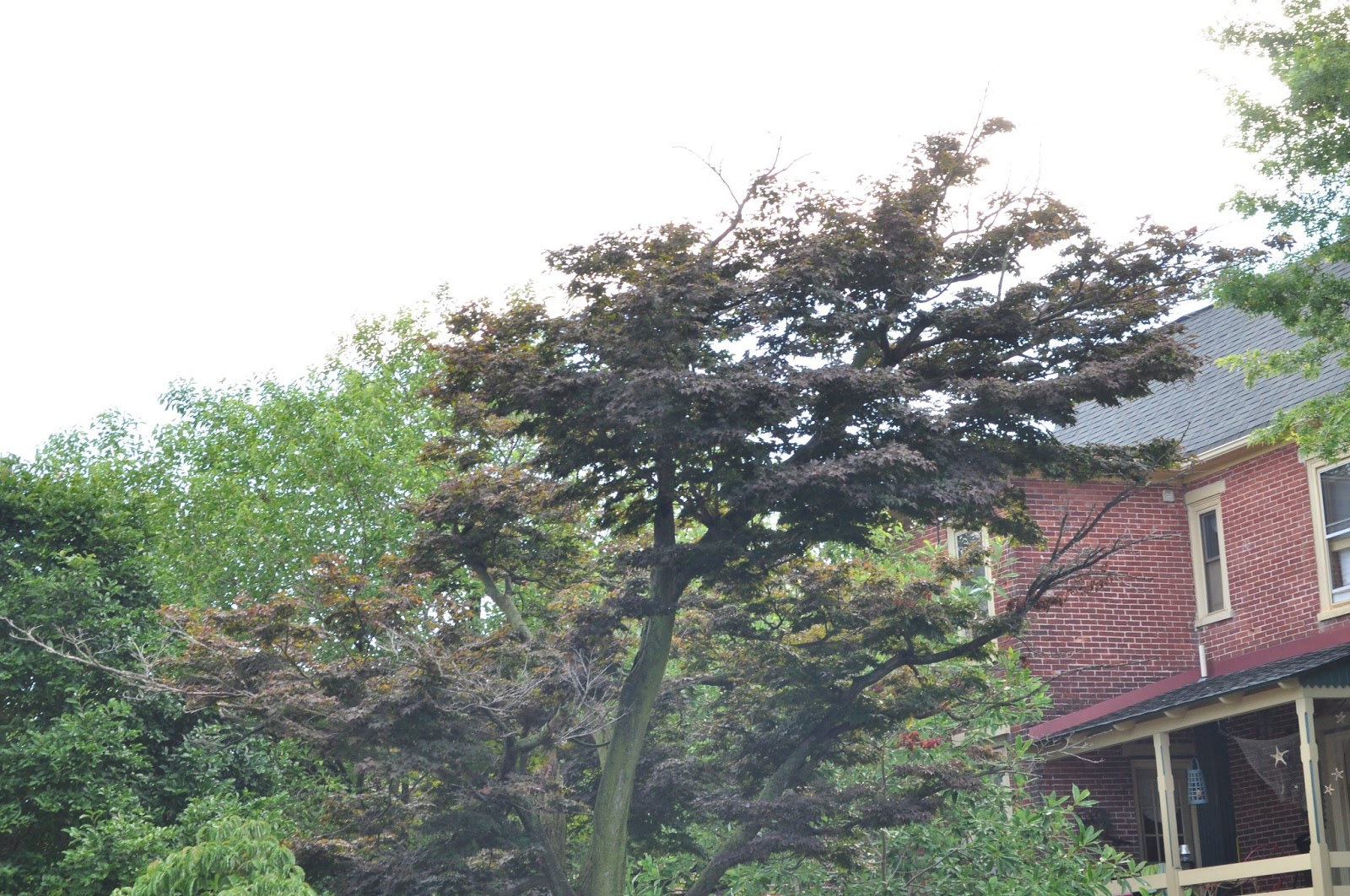
GAWD they cling to their machines too! The houses in Sophie's neighborhood are old - hers is 18th century - so it looks quiet and sleepy. But there's actually an inordinate number of recklessly speeding vehicles and noise from power equipment, which I hate. Well, and the trees are dying.
The little tree below has had all it's branches chopped off to encourage new growth.
It was stifling, sweltering hot and I went to sit on the front porch step for a rest, but the racket from mowers and hedge trimmers and even a ride-on vacuum - yes, to clean the sidewalk and curb!! - was deafening. Oops that little tree behind the one that was amputated was completely whacked.
The motorized equipment seems crazy because the lawns are so tiny they could be easily tended with push-mowers and rakes...the sidewalk could be swept with a broom and the hedges trimmed with clippers.
All that machinery was so loud I nearly was run over in the street while unloading the car, because I couldn't hear an SUV coming up behind me. Rather than slowing down (???) the driver just blasted his horn.
When things were calmer I decided to explore down this little alley across the street.
It runs inbetween the backyards of two rows of houses, where there were lots of parked cars and dying - or dead - trees. Isn't it adorable how these little concrete animals decorate this stump, wide enough for a whole menagerie? It's so large I imagine quite a few real creatures lost their home, permanently, when it was taken down.
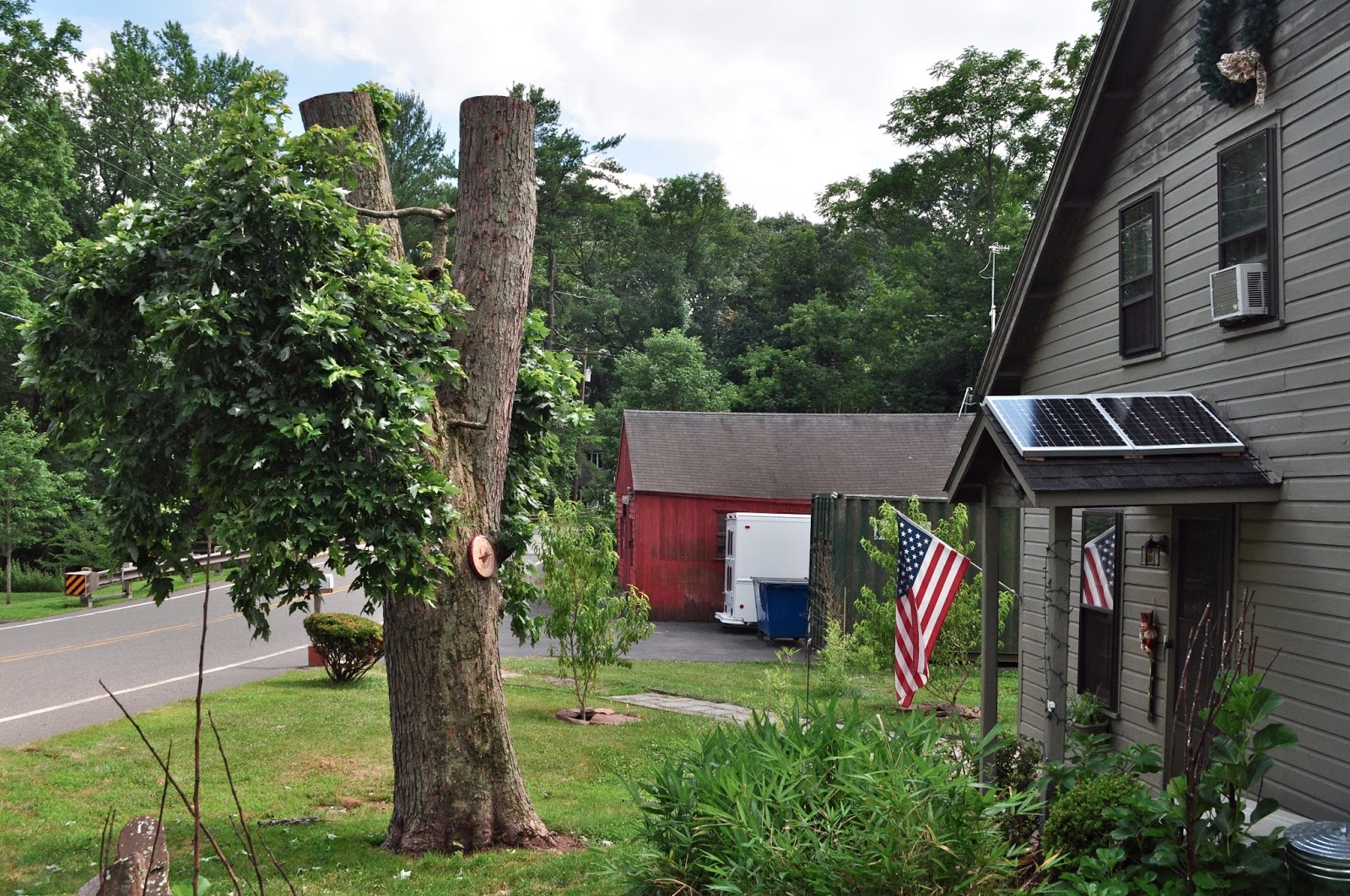
It's impossible to imagine how this neighborhood must have been so much cooler and more lovely when the old trees provided shade. This giant with it's head lopped off perplexed me.
It had some poison ivy growing up the trunk, exhibiting what I call the albino leaf that I see on all sorts of plants this summer.
I wasn't sure what kind of tree it was although I suspected a mulberry. At the house in Ipswich where I grew up, we had an old mulberry which had been planted in a prior century by a former occupant, who was a nurseryman. There was nothing left of his business but a broken-down greenhouse foundation littered with countless shards of shattered glass, a yellowed ledger found in the attic filled with spidery script notations of ancient transactions - and the mulberry. When I got home I searched online and found a paper on mulberries written by Dr. Sally Weeks, a dendrologist at Purdue. Here's what the paper says:
"White mulberry is native to China. For thousands of years, it was cultivated as the preferred food source for the silk worm. The art of silk-making spread to Japan, then to India, and eventually into Europe."
"Although earlier attempts to establish mulberry in the New World failed, it was introduced in the Long Island area in 1827, being touted by European sericulturists as the basis of a great commercial enterprise. Word spread quickly and mulberry was eagerly planted throughout the eastern United States."
Above is a photo from her paper. I still wasn't quite convinced that the tree I saw was indeed a mulberry, because the leaves weren't quite the same - so I wrote her:
Dear Dr. Weeks,
I found your guide to mulberries online and wondered if you could help me identify this attached tree. The leaves look quite like white mulberry but not exactly. If it's not mulberry do you know what it is?
Thanks so much, I appreciate any help!
Gail Zawacki
She wrote right back! With some very interesting comments:
Hi Gail,
You are correct - it is Morus alba. Hormones make trees do funky things sometimes, and the cutting of the tree has created a flush of new, vigorous growth. You really never know what shape the mulberry's leaves will be on such growth (kind of like acne on young adults - hormones can cause such things). Sassafras, as well as several other tree species, do the same.
Thanks for the email from so far away :-)
Sally
Sally S. Weeks
Dendrologist
Dept. Forestry and Natural Resources
Purdue University
West Lafayette, IN 47907
This is an intriguing point about hormones stimulating new growth, which I already knew, but making leaves different shapes is something I didn't know. The story of the silk worm industry is also critical because so many foresters make the case that invasive species are the reason trees are dying abruptly, from alien insects, disease and fungus brought in on imported nursery stock. I keep making the point here on Wit's End that nursery stock has been traded internationally for decades if not centuries, and here the mulberry is quite an example. I simply couldn't resist taking a picture of the decoration on the truck parked next to it:
The title for this post is "A Walk in the Park In the Land of the Bitterz" because one afternoon I went to a really large preserve near Sophie's house, called Tyler Arboretum. Sophie wanted me to fill her pots with heirloom tomatoes, herbs and flowers, so I accidentally found the park while looking on a map for a Lowe's, to get soil. What a discovery! It has 20 miles of trails on 650 acres but even more importantly, it's very, very old. The planting of imported trees began in the 1820's, meaning they, too silently attest that whatever is killing trees, alien species can hardly account for it.
The property runs well off this section of their map and of this, I barely went much past the stream that feeds the pond. That central area is where the largest, oldest trees are, and I took many pictures of them in between hiding from the intermittant rain. The brochure says that of the original 1,100 specimens planted between 1825 and 1876, 20 survive, in addition to five other native from the same era or possibly earlier. Their website still says that 26 survive, so obviously the number is dropping and in fact when I was paying the admittance fee, the helpful clerk took a pen and X-d out two more that fell. One, she said, was the River Birch taken out by a storm and the other, a Sugar Maple, from "old, old age". Of course, since the Sugar Maple was one of those first planted, that means it could have been at most 188 years old which is not "OLD, OLD" for a tree that can live to be 300 to 400 years old if left undisturbed, thank you very much.
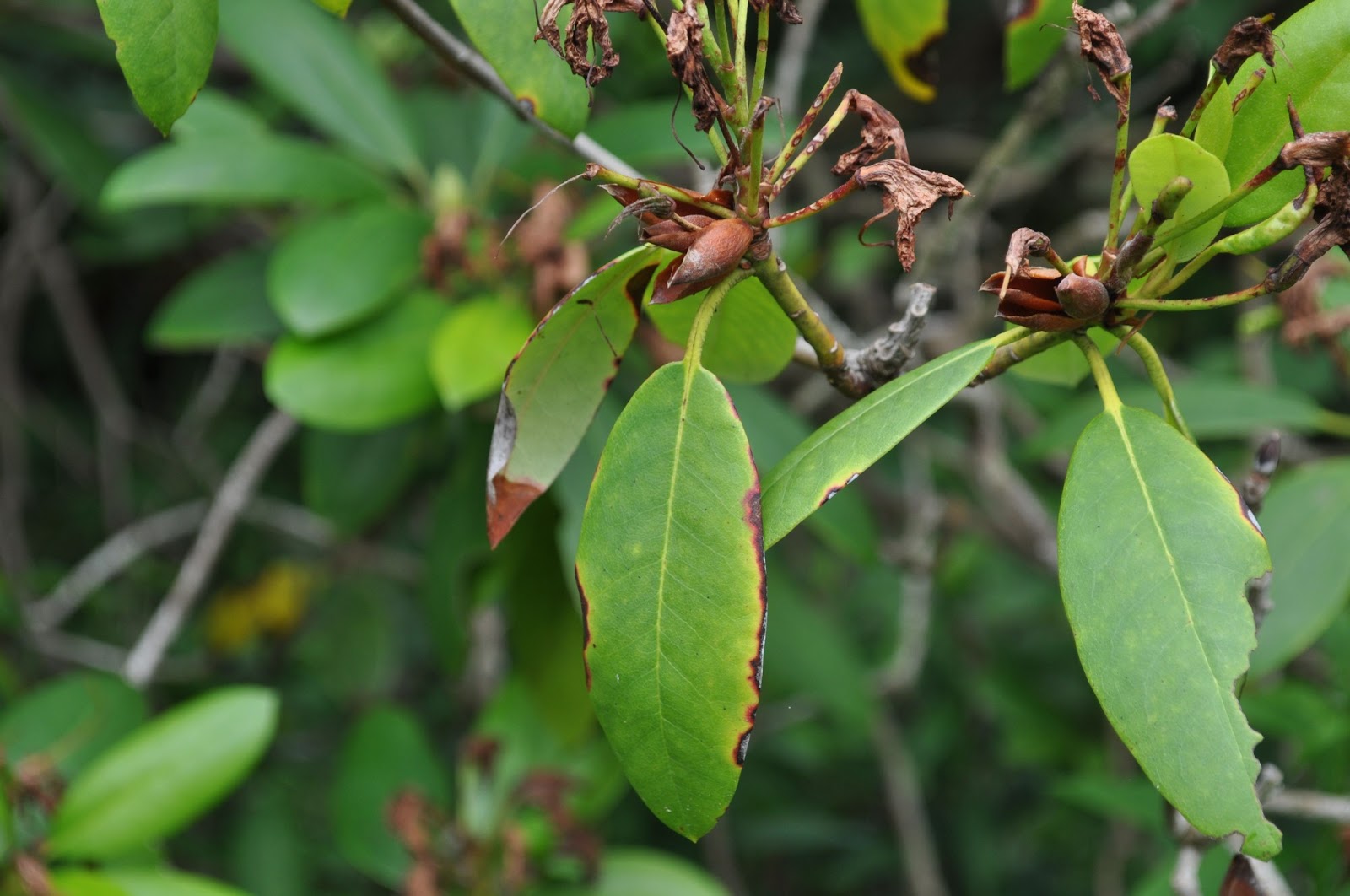
The rest of this post consists of photos of the trees, at a distance and then close-ups of the leaves or bark. It's an incredibly important exercise, because every single one of them, whether old or young, tree or shrub or even groundcover, exhibits injured foliage as of the beginning of July. The damage ranges the full gamut - spotting, chlorotic yellowing, necrosis, and leaf and needle drop. Whether you want to blame drought or climate change or invasives or pollution, this indicates a very serious trend.
Even before I went into the gift shop to buy my ticket, I could see in the parking lot that the "evergreen" shrubs were in very bad condition.
Some of them had barely any leaves left at all, and those that remained were spotted.
Some of them look burnt.
The trees are broken and thin.
Even the potted nasturtiums in the windowbox are unhealthy.
Following are some excerpts from the Arboretum website, about the history of the farm:
“There is something noble and pure in a taste for the beauty of vegetation. Thee who plants a tree plats for posterity and he who exalts it will continue to flourish long after he shall cease to enjoy his paternal fields. Let us cherish the groves that surround our ancestral mansion – look back with proud recollection and forward with honorable anticipation.” ~ Minshall Painter
"Starting in 1825 and continuing until 1876, Minshall and Jacob Painter, began collecting and planting trees, shrubs, and herbaceous plants in the valley directly behind their home and farm buildings. Their collection of plants grew to more than 1,100 specimens, planted in tidy rows that radiated out from the farmhouse. The one exception was the giant sequoia, located on the crest of the hill adjacent to Painter Road. Today, over 20 of these Painter Plants are alive, some of which are state champions. Additionally, five native trees from the Painter brothers’ era or earlier survive."
"In 1681 Thomas Minshall, an English Quaker, purchased property in Pennsylvania from William Penn that contained the site now occupied by the Arboretum. Between 1681 and 1944, the property was owned by eight generations of the same Minshall/Painter/Tyler family. Until 1944, it was a working farm and served as a summer residence for the Tyler family."
"The Arboretum itself began as the private collection of two brothers, Jacob and Minshall Painter. The brothers were fascinated by the popular 19th century study of natural history. During their lifetimes, they managed to amass large collections of dried plants, rocks, and other specimens. In 1825, the brothers set aside some of their land to begin the systematic planting of more than 1,000 varieties of trees and shrubs."
"In 1944, Laura Tyler, a direct descendant of Thomas Minshall, bequeathed the property to a board of Trustees that had been established to direct and oversee the land as an arboretum. Dr. John Casper Wister, Tyler Arboretum’s first director, was considered by many to be one of the great American horticultural figures of the 20th century. He set out to build upon the Painter legacy, whereupon he created comprehensive collections representing conifers, magnolias, lilacs, hollies, narcissus, peonies and rhododendrons."
"The primary industry in the early years of the property was the growing and harvesting of grains. Cows and pigs were raised primarily to serve the family. Enos Painter (Minshall and Jacob Painter’s father) decided to shift the farm’s production to beef and dairy cattle. To house his livestock, Enos began construction in 1833 of a massive, three-story addition to the western end of the existing barn. Built into a south-facing slope, this bank barn is believed to be one of the largest remaining in the Delaware Valley. The first floor sheltered animals; the second and third floors provided storage for hay and grain to feed them."
I read a terrific article at the UK Guardian, which I'm going to copy below. Apparently, the robots HAVE ALREADY taken over the world, we just haven't noticed, because they have cleverly mesmerized us with technological wizardry. It explains a lot:
How technology has stopped evolution and is destroying the world; Doug Tompkins, founder of The North Face, on battles with Steve Jobs and why we need to dismantle our techno-industrial society.
It has become something of a mantra within the sustainabilitymovement that innovations in technology can save the world. But rather than liberating us, Doug Tompkins, the cofounder of retail brands The North Face and Esprit, believes technology has enslaved us and is destroying the very health of the planet on which all species depend.
Tompkins, 70 has used his enormous wealth from selling both companies to preserve more land than any other individual in history, spending more than £200m buying over two million acres of wilderness in Argentina and Chile.
He challenges the view that technology is extending democracy, arguing that it is concentrating even more power in the hands of a tiny elite. What troubles him the most is that the very social and environmental movements that should be challenging the destructive nature of mega-technologies, have instead fallen under their spell.
"We have been poor on doing the systemic analysis and especially in the area of technology criticism," says Tompkins, who has been deeply influenced by former Norwegian philosopher Arne Naess, who called for a dismantling of the techno-industrial society.
"Until we get better at that, I think we're cooked, we're going to continue to extinct species and we're going to continue to dig the hole deeper of the whole eco-social crisis.
"If you just hold your cell phone for 30 seconds and think backwards through its production you have the entire techno-industrial culture wrapped up there. You can't have that device without everything that goes with it. You see mining, transportation, manufacturing, computers, high-speed communications, satellite communications, it's all there, you see and it's that techno-industrial culture that's destroying the world."
Championing the environment
Tompkins is considered a hero in the deep ecology movement and works hand in hand with his wife Kris, the former CEO of the outdoor clothing and equipment company Patagonia.
Amelanchier Canadensis
They have been instrumental in creating two huge nature reserves and are in the process of creating another one in the South American region of Patagonia, despite opposition within Latin America, including being accused by rightwing Chilean politicians of effectively splitting the country in two in a conspiratorial land grab.
Too many standing dead trees to keep up with removal!
Together, they also fund numerous small activist NGOs, arguing that more established organisations such as WWF and Greenpeace have become too closely enmeshed with corporations.
Bark falling off Cedrus atlantica
"When WWF started out, they were doing some good stuff," says Tompkins. "Now, they're burning up money like crazy and they don't really get too much done. Most all of these organisations grew too big for their own good and the small scrappy organisations are the ones who are really getting things done on the ground."
Cedrus libani
Tompkins derides those who pin their hopes on technological developments in areas such as wind, solar and nuclear as coming from the smart resource management school, saying they fail to understand that this will not address the core issue, which is that capitalism is addicted to growth.
One of the original Painter trees - imported from Asia Minor
"Resource efficiency is the wrong metric," he says. "We should use nature as the measure, using nature's wisdom as a template for our economic systems.
The sign says in ancient times these trees covered the hillsides of the eastern Mediterranean but almost all were cut for ships and building materials.
"Capitalism doesn't function when it starts to contract and we can see that quite clearly right here in the eurozone. It's like pushing a giant monster underwater that's gasping for air. It goes nuts. Capitalism may have all sorts of things that are good, but ultimately it's bad for everyone."
Mahonia bealei
He believes most sustainability practitioners have made the mistake of spending their time creating strategies and projects, without taking the time to gain a deep understanding of how we got into a mess in the first place. As a result, they may end up doing more harm than good.
"As we get sucked more and more into the technosphere, we become less and less capable of understanding it because it becomes a technological milieu that we're in," he warns.
"It's similar to air; we're basically unconscious about the air. What we need is to understand what technologies themselves bring with them when they're introduced into culture.
"If you extinct all the biodiversity and we end up living on a sandheap with a Norwegian rat and some cockroaches, that doesn't have too much logic to it. That would show that our behaviour as a civilization today is to the pathological. But, if you make a systemic analysis, that's exactly where we're going."
A strategic embrace, not a substantive embrace
Tompkins was a friend of Steve Jobs and the two men had many arguments over the years, with the former Apple CEO trying to convince Tompkins that computers were going to save the world, and Tompkins insisting the opposite.
Tompkins recalls the Apple advertising campaign that highlighted the 1,001 great things that the PC was going to give to us and would tell Jobs that these represented a mere 5% of what the computer did while the other 95% was all negative and exacerbating the biodiversity crisis.
"He'd get mad at me when I'd tell him that," says Tompkins.
"He was locked into a view that these technologies were going to bring all these good things. But that's typical of the purveyors of new technology. They're selling their product and their idea, and their prestige, their power and their influence. Their self-esteem is wrapped up in that. It's impossible for them to see it or to admit it, you see? Because, it pulls the rug out from underneath their purpose, especially when it's attached to a moral purpose.
"That's typical of everybody who introduces a new widget into society. They don't tell you the negative side effects that this introduction of this new invention could provoke."
While there has been much talk of the democratisation that the internet has brought, Tompkins points out that while individuals use it largely for their own narrow interests, large corporations are the big winners as they are able to take advantage of it to become ever more powerful.
Boxelder - Acer negundo
Tompkins also warns technology has become omnipresent and describes how he felt coerced into buying a laptop after recognising that he was becoming increasingly marginalised.
Ulmacaea
"I did not want to compromise my engagement so I was forced to use the very technology that is undoing the world," he says. "I have a strategic embrace, not a substantive embrace. The problem is that 99.9% of the people in our own movement love this thing, they think this is going to lead us to the promised land. I have no such pretensions."
Is technology stemming evolution?
Rather than adding to our knowledge, Tompkins argues computers and smartphones represent "deskilling devices; they make us dumber. We're immersed in a system that now requires the use of a cell phone just to get around, just to function and so the logic of that cell phone has been imposed on us.
"The computer is a mechanism for acceleration, it accelerates economic activity and this is eating up the world. It's eating up resources, it's processing, it's manufacturing, it's distributing, it's consuming. That's what the computer's real work does and it does that 24/7, 365 days a year, non-stop just to satisfy our own narrow needs."
Cucumber Magnolia - one of the original Painter trees, thick with lichen.
Tompkins foresees a dark future dominated as he puts it by more ugliness, damaged landscapes, extinct species, extreme poverty, and lack of equity and says humanity faces a stark choice; either to transition now to a different system or face a painful collapse.
"Of course I'd prefer the transition, because a crash will be highly unpredictable," he says. "It could exacerbate something terrible.
"The extinction crisis is the mother of all crises. There will be no society, there will be no economy, there will be no art and culture on a dead planet basically. We've stopped evolution."
Ginkgo biloba - it dwarfs the family home Lachford Hall, named for the town in England from which the family emigrated in 1681.
This trunk is 21 feet in diameter.
Ginko's are the oldest living species of tree - fossil records date back 150 million years. Think about that. Genetically the same tree has survived many climate changes and weather extremes. So why are they dying now?
An article from 2008 published in Urbanhabitats - an electronic journal on the biology of urban areas around the world says that what is described as an ongoing study by the University of Virginia had already found that ozone is causing the demise of native species, allowing for an increase in invasive species. This certainly deserves followup, but at that time, this is what the researchers had found:
Elevated Ozone Levels May Lead to Strengthened Invasive Species in Urban Forests
by Eric E. Elton
"Without notable advances in the protection of forests against the stresses caused by air pollution and the advance of invasive species, it is likely that dramatic diebacks and species shifts will occur in urban ecosystems. Yet very few scientists have concentrated on both air pollution and nonnative species and how they combine to weaken forest ecosystems. In an effort to delve deeper into this issue, the Department of Environmental Studies at the University of Virginia has undertaken an ongoing study of the effects of ground-level ozone (O3) on mid-Atlantic urban forests. Their preliminary data suggest that some important native species (e.g., Acer rubrum, Liquidambar styraciflua, Celtis occidentalis,Quercus rubra) are less equipped to defend against oxidation reactions generated from elevated ozone levels than common invasive species (e.g., Ailanthus altissima, Morus alba, Paulownia tomentosa)."
Acer saccharum above the spring house
"Ground-level, or tropospheric, ozone is the main constituent of industrial smog; the gas is formed by a chemical reaction of nitrous oxides (nitrogen dioxide, nitric acid, nitrates, nitrous oxide) and volatile organic compounds (benzene, formaldehyde, toluene) in the presence of sunlight."
The spring house was the original source of water for the farm and a refrigerator. The water was pumped to a cistern above the house, which supplied running water through underground pipes.
"When the stomata of a plant are left open for gas exchange, ozone enters the stoma cavity and oxidizes the mesophyll cell wall, creating increased permeability of the cell wall and making the cell more vulnerable to injury. Oxidation damage in a leaf results in decreased plant performance and growth after repeated exposures. The UVA study has so far focused on leaf injuries caused by ozone damage in native and invasive trees at nine forested sites within three major East Coast cities, Washington, D.C., Baltimore, Maryland, and Philadelphia, Pennsylvania."
"Within each city, UVA scientists chose three separate sites on the basis of their relative annual concentration of ground-level ozone, with thresholds set at: low (0–79 ppb), medium (80–99 ppb), and high (100–125+ ppb). In determining these concentration thresholds, the scientists assumed that the low levels would not injure plants, medium levels would injure only ozone-sensitive plants, and high levels would harm all but the most ozone-tolerant plants. They also assumed that high pollution levels would selectively eliminate pollution-intolerant species while augmenting establishment of pollution-tolerant species; and that forests in low-pollution areas would not have experienced this disturbance and would therefore retain native intolerant species, thus reducing the number of invasive plants that were able to establish there."
Figure 2: Nine urban forested sites are used to compare ozone damage along an ozone level scale.
"The study's preliminary results indicate that as ground-level ozone concentrations increase in forest settings, the native flora presence decreases, while the density of invasive species actually increases. One example of this trend shows the density of the common invasive tree of heaven (Ailanthus altissima) increase in abundance from low sites to high sites, while the native green ash (Fraxinus pennsylvanica) decreases in overall abundance. Early data also suggest that the native species studied have a greater incidence of ozone-induced oxidative injury than the invasive species. Across all sites, the plants at low-ozone-level sites experienced less overall injury than those at high concentration sites."
"Native species are known to be less adaptive to changes in environmental conditions, while invasive species often cope with changes by reallocating resources and out-competing native counterparts. The ruderal nature of most invasives gives them an inherent advantage over those natives that are not able to adapt to phytotoxic gas increases."
That stump is the "old old" maple that died and was X'd out of the brochure.
"It is clear that some plant species exhibit more tolerance to oxidative damage than others (e.g., Prunus serotina is more tolerant than Fraxinus americana), which may be due to the function of leaf chemicals. The most important chemicals in determining the injury a plant will suffer are antioxidant chemicals. Some species produce large amounts of antioxidant chemicals (e.g., ascorbate, glutathione, superoxide-dismutase, peroxidase, polyamines, carotenoids, α-tocopherol), which may decrease initial injury in active oxygen species and reduce the recovery time from injury. I plan to undertake a comparison of the leaf chemicals of congeneric native and invasive plants, as well as those of invasives and natives found in the same wooded locales. Developing an understanding of how leaf chemicals are involved in oxidative injury will illuminate their role in the interplay between air pollution and invasive ecology."
"The EPA is currently considering amendments to national air quality standards for ground level ozone levels in order to address the issue of vegetation damage. Dating back to 1985, European agencies like the United Nations Economics Commission for Europe established the International Co-operative Programme Forests group to prevent another major forest dieback. However, the EPA's proposed work with regard to ground-level ozone and the European resolutions addressing ozone-forest interactions fail to recognize and assess the role of invasive species, as these issues are commonly dealt with separately. The UVA study clearly suggests that increased levels of air pollution lead to increased populations of invasive species—tying the two issues together quite strongly. In order to ensure that our forests persist intact into the future, scientists and regulators must begin to tackle the hazards of air pollution and invasive species in tandem."
NOTE: The Obama administration refused to allow the EPA to amend AQ standards to protect vegetation from damage.
Figure 3: Prunus serotina showing typical stipple damage due to high levels of ozone exposure. (Photo courtesy of Schaub, M., Jakob, P., Bernhard, L., Innes, J.L., Skelly, J.M., Kräuchi, N. 2002. Ozone injury database.http://www.ozone.wsl.ch. Swiss Federal Research Institute WSL, Birmensdorf
The photo above is from a Swiss ozone research site that has many photos, and details fumigation experiments. The most recent papers published is from 2003. It makes me kind of crazy that everyone seems to have pretty much just closed up shop - but then it doesn't seem to take much to make me crazy these days. I couldn't find any links to the "ongoing" research at the University of Virginia so I wrote to the thesis advisor of the author to see if they just gave up too. Here is his answer (RATS):
Gail,
Eric successfully defended his dissertation, but, unfortunately, he has not published any of it. His dissertation is available from UVa, but you should remember that it has not been truly peer-reviewed at this point.
David Carr
Wait here's a cartoon break before the next dying tree story!
The seeds on the maple are turning brown on the tree before falling off. How viable is that?
It really takes no effort at all to find stories about "new" tree disease epidemics, they are everywhere. This one is from the UK, about dying oaks. Their photo of bleeding bark is, unfortuanately, all too familiar.
Caption: An oak showing symptoms of stem bleeding – dried fluid crusted in bark splits. Photograph: UK Forestry Commission
Acute oak decline disease prompts £1.1m research effort
Project aims to understand distribution and severity of mystery disease causing Britain's oak trees to 'bleed to death'
"A mystery disease causing Britain's oak trees to "bleed to death" has prompted a £1.1m research effort to identify its cause."
"The government-funded project aims to understand the distribution and severity of acute oak decline (AOD), a fast-acting disease that can lead to the death of an oak tree within three to 10 years of infection. AOD, first observed in the 1980s, is affecting several thousand oak trees across East Anglia, the Midlands and south-east England, but scientists do not know what is causing it.
Dr Sandra Denman, lead scientist on the project to identify its cause, said: 'AOD is a serious problem for both of Britain's native oak trees. Oak is our most important native broad-leafed tree species and is iconic to Britain.'"
"Dr John Morgan, head of the Forestry Commission's plant health service, said: 'We are determined to do everything possible to protect our trees. AOD is a complex condition, and this new Defra funding will enable us to better understand the condition and the number and distribution of trees affected.'"
"At a biosecurity summit last week, the environment secretary, Owen Paterson, called for a united front against tree diseases: 'It is clear that it is only by working together that we can do our best to protect our plants and trees,' he said."
"Denman said the causes of AOD were complex, and two of the bacteria that had been isolated were unique to the diseased trees. Her team also found AOD coincided with the oak jewel beetle, Agrilus biguttatus, being found within the trees. She said: 'Thus a key research question is to determine the relationship between the beetle and the bacteria.'"
"Brian Muelaner, an ancient tree adviser at the National Trust, said: 'The disease can be seen on affected trees as a black, tarry-like resin bleeding from the tree bark. The tar forms as the tree floods the infected area with sap to make anaerobic conditions to kill the infection.'"
Research reported in Scientific American that is concerned about invasive mammals reveals, somewhat tangentially, that trees are producing crops of seeds more frequently. Naturally they blame it on climate change but can't even agree on whether it is temperature increase or temperature swings. Maybe it's because all the trees are dying from pollution, and when trees are prematurely in decline they throw more energy into reproducing? Hm?
"The study relied on masting and climate data going back to the 1970s, focusing on masting in New Zealand’s Orongorongo Valley beech trees. Masting used to happen once every six or seven years, Daniel Tompkins, research leader of Landcare Research’s Wildlife Ecology and Management team, says, but in the past decade, the average has been every three or four years."
"Dave Kelly, an ecologist at the University of Canterbury in Christchurch, warned against overgeneralizing Tompkins’ findings. Slight changes in temperature—even a gradual increase—are unlikely to affect masting frequency, he argues. Instead, climate change could have an impact by causing more extreme events, like extremely hot or cold temperatures, which could lead to more frequent masting in New Zealand—and around the world. 'As long as other parts of the world have plants that use the same cues, [the findings] should be generalizable,” he adds. “I would be surprised if our climate cue mechanism was not found widely outside New Zealand.'"
Trident Maple - Acer buergerianum
Here's a perfect example of extraordinary seed production in this fairly young Trident Maple:
This fabulous sculptural relic is listed in the brochure even though it's been long dead.
The brochure says: "Osage Orange - Maclura pomifera - Although this tree fell in 1954, it has resisted decay because its hard wood contains a naturally occurring checmical that is toxic to fungi. Natve to the Ozark Mountains the resilient wood was used by the Osage Indians to make bows. Female trees bear a yellow-green fruit that resembles a large bumpy orange."
I love the shape so much I made a black and white version:
Ugh. Beyond the osage orange, you can see a tuliptree with a painfully thin crown.
Worse still, the dignity and grace of this venerable specimen has been ruined by the construction of a "bell house" by a sadly misguided architect.
It looks as constricting as a corset or maybe even that horrible iron mask in Django Unchained. Visitors are encouraged to amuse themselves pulling on ropes to ring bells. In fact an entire network of garishly ugly "amusements" have been scattered around the arboretum, which claims on its website that the installation of "Totally Terrific Treehouses" increased visitorship (and presumeably revenue) by 400%.
Because Americans won't go just to, you know, appreciate Nature without some kind of Disneyesque enhancement.
One of the least offensive is this set of oversize chairs. The scale is deceptive; three people could easily sit side-by-side on the largest, and it's taller than I am.
Pinus strubus
So the tree looks much smaller than it really is. Looking up, it's too transparent.
A new study - Modeled PM2.5 removal by trees in ten U.S. cities and associated health effects - prompted another round of email inquiries, but in order to follow the exchange we have to backtrack to an earlier message:
From: Wit's End [mailto:witsendnj@yahoo.com] Sent: Thursday, January 17, 2013 2:07 PM To: Liebhold, Andrew -FS Subject: Re: insects in the forest
Hi Sandy,
I see from this article that you collaborated on a study:
"Although the study shows the association between loss of trees and human mortality from cardiovascular and lower respiratory disease, it did not prove a causal link. The reason for the association is yet to be determined."
I don't suppose that could be because trees are absorbing (and dying from) ozone which would otherwise be killing people?
The case is growing stronger.
Regards,
Gail
From: "Liebhold, Andrew -FS" <aliebhold@fs.fed.us> To: Wit's End <witsendnj@yahoo.com> Sent: Thursday, January 17, 2013 5:17 PM Subject: RE: insects in the forest
Bottlebrush buckeye - Aesculus parviflora
Hi Gail – That’s an interesting thought about trees and ozone. In the case of emerald ash borer, vast numbers of trees are dying in urban and semi-urban areas as a result of this invading insect species. My personal guess is that the dying trees cause substantial level of anxiety among residents in these areas and that the cardiovascular symptoms are related to that anxiety. I’m certainly not an expert on medical matters but I understand that relationships between anxiety and these sorts of disorders are known to exist. Nevertheless, I would acknowledge that there might be other possibilities too….
-Sandy
From: Wit's End [mailto:witsendnj@yahoo.com] Sent: Sunday, July 14, 2013 10:23 AM To: Liebhold, Andrew -FS Cc: Donovan, Geoffrey H -FS; Nowak, David -FS Subject: Re: insects in the forest
Sweetgum - Liquidambar styraciflua
Dear Sandy (and Dr. Donovan and Dr. Nowak),
In light of Dr. Nowak's study (link and abstract below), is it possible to say that the reason your study showed more people died prematurely in neighborhoods where trees had been removed is because trees absorb pollution...and not because their presence "relieves stress"?
Although Dr. Nowak's study is confined to particulate pollution, it seems that it would be at least as true for ozone. And perhaps that would pave the way to understanding why so many (all, basically) trees are dying prematurely.
Abstract: Urban particulate air pollution is a serious health issue. Trees within cities can remove fine particles from the atmosphere and consequently improve air quality and human health. Tree effects on PM2.5 concentrations and human health are modeled for 10 U.S. cities. The total amount of PM2.5 removed annually by trees varied from 4.7 tonnes in Syracuse to 64.5 tonnes in Atlanta, with annual values varying from $1.1 million in Syracuse to $60.1 million in New York City. Most of these values were from the effects of reducing human mortality. Mortality reductions were typically around 1 person yr-1 per city, but were as high as 7.6 people yr-1 in New York City. Average annual percent air quality improvement ranged between 0.05% in San Francisco and 0.24% in Atlanta. Understanding the impact of urban trees on air quality can lead to improved urban forest management strategies to sustain human health in cities.
Magnolia tripetata
From: Donovan, Geoffrey H -FS Sent: Monday, July 15, 2013 11:50 AM To: Wit's End; Liebhold, Andrew -FS Cc: Nowak, David -FS Subject: RE: insects in the forest
No. Neither of these studies say anything definitive about the mechanism linking trees to health. We need some experimental work to illuminate this relationship. However, I think that it’s extremely unlikely that there is only one mechanism mediating such a fundamental relationship.
From: Nowak, David -FS Sent: Monday, July 15, 2013 9:21 AM To: Donovan, Geoffrey H -FS; Wit's End; Liebhold, Andrew -FS Subject: RE: insects in the forest
FYI - The PM2.5 paper has mechanistic links in that it links trees to changes in pollutant concentrations and links changes in concentration to human health. It may not be definitive, but there are mechanistic links or associations (unless I am misunderstanding what you are stating in relation to links)
You’re right, there are certainly plausible mechanisms linking trees to better air quality and in turn to better health. However, we don’t know for sure that this is the link, and we certainly don’t know that air quality is the only link. The public-health folks get really hung up on this. I’m a bit more sanguine, but I know what will happen if we say that we understand the mechanism linking trees and health. It’ll involve pitchforks and flaming torches, and it won’t end well for us.
What can I say - scientists are reticent and no doubt for good reason. And they don't seem to agree with each other. In this review at Grist, which includes a quote from a coauthor, the link is unequivocally made:
Beech
Study: Trees save at least a life a year in each of 10 major U.S. cities
"Next time you hug a city-dwelling tree, be sure to whisper quiet thanks for the lives it is helping to save."
"Researchers recently calculated that urban forests help save one or more people from dying every year in each of 10 major cities studied."
"Trees growing in cities help clean the air of fine particulate air pollution — soot, smoke, dust, dirt — that can lodge in human lungs and cause health problems. Trees clear 71 tons of fine particulate matter (PM2.5) from Atlanta’s air annually. And they suck up enough pollution to save seven or eight lives every year in New York City.
Sweet Birch - Botula lenta
"These are the findings of researchers with the U.S. Forest Service and Davey Institute, published in the journal Environmental Pollution[PDF]. They calculated the health and economic benefits of air-cleansing urban forests in 10 U.S. cities and found that trees save lives, reduce hospital visits, and reduce the number of days taken off work. They do that mainly by sucking pollutants out of the air. Economic benefits, mostly from reduced mortality, ranged from $1.1 million a year in Syracuse, N.Y., to $60.1 million a year in New York City.
Overall, the greatest effect of trees on reducing health impacts of PM2.5 occurred in New York due to its relatively large human population and the trees’ moderately high removal rate and reduction in pollution concentration. The greatest overall removal by trees was in Atlanta due to its relatively high percent tree cover and PM2.5 concentrations."
Paperbark Maple - Acer Griseum from Central China
"And these findings cover only the effects of cleaning up fine particulate pollution. The study didn’t investigate the economic and life-giving benefits of trees sucking up larger soot particles, ozone, sulfur dioxide, nitrogen dioxide, or other types of air pollution."
“'This research clearly illustrates that America’s urban forests are critical capital investments helping produce clear air and water; reduce energy costs; and, making cities more livable,' Forest Service researcher Michael Rains said in the press release."
"The study comes after some of the researchers’ Forest Service colleagues discovered a correlation between loss of trees and higher human death rates, which they described in the American Journal of Preventive Medicine. As we told you last week, the scientists found that the more trees there are in an area, the less likely people there are to die.
In at least one instance, as reported by the BBC in June 2011, it turns out that an invasive bug had been lurking for much longer than assumed, and only recently began to cause signficant damage (the wooly adelgid killing hemlocks in the US is another).
"'It is a moth that has been the target of a lot of research recently because it has been expanding [its range] so fast - much faster than other kinds of leaf-mining moths,' explained co-author David Lees from the French Institute for Agricultural Research (INRA)."
"The larval form of the Cameraria ohridella moth feed inside the leaves of the white flowering horse chestnut tree (Aesculus hippocastanum), producing characteristic "mines" between the leaves' veins."
The pond is scummy and the water lily leaves look just as bad as leaves on trees.
"The creatures do not kill the tree but infested trees may produce smaller conkers."
"Dr Lees said C. ohridella was spreading its range by about 60km (40 miles) across Europe each year."
Vernal Witchhazel - Hamamelidaceae
"The small but highly invasive moth was first discovered in 1984, and first described by scientists as a genus new to Europe in just 1986. Since then, it has expanded its range across almost all of Europe."
"'We recently marked the first quarter century of this blight on horse chestnuts and it is quite amazing that during this time its origin has remained a mystery," noted Dr Lees, a scientific associate with the Natural History Museum in London.'"
Unbelievable
"'We decided to look at whether specimens of the moth appeared in herbarium collections, so I contacted (co-author) Walter Lack at Berlin Botanic Garden, who had been studying the history of this tree in Europe.'"
"'I asked him whether he had come across any mines in his historic herbarium collection. He wrote straight back and said that he did have some, which had been collected in 1928 in Albania. He said that there were spots on the leaves but he had no idea what they were.'"
"Dr Lees admitted he was very excited when he examined photos of the specimens and saw the outline of a caterpillar mine."
"'That's when we started to look more widely,' he went on. 'I went to Kew Gardens (London) and as I was looking through the herbarium there I found a specimen from 1879 which had mines in it. We just could not believe it.'"
"They also found examples of leaf miners on collections in Paris."
"Dr. Lees said some of samples of leaf mines had been hidden, as the result of proud botanists attempting to disguise blemishes on their prized leaves."
"He also felt there was another reason why the discovery had not been made before: "'Disciplines stick to what they know best so entomologists would not necessarily go to herbariums.'"
"He explained that the tree has been transported from its native Balkan range and planted throughout Europe since the late 16th Century, so mystery had surrounded why the moth had not 'caught up with its dinner sooner'."
"'We know that this moth has been distributing very fast since the last 1980s, ever since it somehow got to Austria,' Dr Lees said."
Tuliptree - Liriodendron tulipifera
"The arrival of roads in areas within the moths' original range played a part, he suggested."
"'The pupae hibernate in the mine (on a leaf), and they are able to be transported in trucks.'"
The tree set back in the center is a Yellow Buckeye - Aesculus flava
"Before this, the distribution was unlikely to have be widespread because the moths were not able fly far enough to extend their range."
Many of its leaves are turning yellow
Did you catch that? It's now discovered that the moths were found in London and Paris in the 19th century, but it's because of trucks that they have suddenly spread and become such a problem? Or, maybe their population is expanding suddenly because the trees are weakened from pollution?
From under the Buckeye, the yellowing leaves are backlit like little lanterns.
In the nature of man, we find three principal causes of quarrel. First, competition: secondly, diffidence: thirdly, glory. The first, maketh men invade for gain: the second, for safety: and the third, for reputation.
~ Thomas Hobbes, Leviathan, 1651.
A young Red Horse Chestnut - Aesculus x carnea
We are only about halfway through our walk through the land of the Bitterz so rather than post more tree stories I am going to expound on my latest frustrations (because why not it's my blog, eh?)
Once the mind is open to the distinct probability that humans are rushing willy-nilly into the arms of extinction, a number of questions seem to arise, and the desire to find answers is powerful. Is there anything we can we do to stop this? If we can't stop it, what should we do instead?
^lichen^
Once the overwhelming evidence for the inevitability of, at the very least, totally catastrophic results of overpopulation, overshoot, pollution and climate change cannot be denied - in other words, once it is acknowledged that it is already too damn late - the next question often is, When did it become to late - was it always inevitable? Is it encoded into our DNA to self-destruct? Is it a law of the universe for intelligent life to cleverly overshoot resources and implode? Why why why???
A grove of White Oaks - Quercus alba
This is the path down which many - most? - people cannot bear to tread, and the efforts they make to veer away, no matter how absurd, are myriad. The squirming gyrations to avoid the obvious knows no bounds.
“I believe that imagination is stronger than knowledge. That myth is more potent than history. That dreams are more powerful than facts. That hope always triumphs over experience. That laughter is the only cure for grief. And I believe that love is stronger than death.”
~ Robert Fulghum
I had never heard of Fulghum although it turns out the title of his book "Everything you ever needed to know you learned in Kindergarden" was familiar to me - and the junk intellect it reveals is precisely WHY I never bothered to learn who the author was. Anyway this was so I could not resist replying:
Okay, now that is one of the most inane, hilariously vacuous things I’ve read in a long time. Even wiki calls that book “trite and saccharine”.
Well, what do you expect from a guy with 4 children and 9 grandchildren…one home in Seattle and one on Crete.
There’s a guy with a low carbon footprint and a love for ecology.
Later after being admonished for that, I added: Tender and hopeful feelings are great unless they are delusional. Then they lead to stupid and self-destructive and short-sighted behaviors – like trashing the environment and having too many children.
Besides, what Fulghum wrote doesn’t even make any sense! How can imagination be stronger than knowledge…what does that even mean? Ditto for dreams being more powerful than facts – tell that to Mother Nature when climate change goes exponential. Isn’t this blog called Nature Bats Last – NOT “Dreams Bat Last”?? Hope most certainly DOES NOT always triumph over experience…if it did I would be filthy rich and have a yacht, or maybe a house on the lovely island of Crete that I could fly to every few months and have that not even be a bad thing. I could have nine grandchildren and not worry about them starving to death, too!
Love is stronger than death? What kind of ridiculous idea is that? Is it stronger than NTE too??
I’m all for love – I’m all for laughter. It’s DUMBNESS that bothers me and that entire passage is sophomoric, it’s cretinous even. It’s so annoying that now I’m sounding like ulvfugl on a tear.
Speaking of laughter - comic break courtesy of DesdemonaDespair:
Back to Near Term Extinction and how to pretend it's not happening.
Somehow I have managed to squander several days down a particular rabbit hole that began with an innocent enough search for "Richard Dawkins + racist" after I read a comment that he was. That swiftly turned up his tweet about Elevatorgate, an infamous incident that began with a youtube video posted in 2011. I saw it at the time and promptly forgot it, but it turns out that the controversy it initiated has played on…and on and on. I never suspected that there were so many people immersed in atheism, that there are meetings and organizations galore. I knew there were books - here's an excellent reading list about it - but didn't realize it is so all-consuming to so many people on a daily basis. In that sense, I can see where the accusation that atheism is a religion arises although obsession might be a better description.
Is this because atheism is supposed to save the world? Because our foolish tendency to "believe" is a fatal flaw?
One of the most astonishing aspects of the flame war I'm about to describe, which seems hugely disproportionate to the instigation (but that's always the way when it is a stand-in for deeper issues, I guess), is that even though it is being conducted by obviously well-educated people, there is almost never a mention of climate change unless it's used in the context of a sardonic taunt, such as "He probably thinks he'll save the world from climate change by buying an overpriced tote bag made out of a recycled sail." Just as people who are aware of climate change waste time in squabbling endlessly online with deniers who will never be convinced they are wrong no matter how violent the weather, these people seem to avoid even talking about the subject. At any rate, they spend so much energy bickering over trivia they can't possibly have much time left over to worry about ecopocalypse.
Swamp White Oak - Quercus bicolor
This schism between factions of the atheist/sceptical/secular community, however you wish to label them, is another ludicrous and discouraging example of the utter futility of any real cooperation between people - certainly anything significant and sustained enough to accomplish real progress.
This kind of oak likes to grow in wet places, like above this stream. Since it's a native spcies and not mentioned in any records, it was likely already growing when the Painters began planting.
Just as the explosion over feminism which erupted spontaneously and so unexpectedly at the Four Quarters conference demonstrated, some of the very people who claim to be the most rational and reality based are absolutely no more reasonable, empathetic or even intelligent (though they might be more glib) than the unabashed fundamentalists.
Corsican Pine - Pinus nigra. Subspecies of the Austrian Pine, native to eastern Europe.
This seems to be especially so when it comes to feminism. The amount of vitriol and intolerance on all sides is so astounding that it's quite possible to read reams and reams of comment threads and never have any idea who has the moral highground and who is perversely wrong. Maybe they're all at fault - yeah, that's it. The personal invective is cringe-inducing, the hyperbole is overblown and the jeering and swearing is prodigiously crude - and not only between the feuding sides but there is internecine carnage within the fold of each. Jeez!
In the wreckage of Elevatorgate, the faction that was ostracized from the main collection of atheism's most influential bloggers, (who are linked under the umbrella Free Thought Blogs) started their own forum, affectionately dubbed the Slyme Pit. Truthfully though, sometimes it is also funny, which is why I've read far more of the banter than I should have and also there are all sorts of irresistably silly videos and photoshops. It appears the standard welcome to newcomers is "Fuck You", so be prepared if you decide to join - also please send me a penny every time you see any of the following words: victimhood privilege harrassment bullying objectification or rape, plus any sort of profanity. And then I will be rich.
So much of the chaotic rift and turmoil seems to derive from the most petulant resentments of being banned from comments on blogs, ostensibly due to rudeness, personal insults both real and imagined, and some even manufactured by trolls or at least accusations of such.
Sawara False Cypress - Schamaecyperis pisifera
From Japan and barely alive anymore
not even one of the park's tallest, look at the bench underneath
When I lived in California I often was often exasperated by West Coast people, who had a penchant for complaining about the East Coast, which was denigrated for thinking they were superior and mired in class distinctions. What they failed to see was that people on the West Coast were just as obsessed with status, they simply expressed it differently. I worked in a post corporate office around the time that everyone started inflecting up at the end of a declarative sentence, which was tremendously annoying. It caught on like wildfire and I never met a single person who wondered why. I couldn't help but feel a preference for the unapologetic and blatant snobbery more prevalent on the East Coast than the hypocritical, reverse holier-than-thouism of the West - but that's probably just because it's what I am used to.
More recently, since becoming part of quite a few organizations and protests, I came to the conclusion that the same inescapable preening and petty self-aggrandizement explain the adject failure of the climate change/environmental movements to coalesce long enough to make any sort of impact.
Magnolia sprengeri native to Central China
An anonymous commenter at DOTE described this so concisely, I'll reprint it below:
"The key driver for the behavior of human beings, like all social primates, is status. Greed, aggression, violence, deception are almost always employed in the act of gaining or maintaining status."
"This is because status is the key element of our identity. As Marshall McLuhan pointed out, violence is always a search for identity. It is how a nobody attempts to become a somebody.
Take away somebody's status, and you threaten their identity. You take away all that is solid in their lives. If you have ever been demoted or fired you will know what I mean."
"Whenever two human beings meet, they are always unconsciously picking up clues to the other person's status. This governs how the interaction will proceed."
"Simply, humanity cannot address its problems because to do so would threaten the status of almost everyone in the world, especially those in the West."
"Humans are status junkies, and this is why every political or environmental movement, no matter how well intentioned, sooner or later is deflected from its purpose by status-related feuding, or by status-granting blandishments from the status quo."
"The only hope for humanity is for it to recognise its perilous addiction to status. Unfortunately, if any mainstream thinker were to recognise this, it is very unlikely that he would be given a big, shiny, status-conferring prize."
Below is the pride and joy of the Arboretum, the giant Sequoia. The description is quoted below:
"Tyler’s giant sequoia is the tallest of its kind in Pennsylvania. Over 150 years old, this giant sequoia was planted by Jacob and Minshall Painter and is the signature tree of the Arboretum." It's pathetic. You can see right through it all the way to the other side.
Oriental Spruce - Picea orientalis - Native to Asia Minor.
This is over 100 feet tall, another PA State Champion Tree.
One of the original trees planted by the Painter brothers, it is covered with dripping sap and cankers.
The arborists have installed a new, young Oriental Spruce adjacent to the original, dying one, but it is thin.
It already has lichen growing on it, a sign of decline.
Kentucky Coffee Tree - Gymnocladus dioica
The bark of the Kentucky Coffee Tree is falling off.
Cutleaf Norway Maple - Acer platanoides
Heavy lichen growth and damaged foliage mar the Cutleaf Maple.
We have come full circle to the barn that was pictured in the old photo at the top.
Now it is used as an education center and hired out for parties. Even though it is three stories high, it is small compared to the towering Cypress.
Silhouetted against the grey light their thinness is exposed, and their branches are breaking.
One more pass by the house in the other direction, to take a peek at the library before leaving.
A leaf from the giant ginko lies where it fell, on a hydrangea.
Here there are formal ornamental gardens.
Following is the description from the literature:
"The Painter Library is a small but unique repository of 18th and 19th century manuscripts, letters, documents and books. It was constructed in 1863 by Jacob and Minshall Painter, bachelor brothers who had an unquenchable curiosity about the natural world."
"The high esteem in which they regarded their documents and volumes is evidenced by the unique fireproof vaults on each floor."
"The first floor contains bookcases where a portion of their large collection of books was kept along with a display of 19th century cultural items such as pottery, tinware, and memorabilia. The stove is from the 1860s period, as well as the several pieces of furniture."
"The second floor vault originally contained a categorized collection of loose documents and deeds; textbooks dating back to the late 18th century; books pertaining to the Society of Friends, including the writings of William Penn, George Fox, and other prominent Quakers; State and County Histories; a set of the Colonial Records of Pennsylvania; and other 19th century government publications."
"Most of this material is now housed in the Friends Historical Library of Swarthmore College."
The arborist told me that the hemlocks have the wooly adelgid and are not expected to live.
Under this stand is a large dying rhododendron.
Even so there are some lovely flowers blooming, so with thanks to reader Gatorindo, here's a poem.
Blackberrying
~ Sylvia Plath
Nobody in the lane, and nothing, nothing but blackberries,
Blackberries on either side, though on the right mainly,
A blackberry alley, going down in hooks, and a sea
Somewhere at the end of it, heaving. Blackberries
Big as the ball of my thumb, and dumb as eyes
Ebon in the hedges, fat
With blue-red juices. These they squander on my fingers.
I had not asked for such a blood sisterhood; they must love me.
They accommodate themselves to my milkbottle, flattening their sides.
Overhead go the choughs in black, cacophonous flocks—
Bits of burnt paper wheeling in a blown sky.
Theirs is the only voice, protesting, protesting.
I do not think the sea will appear at all.
The high, green meadows are glowing, as if lit from within.
I come to one bush of berries so ripe it is a bush of flies,
Hanging their bluegreen bellies and their wing panes in a Chinese screen.
The honey-feast of the berries has stunned them; they believe in heaven.
One more hook, and the berries and bushes end.
The only thing to come now is the sea.
From between two hills a sudden wind funnels at me,
Slapping its phantom laundry in my face.
These hills are too green and sweet to have tasted salt.
I follow the sheep path between them. A last hook brings me
To the hills' northern face, and the face is orange rock
That looks out on nothing, nothing but a great space
Of white and pewter lights, and a din like silversmiths
Beating and beating at an intractable metal.
Not far from Sophie's house, hidden behind the sprawling cement wasteland where the Lowe's and other big-box stores stare ponderously at the ocean of traffic like very our own Easter Island statues, there is a tiny road that was forgotten when the highway was built. There I found this lovely colonial farmstead surrounded by hay fields.
Across the drive from that broken tree, another that has fallen sometime since it leafed out this spring still lies on the ground, untouched, both of them spectacularly rotted on the inside.
Pennsylvania is such a boggling contradiction of the most exquisitely crafted historic buildings and adjectly squalid developments. This stone house, built for John Chads, is now owned by the Chadds Ford Historical Society.
The springhouse is across the street. It first served as the one-room home of the German mason who built both of them over several years' time.
A large stump stands between the two structures.
Another, enormous hollow tree has fallen a bit further along the road.
The proud owner of this fantastic antique told me it was built in 1732.
Just beyond it, another idyllic home with the same tall, narrow shape.
When I came to tiny, obscure Centerville, New Jersey, I stopped to take some pictures.
I stopped because this juncture seems to epitomize the precarious point we teeter upon, staring at the downslope of peak everything - the hopeful solar panels and defiant flag...
The abandoned inn...
A passel of ruined trees.
Oh well, did you know that the denizens of Detroit are deliberately burning it down? About 5,000 arsons last year, according to their Fire Department. Of all the obscenely moronic indulgences we engage in that could be mentioned - deforestation, blowing up coral reefs, wars, watching Honey Boo Boo, etc ad infinitum, this one caught my fancy: