“Nature, Mr. Allnut, is what we are put in this world to rise above.”
~ Katherine Hepburn, as Miss Rose Sayer, in
The African Queen, 1951
 |
De kindermoord in Bethlehem
~ Cornelis Cornelisz van Haarlem, 1590 |
The painting portrays a particularly gruesome episode of infanticide as reported in the Biblical Gospel of Matthew, which was recorded sometime during the later part of the First Century AD. Does it matter whether the Massacre of the Innocents, as it is known, is a historically accurate account of King Herod's decree? To preserve his throne from the prophesied rise of a usurper, he ordered that all the males of age two and under in Bethlehem be murdered. While we see the baby sons being ripped from the arms of their frantic mothers two millenia ago, it's worth noting that art historians relate these grotesquely graphic images to the actual wars that were contemporary at the time of these paintings' creation.
 |
The Massacre of the Innocents
~ Peter Paul Rubens, 1610-12 |
Whether or not it transpired as written, the mere fact that such an atrocity can emerge from the human imagination is sufficient to raise the suspicion that our species is not only capable of the most depraved behavior, but that it is genetically determined. Throughout time and across cultures, there is no lack of evidence that we have a propensity to repeatedly overshoot ecological boundaries, and solve the subsequent conflicts over resources with violence. We haven’t done a very good job of rising above our natures, Katherine Hepburn’s elegance notwithstanding.
“All species expand as much as resources allow and
predators, parasites, and physical conditions permit.
When a species is introduced into a new habitat with
abundant resources that accumulated before its arrival,
the population expands rapidly until all the resources
are used up.”
~ David Price, Energy and Human Evolution
Last Thursday I went to the Four Quarters Interfaith Sanctuary in rural Pennsylvania for the Age of Limits Conference. When I approached the Allegheny Mountains a spectacular dark storm was brewing, trapped vapor began pouring over the ridge, and as I wound over the range I saw three different rainbows.
When the swift squall cleared, the low sun made glorious highlights across swales in the meadows - but the temperature dropped precipitously and stayed that way all through the long weekend.
We shivered while the damp permeated layers of thin clothing and even when the sun emerged it remained bitterly, unseasonably frigid. Everyone complained about not bringing enough warm jackets and blankets, but I think I claimed the dubious distinction of being the least prepared, inspiring one fellow attendee to give me those purple gloves, and another to loan the colorful shawl. So much for my intention to make a fashion statement (but hey, at least they sort of matched).
As a blogger of the event I also failed, since I took no notes and few pictures. I plan to keep checking for updates at the
Doomstead Diner, where the above photo was posted along with promises to upload videos of the presentations. To be honest, it was never my intention to analyze the proceedings. I wanted to
BE there, to listen and learn, and to compare notes with people who understand collapse even though the dimensions and causes mean different things to different people.

No matter how peacefully collapse is internalized, it's really lonely if you know hardly anybody else who shares that perspective. Online blogs and comments only go so far, so in that sense it was a really unique and wonderful experience. From many intense conversations I discovered that what seemed like a plethora of the participants went for the precise reason I did - to share thoughts and feelings with people who aren't in full-blown denial of collapse - whatever their scenario is. It seems to be overwhelmingly common that friends, family, co-workers and even more sad, I was told, frequently partners and spouses are oblivious to the existential threats represented by peak oil, climate change, and ecopocalypse.
I approached the weekend as a watershed event in my own personal journey towards reconciling with the irreversible and unavoidable morass that characterizes our foolish predicament. After five years since learning about the converging catastrophes that loom in our future (indeed have already begun), I am ready to move past grief, past attempts to persuade, and on to calm acceptance...and finding something worthwhile to do with the time that remains other than track the path of decline. It was refreshing to find it's possible to share bemused laughter at our intractable conundrum.
I went because I know I am insignificant and cannot influence this stubborn march towards ecocide, I cannot persuade or change anyone's mind and what's more, I don't even want to try anymore. I don’t plan to completely abandon blogging about trees and pollution - but I do intend to cut back on reading scientific research, unsubscribe from my favorite doomer blogs and disengage from comments. Instead I want to return to reading more fiction...and to resume doing things I love to do, like painting and gardening. As Professor McPherson says, “Art matters”.

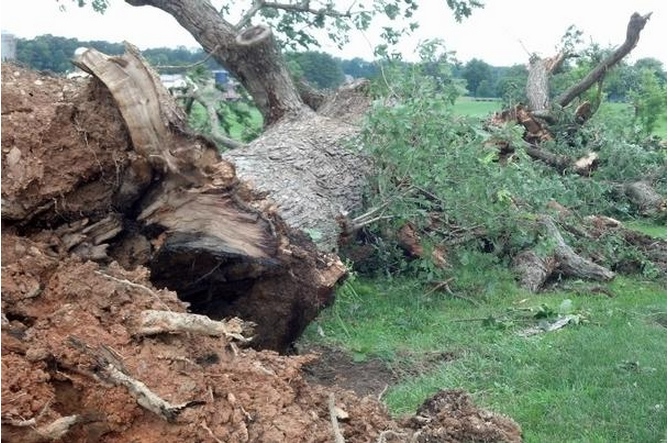
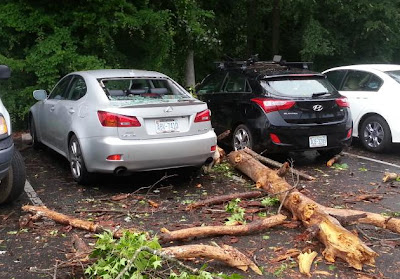
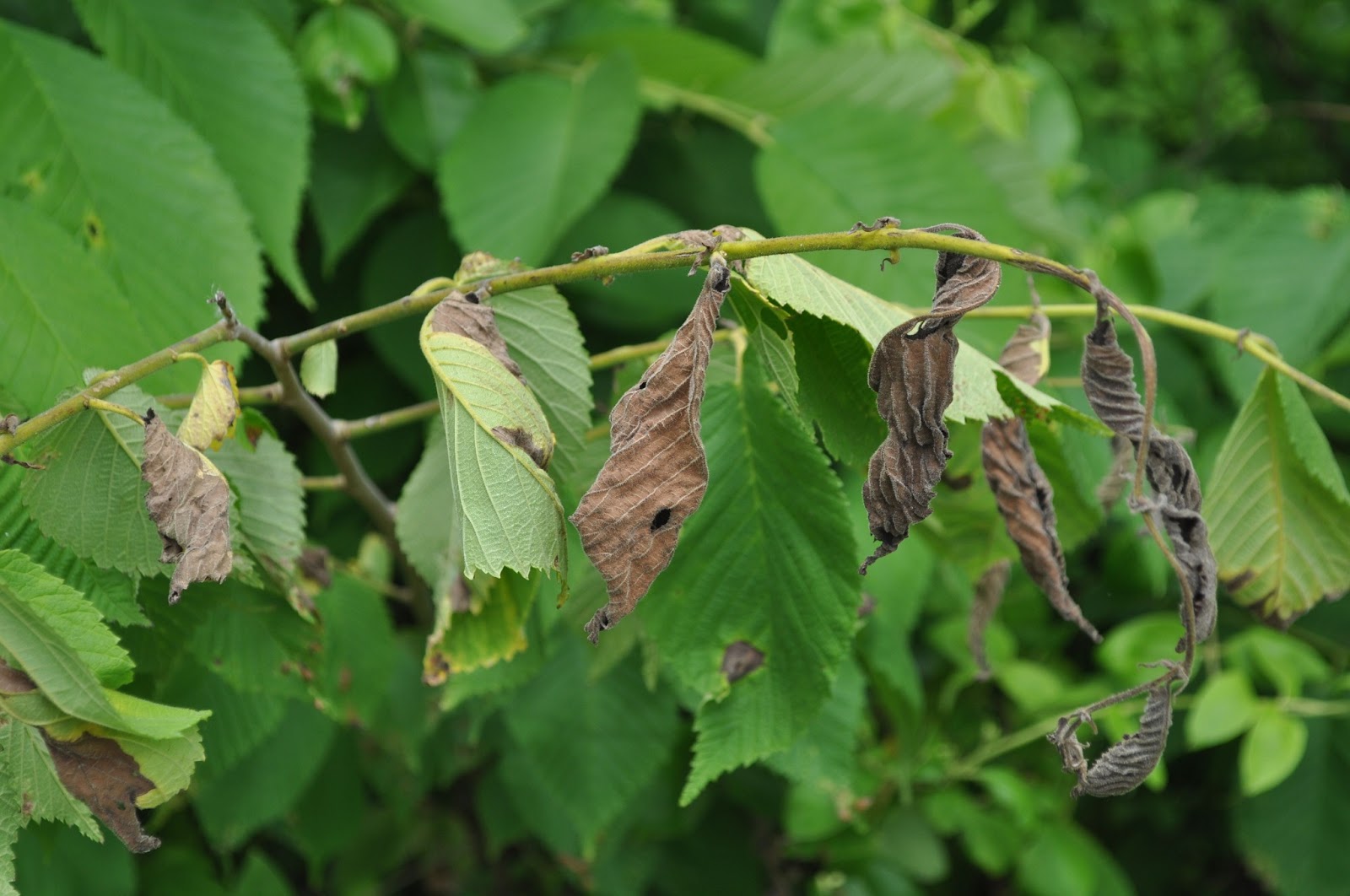
What I saw at the camp, and when I came home, is that in addition to trees that haven't leafed out at all, and the many only partially leafed, there are many green leaves falling off already, an extremely bad portent considering it's not even June yet, or hot...or even dry. They are lying all over the ground, and every sort is falling, too - tulip poplar, maple, oaks, chestnuts, birch and hickory. I have never seen this before. Also there are many new leaves that are bizarrely stunted or shriveling up, definitely far advanced damage over previous year's pace.

It was great to actually meet Guy and it seems that he and I were among the few there who don't come to collapse from the peak oil viewpoint. Which meant that while most everyone was familiar with the notion of collapse of industrial civilization, far fewer had even considered the collapse of nature, a very different and far more soul-challenging concept. There was one climate scientist - a university professor - who made it plain he doesn't think it's going to be nearly as bad as Guy warns.
Our first speaker was the founder of Four Quarters, Orren Whitten. Orren is an engaging, swaggering, intense, larger-than-life sort of character, who can pivot mercurially from winsome charisma to a fierce and one suspects uncompromising braggadocio. If any contradiction lurks between the mystical spiritualism that informs his “
church”, and his unrepentant chain-smoking hedonism, he seems unfettered by it. Since his vision permeates the enterprise it is refreshingly grounded in unsentimental realities when it comes to zombie incursions. I have an inkling that the establishment of the church was a clever tactic to avoid all sorts of taxes and regulations that otherwise might interfere with his vision of pagan enjoyment of the property. Orren claims that he is not a cult leader but it's difficult to imagine the mission of Four Quarters being navigated without his brand of determination, energy, and drive that dictates policy, despite the formal governance by a board of trustees, to the volunteers and members. A labyrinthine website describes it all
here.
Gail Tverborg's talks were compelling and I discovered to my pleasure that despite her skillful disguise as a normal, ordinary suited businesswoman with a sensible haircut and low-heeled pumps, the steely heart of a radical Darwinian realist lurks within. Of all the speakers, she alone harbors absolutely no wishy-washy romantic illusions about the human capacity for compassion overriding competition, or our prospects for survival. She places the roots of our impending demise as a species squarely on our earliest capabilities to conquer natural constraints back when somebody - Prometheus? - discovered fire, even if she does frame it mostly in economic terms. If/when the videos become available, I recommend her talks above any of the others excepting, obviously, Guy's.
I have seen previous iterations of Guy's second talk about tipping points on Nature Bats Last, but either it's better in person or he delivered it with an added frisson of humor, because it was very funny and entertaining, eliciting outbursts of hilarity and applause despite the grim import. His message of near term extinction (NTE) obviously came as a shock to many among the audience, as he says it typically does - in fact, he later said that frequently after he is invited to give a talk, he is shortly thereafter abruptly dis-invited once whatever church or organization looks more closely at his website.

Sure enough, those who retain hopium were in the majority, I'd say. Most were peak oil preppers who understand civilization collapse and think they have a chance of squeezing through the bottleneck if they plan correctly. Despite prior advertising, real scrutiny of Guy's prediction of the collapse of nature/climate and the prospect of NTE was foreign to most everyone, so there were some who reacted with denial and others in horror. I spoke to many people afterwards who confessed they were shaken to their core. It was very emotional, and exhausting.
In a way it's odd that people who are collapse aware don't know much about how imminent climate catastrophe is, because information is readily located on the internet if not main stream media, and so it really isn’t that obscure, and really shouldn’t be controversial. Consider a recent article from MediaLens marking the milestone of 400 ppm, which comes astonishingly close to reiterating verbatim Guy’s major points:
The last time CO2 was this high was probably 4.5 million years ago, before modern humans even existed.
Throughout recorded history, up till the Industrial Revolution, CO2 was much lower at around 280 ppm. But large-scale industrial and agricultural activity since then has seen humanity profoundly alter the make-up of the atmosphere and even the stability of Earth's climate.
'We are creating a prehistoric climate in which human societies will face huge and potentially catastrophic risks,'said Bob Ward, policy director at the Grantham Research Institute on Climate Change at the London School of Economics.
According to Bob Watson, former chair of the Intergovernmental Panel on Climate Change and former UK government chief scientific adviser:
'the world is now most likely committed to an increase in surface temperature of 3C-5C compared to pre-industrial times.'
As Damian Carrington noted in the Guardian, even just 2C is regarded as 'the level beyond which catastrophic warming is thought to become unstoppable.' But social scientist Chris Shaw has warned that even the notion of a single 'safe' global temperature rise is dangerous. He observes that:
'falsely ascribing a scientifically derived dangerous limit to climate change diverts attention away from questions about the political and social order that have given rise to the crisis.'
But for the corporate media, such questions are essentially taboo, and the global corporate and financial juggernaut, driven by the demands of capital, shows no sign of slowing down. Scientists calculate that humans pumped around 10.4 billion tonnes of carbon into the atmosphere in 2011, the most recent year analysed. A Nature news article reports:
'About half of that is taken up each year by carbon "sinks" such as the ocean and vegetation on land; the rest remains in the atmosphere and raises the global concentration of CO2.'
'The real question now', says environmental scientist Gregg Marland from Appalachian State University in Boone, North Carolina , 'is how will the sinks behave in the future?' And biogeochemist Jim White at the University of Colorado in Boulder warns:
'At some point the planet can't keep doing us a favour.'
In other words, the ability of the planet's natural carbon 'sinks' to soak up humanity's CO2 emissions will diminish, and the atmospheric concentration of CO2 will rise at an increasing rate. What is so dangerous about climate change is not just the high level of CO2 today, but the speed at which it is increasing. In other words, climate change is accelerating.
Most fascinating to me is the recognition of the importance of plants as a CO2 sink, because no doubt they are looking at a loss of that ability from the perspective of drought and heat - whereas Ozonists and Ozonistas know we are already losing that carbon sink at a far more rapid rate due to pollution. If they think climate change is accelerating due to the loss of the vegetation sink from heat and drought, then how much faster would they predict that acceleration to be if they understood the decline from ozone?
A tall tulip poplar has almost not crown left at all.
As I had assumed, it became clearer to me that Guy (as does nearly everyone!) blames industrial civilization and technology for our ultimate ecocide. I brought up the Fermi paradox as one supporting idea for the notion that eventually humans (having discovered fire) were inevitably doomed and it was only a matter of time before our population - with the help of ever more sophisticated technology and the discovery of fossil fuels - overran the planet. If I understood him correctly, he maintained that had we continued to live as we did prior to industrialization, we could have been sustainable indefinitely - or at the very least not brought down so many other species with us. He raised the objection that since the universe is infinite there must be infinite planets that can support life, of infinite sizes some of which must have much greater resources than Earth's - and therefore, at some place at some time, there must exist an intelligent race who could outsmart the limits to growth by getting technologically skilled enough for interplanetary travel and therefore, the solution to Fermi's paradox cannot be that intelligent life is inherently flawed and sows the seeds of its own destruction through overshoot. (But, entropy?) As Paul Chefurka wrote me in answer to my questions about this: “I don’t think it’s possible to have sustainable, intelligent life. Those two qualities are antithetical, and you only get to choose one...Even if there had been no fossil fuels, we would have burned up the planet’s trees instead and done ourselves in that way” - (an eventuality that may still come to pass).
Not until I was on the way home did the following question occur to me - (of course!). One of Guy's premises is that industrial civilization must be brought down as soon as possible in order to save as many life forms as possible (I think it's too late to matter, personally, but that's another issue). As Guy accepts that there is currently no politician that will - or could - make such a proposal (heck, they can't even promote minimal conservation), then at exactly which point in history, in what society and from which leader could that proposal have derived? How far back in technology would you have to go to halt the march towards irreversible destruction? Iphones, internal combustion engine, forging metal, the wheel, fire? One impossible impediment is that in order to be effective, any cessation of “progress” would have to result from a global understanding, but to get to the point where global communication is feasible, would mean technology has already surpassed anything remotely sustainable.

Despite wide adherence to the theme of the conference - that there are limits to growth - some dissension is to be expected. When Guy advocated the Deep Green Resistance movement and http://underminers.org/ which are working to dismantle the machinery of destruction, one vocal member of the audience, quite unabashed, said that he believes one single solitary human life is worth more than every other living creature in the world put together.
So there! Aside from some incredulous mutterings, that comment was ignored. But where the cracks turned into chasms was on the treacherous shoals of gender politics, of all things. And here, I thought that was ancient history.
This most overtly contentious issue first arose after a drum song performed by Carolyn Baker. The narration describes the lament of a woman whose husband has returned home from war and is no longer his former kindly self. The wife seeks the counsel of a shaman, who advises her that in order to restore her husband's former benevolent personality, she must entice a tiger to relinquish a whisker and then deliver it to the shaman. So, she spends many months devotedly bringing a tiger food every day (implicit in the riskiness is how desperate she is, and how dangerously violent her husband has become), coaxing the tiger closer, and finally tricks him into complacency whereupon she cuts a whisker and brings it to the magic man. He burns it and then informs her, in essence, that she doesn't need the magic of the whisker after all, because she has now discovered the patience and dedication required to help her husband let go of his rage.
During the discussion that followed there was more than one objection voiced, much to the consternation of Ms. Baker who obviously expected this to be an uplifting and optimistic fable that would be embraced by all. One or two in the audience looked at it from the perspective of the tiger, who they felt had been betrayed since he was lulled into trust and then summarily abandoned. More pointed out that wars conducted by men were the problem, that it was unreasonable to expect women to have the ability to fix PTSD no matter how patient and kind they were in the aftermath, and that such logic veered perilously close to blaming the victim for domestic violence. When I pointed out that is an approach that is rarely effective in reality, Ms. Baker snapped at me that it is a myth and changed the subject. I seem to have a talent for pissing people off.
Things got even more acrimonious following Dmitri Orlov's presentation, in which he examined the qualities shared by various intentional communities that he deemed successfully self-sustaining. Several women noted that not only were all of those he cited male-dominated but in fact several exhibited many even worse traits, of spousal and child abuse, as well as other forms of discrimination. In answer to a question about how LGBT minorities were treated in, say, Amish culture, he averred there would be no way to know since they are so private and secretive - but when asked about physical abuse, he responded that they wouldn't be able to conceal "a gunshot wound" from outside authorities, as if all beatings have to be that extreme to fall into the category of abuse.

Actually, the simple answer he could have given when asked why all his examples are patriarchal would be the verity that there really aren't any matriarchal examples to choose from, but instead he took offense and as more discussion ensued various prejudices emerged. It was like the cork had popped and there was no pushing the carbonated beverage back into the bottle. After he asserted that Russian women believe feminism in the west is a “
failed experiment”
and prefer the current stereotypical roles, I asked him “What about Pussy Riot?”* He barked witheringly without any elaboration - “They're idiots” and moved on to the next question. Well, they may be idiots but they clearly represent SOME segment of women in Russia who dissent from patriarchal privilege, especially as it is embodied in the church and government.
*everyone knows
I love Pussy Riot.
One woman was so disgusted that she walked out, and others, a few of the men as well as women, appeared dismayed at some of the more clueless sexist comments - such as equating courtesy (extending a hand to a woman disembarking a bus) with respect. Count me as dismayed. Albert Bates volunteered that it is presumptuous and disrespectful to condemn other cultures that practice polygamy, for instance. One woman responded that most such cultures pair very young, often prepubescent girls who have no choice in the matter with old men (ewwww, right?)...and I got no response to my question as to whether that taboo against cultural judgment would apply to slavery.

I would have thought people otherwise enlightened would be also be well aware of gender inequality issues, but as Guy later pointed out, those at the top never feel the pain and subjugation of those underneath them. Also, as another person observed, people attuned to peak oil come from across the political spectrum. Some of them are very conservative and not the least concerned about social justice.
In my opinion, that would constitute an excellent topic for a session at next year's conference (assuming we're all still alive and able to travel then) since if this group is any indication, there hasn't been much discussion of how intentional communities could overcome not only the human instinct for overshoot but also the instinct for males to dominate females, and how to incorporate modern standards into tribal groups that don't exceed Dunbar's number. Not that we will have an opportunity to find out.
Later on during a conversation around the campfire about overpopulation and birth control, I said that I once had hoped that people would come to understand that we are essentially one family and could agree to all share the nurturing and joy of raising far fewer children. Orren responded with a startlingly bitter edge in his tone, that competition makes that impossible since - get this - women have evolved to hide estrus in order to manipulate men. Wow! When I say bitter, I'm not kidding!
Coincidentally it happens that since I've become interested in the relative influence of nature/nurture - or put another way, in evolutionary imperatives v. cultural norms - I recently ordered a used copy of “
Sex at Dawn; The Prehistoric Origins of Modern Sexuality”...but I haven't had a chance to read it yet. So a quick google search found a couple of research papers indicating that Orren's view is, um, possibly outdated. One is an amusing article about a study tabulating the tips earned by lap dancers, which indicates that somehow or another, whether through olfactory or other physical motion cues, men actually can get a pretty good idea when a woman is fertile. More seriously, a scholarly 2006 presents a “
Reevaluation” of the genetic evolutionary "loss of estrus" and undetectable ovulation. I mean, if anyone is interested. Worse,
a diatribe relating to Orren's divorce turned up too, perhaps revealing a less than egalitarian personality - but such acrimonious events bring out the worst in people and no doubt there is another side.
It's impossible to not like Dmitri, who has a charmingly diffident and disarming manner, paired with a bracingly acerbic wit (even if he does retain a rather old-fashioned attitude about gender roles). I was glad he was my partner for the one group exercise in manufactured intimacy I was unable to evade, wherein we were supposed to stare into our neighbor's eyes and chant “I see You” and other such drivel. I could tell when he was the only other person in the audience who refrained from singing some tribal chant that opened the session that we were the only two people there who constitutionally despise such inanities, and so luckily we agreed to ignore the instructions and instead talk about other more genuine things, like how his cat fell off the boat that he calls home in Boston harbor.
You can see from these two photos of the closing in the stone circle that Dmitri is in such a rush to terminate the ceremonies that a body goes flying in the wake of his escape.
For those curious about the potential showdown between Guy and “The Archdruid” John Michael Greer following JMG's not-so-stealth broadside immediately prior to the conference, last I heard they hadn't even exchanged greetings - which was some sort of feat because it was not a particularly large assemblage. Personally I had decided in advance to avoid any confrontation with the wizard but found myself waiting with him in the line for supper. He was pontificating on the inadequacies of modern medicine and mentioned that placebos work quite well and said (I think facetiously) that we should promote placebo vaccines to keep the population healthful.
Gratified that there appeared to be something we could agree upon, I chimed in (I thought helpfully) that indeed, placebos have a demonstrably beneficial effect - look at the number of people who claim to be cured by homeopathy. At this apparent heresy, JMG's eyes bulged as his formidable eyebrows reared up, and his beard quivered. “But homeopathy DOES work” he declared. “It’s been proven in dozens of controlled trials. It’s not supposed to work, they can’t explain how it works. And that’s because it’s magic...like a lot of things science can’t explain!”
That was followed by his signature high-pitched giggle, which often seems to append his more outlandish pronouncements judging from his first presentation (the only one I sat through), the entirety of which he read out loud from a script. So it was kind of boring. Just sayin'.
There is one other thing I can agree with him about though, and that is his criticism of climate activists and scientists who typically do nothing significant to reduce their own carbon footprint. However he seems to imply that such neglect invalidates the findings of climate science which is ludicrous, it only means they are no more or less hypocritical than almost everyone else. Has anyone taken a look at the locations listed on the 2013 speaking schedule for another presenter, a long-time promoter of permaculture and biochar - the aforementioned Albert Bates?
Here, I’ll save you the trouble:
Belize and Columbia, return to Tennessee, Pennsylvania (for the Age of Limits), then to Washington state, return to TN, next to Scotland, Norway, Sweden, and Ireland, return to TN, back up to PA, return to TN, followed by Kansas, Massachusetts, Michigan, and Cuba.
Almost without exception, (almost - although I did meet a few people who volunteered that they read Wit's End, thank you!!!!), there was no awareness that trees are dying, let alone that pollution is causing it. Once when I alluded to it, a member of the staff pointed to a pine tree and said it looked good because she has been feeding it with coffee grounds. Aside from the fact that when it's worthy of notice that one solitary tree looks good, surely it can only mean that the overall trend must be pretty bad, I couldn't think of a reply until I was on my way home -(of course!). From now on though, my standard reply to such observations, which I encounter constantly, will be - by that rationale, because Donald Trump still has money there's no reason to think the economy is bad. Or, because gas is still affordable, peak oil must be scaremongering.
See, how happy we all look!? The rest of these pictures are from the trip home, following the last farewells in the stone circle, when I indulged in one of my guilty pleasures...which is taking a lengthy, leisurely and circuitous route along the back roads, looking for dead trees and abandoned farms (and listening to raucous CountryWestern music, loudly).
The landscape is beyond peculiar. There are fields full of dead shrubs.
Last year's remnants of seed pods haven't even decomposed.
Diseased vines coil and twine, tortured, up old fence posts.
Standing dead hulks line the roadside.
Far more concerning than the occasional dead specimen is this widespread lack of fully leafed crowns. The reason the mountainside in the distance is splotched with brown is that much of it is actually comprised of branches with no foliage.
Along the edges it can be seen.
This barn isn't quite abandoned, but it's lovely.
I love the weathered boards, the idiosyncratic shutters and the patchwork of broken panes of glass.
Dutch doors under the overhang can be seen beyond the rusty barbed wire.
Everywhere you go, stacks of dead wood are found.
A little further on and I came across a terrific relic.
A cluster of buildings is slowly rotting.
Vines protrude from windows.
Not far along, I almost missed this stone house which is one of the most exquisite ruins I have seen.
That's a huge oak on the left and below, an old maple.
It looks like long ago, there must have been a devastating fire.
The cornerstones are massive.
Even after the fire, I cannot understand why no one has ever restored this beautiful piece of historic architecture.
It is so overgrown around it that I couldn't detect the faintest sign of a path or a drive leading to the road.
I didn't dare go very close anyway, because parts of it are ominously teetering.
There were several outbuildings, almost impossible to see concealed behind the trees.
I heard this structure before I saw it.
It is situated alongside a little creek.
I imagine it must have been a place to keep dairy products cool.
I really wanted to go inside where the sound of burbling water echoed but I was afraid of being crushed.
This is as close as I could zoom in without venturing inside, so I couldn't show how the water, after all these years, continues to well up at the far end, and course vigorously through the tank. If I had to hide from the zombie hordes at the end of civilization, I would set up the final siege in this forgotten, enchanted spot.

As marvelous as it was to speak freely of doom for the first time, returning to Wit's End has never felt sweeter. I don't think I've been anyplace where I can hear more different kinds of birds singing ecstatically in the woods, and I found to my delight that a hummingbird has found the feeder I hung up in the magnolia just before I left. In the next few days, I will sit quietly on the porch step so that I can get a picture of it. With the fringe tree now in bloom, the air is so laden with perfume it is like bathing in honey. I'm not sure if I'll ever open Dmitri's home-brewed vodka, regifted from Guy who could not carry it home on the airplane. Maybe, I'll save it for the very last minute - when that moment of doom, in whatever guise, makes its final, unmistakeable approach.
“Our revels now are ended. These our actors,
As I foretold you, were all spirits, and
Are melted into air, into thin air:
And like the baseless fabric of this vision,
The cloud-capp’d tow’rs, the gorgeous palaces,
The solemn temples, the great globe itself,
Yea, all which it inherit, shall dissolve,
And, like this insubstantial pageant faded,
Leave not a rack behind. We are such stuff
As dreams are made on; and our little life
Is rounded with a sleep.”
~ Shakespeare, The Tempest Act 4, scene 1, 148–158