Monday, April 22, 2013

Tim DeChristopher, a genuine Hero

Tim DeChristopher, free after 21 months, appeared on Democracy Now! for Earth Day. Compared to when I saw his fiery speech at Wesleyan University, before his incarceration, he appeared subdued and somber.  Anyone who still harbors fantasies that our president will do anything about climate change (meaning challenge the corporate despots who run the country) needs to ponder the persecution - yes, persecution not prosecution - of Bidder 70 under the Obama administration.

Get Active, was Tim's message.  Interestingly, when asked about the current climate movement, he responded that it's in much better shape but didn't mention 350.org:   "...we have a serious movement that's not impeded nearly as much by the big green groups that are in the Washington bubble which was our problem in 2009.  I've been relatively isolated for the past couple of years and a lot has happened during that time. The Occupy movement didn't exist when I got locked up - the biggest social movement in this country in my lifetime happened when I was behind bars and I only saw it on tv."

Well Tim, your spirit and sacrifice inspired many who took risks to Occupy.  You really deserve that overused (especially in the American media) title of hero.

Sunday, April 21, 2013

Meet the Enemy

Special for Earth Day, the film "Thin Ice" is free to watch online, so it's embedded below for however long it remains available (I think, through tomorrow, April 22) so watch it while you can!  It is comprised of interviews with climate scientists about their work.

Here's a poster for the first Earth Day, circa 1970:
The New Yorker published an article discussing the history of Earth Day, the beginning of which follows:

"On September 20, 1969, Gaylord Nelson, a Democratic senator from Wisconsin, gave a lightly publicized speech in Seattle in which he remarked, “I am convinced that the same concern the youth of this nation took in changing this nation’s priorities on the war in Vietnam and on civil rights can be shown for the problem of the environment. That is why I plan to see to it that a national teach-in is held.” Nelson had been pushing environmental issues for some years, initially worried that water pollution was hurting fishing, canoeing, and other forms of outdoor recreation in his state. In 1963, as a freshman senator, he persuaded President John F. Kennedy to stage a national “conservation tour” to talk about the issue. Kennedy visited eleven states in five days, just two months before his assassination, but the trip was a bust: anemic crowds, little attention, and not much obvious passion from Kennedy himself."

"But Nelson’s idea of a national teach-in took off, to an extent that surprised even him. On April 22, 1970, only seven months after his speech in Seattle, the teach-in, dubbed Earth Day, generated more than twelve thousand events across the country, many of them in high schools and colleges, with more than thirty-five thousand speakers. “Today” devoted ten hours of airtime to it. Congress took the day off, and two-thirds of its members spoke at Earth Day events. In all, millions of people participated. This activity was largely uncoördinated. Earth Day had a tiny national staff—a handful of young activists—and there were no big environmental groups around to get behind it. The staff imposed minimal central direction over the local activity, and chose not to put on a main event, like a march on Washington."

"Earth Day had consequences: it led to the Clean Air Act of 1970, the Clean Water Act of 1972, and the Endangered Species Act of 1973, and to the creation, just eight months after the event, of the Environmental Protection Agency. Throughout the nineteen-seventies, mostly during the Republican Administrations of Richard Nixon and Gerald Ford, Congress passed one environmental bill after another, establishing national controls on air and water pollution. And most of the familiar big green groups are, in their current form, offspring of Earth Day. Dozens of colleges and universities instituted environmental-studies programs, and even many small newspapers created full-time environmental beats."

"Then, forty years after Earth Day, in the summer of 2010, the environmental movement suffered a humiliating defeat as unexpected as the success of Earth Day had been. The Senate Majority Leader, Harry Reid, announced that he would not bring to a vote a bill meant to address the greatest environmental problem of our time—global warming. The movement had poured years of effort into the bill, which involved a complicated system for limiting carbon emissions. Now it was dead, and there has been no significant environmental legislation since. Indeed, one could argue that there has been no major environmental legislation since 1990, when President George H. W. Bush signed a bill aimed at reducing acid rain. Today’s environmental movement is vastly bigger, richer, and better connected than it was in 1970. It’s also vastly less successful. What went wrong?"

You can read the rest for various notions of what went wrong, but I can tell you what I think went wrong:  The only reason environmental legislation was enacted was because the economic cost wasn't yet widely appreciated, and the corporations had yet to assemble opposition.  Soon after, as the incompatibility of endless growth disguised as progress, and clean air and water became apparent, an entire industry was born, of consultants and lawyers and lobbyists, to water down regulations, bribe and corrupt the new agencies and stack them with corporate moles, to infiltrate grassroots environmental organizations and corrupt them by swelling their coffers with corporate foundation money.  Manufacturing was outsourced along with the pollution.  Science became so specialized that ecology was disdained in academia...and then climate eclipsed conservation and concerns about pollution almost completely.

I remember the first Earth Day.  I was fifteen years old, and my family's (non-religious) Unitarian Universalist fellowship had a gathering in the Ipswich Town Hall, an old colonial building with wide-board floors and big mullioned windows with wavy glass.  My contribution was a big cake in the shape of a round ball, which I made by putting together two normal circular layers with round top and bottom baked in mixing bowls.  I made blue and green icing and piped the continents onto the oceans.  As I recall (and I could be very wrong) it looked spectacularly beautiful and tasted delicious.
1971 Pogo Earth Day Poster
What is the carbon footprint of freezing and then hauling four tons of ice to Manhattan?  I don't understand why an ice sculpture in New York was a necessary symbol after the embarrassing withdrawal and subsequent apology following a similarly misguided plan by 350 to have an ice sculpture spelling out HOAX melting in Washington.  This stunt was scheduled during the life-threatening heatwave in West Virginia when people there had no power and no water, let alone ice.  WTF did they forget?  It was just last summer!  Was it just an idea someone thought was so clever they were waiting for a less obviously discordant opportunity?  Don't they carve those things with chain saws??

In response to the news that climate activists will be going to Greenland to publicize the melting ice, I wrote the following comments:

When are climate activists going to stop flying in airplanes?  Air flight is not sustainable even if you want to subscribe to the fantasy that it's possible to power industrial civilization for 7 billion people with so-called clean, renewable energy.  It's not just the fuel, of course.  It's all the pollution, and the other non-renewable resources that are finite.

The larger question is when are climate activists going to stop pretending that it's the big bad fossil fuel companies that are to blame when the real problem is the culture that trains people to be consumers of their products?

When are climate activists going to admit that in order for any life to survive on Earth, humanity is going to have to drastically reduce our population and curtail our so-called standard of living (or else Mother Nature is going to do it for us)?

The emphasis on blaming fossil fuel corporations is about as productive as the epic failure of the war on drugs - like blaming heroin for drug addiction.  It's the addicts that need to be reformed.

Until activists walk the walk instead of just talking the talk, they are merely providing fodder for deniers who scream "Al Gore is Fat" - Like this idiot!

In response to a comment at Nature Bats Last I added this:

I think people consume, period.  It's what we do, what we have always done, long before corporations, which happen to be especially efficient at addicting people to consumption on an unprecedented scale.  Now, we're in a culture that teaches us to consume the products of fossil fuels, which are very expensive in terms of pollution, and enable us to extract far more from the natural world than we would without them, not to mention alter the climate with catastrophic results.

We're simply doing on a global stage what we have done, over and over, in more isolated locations, long before capitalism or even agriculture.  This was my follow-up to the first comment:

There is nothing in my comment that precludes going after fossil fuel companies.  I personally go after them as often as I can.  The point I was making is that focusing EXCLUSIVELY on fossil fuel companies and their activities - mining, fracking, keystone xl - which is the main strategy of the major climate activists, is only part of the problem...half of the math, if you will.  [This 350 production is so adulatory, it's painful to watch.]

I also carefully used the word "activists" and not "scientists".  I fully respect climate scientists and their work which obviously cannot be conducted with the same constraints.  You cannot make an omelet without breaking some eggs.  (I'm very fond of poultry analogies.)

What I'm fed up with is the cocktail-party-circuit celebrity activists who not only refuse to discuss overpopulation and overconsumption and social justice and ecology, but are undermining the credibility of the science that says we must radically reduce the human impact on nature by making not even the simple concession of, say, not flying.

So the problem isn't that I (as if I were anyone important) don't want to blame fossil fuel corporations, the problem is that THEY don't want to blame US (remember Pogo?).  Not only do the major "green" groups avoid any criticism of consumption and population (not to mention eating meat, lord forbid Americans be asked to forgo hamburger), but they also won't challenge the entire oligarchy that controls militarism, one of the biggest contributors to greenhouse gases on the planet.  Instead you see them cheering because the Navy is experimenting with biofuels, as if that were a solution.

Next thing you know, Benjamin the Donkey added this wonderful limerick, thanks BTD!!!

Whom should we blame? The plot thickens,
While running around headless quickens;
Since we’ve overproduced,
Effects come home to roost:
There’s nobody here but us chickens.

~ Benjamin the Donkey

Saturday, April 20, 2013

Souls Tormented by Devils

It can truly be said:  Men are the devils of the earth, and the animals are its tormented souls.

~ Arthur Schopenhauer
Spring is really here, and the rain obligingly watered my garden last night.  Thank you, rain!
New birds are thronging around the feeder in the Japanese maple, whose pale delicate leaves are unfurling.
How could a day with so many signs of life, a fragrant breeze, an azure sky, demand a quote as bleak as Schopenhauer's?
 The forsythia along the paddock fence is brilliantly golden.
The quince is just opening its buds, with a promise of hard, round fruit in the fall, excellent poached in vanilla syrup for an apple tarte tatin.
 This vinca has a particularly pleasing shade of violet...what could possibly mar April's exaltation?
 The emerging new growth obscures the ongoing, exponentially accelerating decline, that's what.
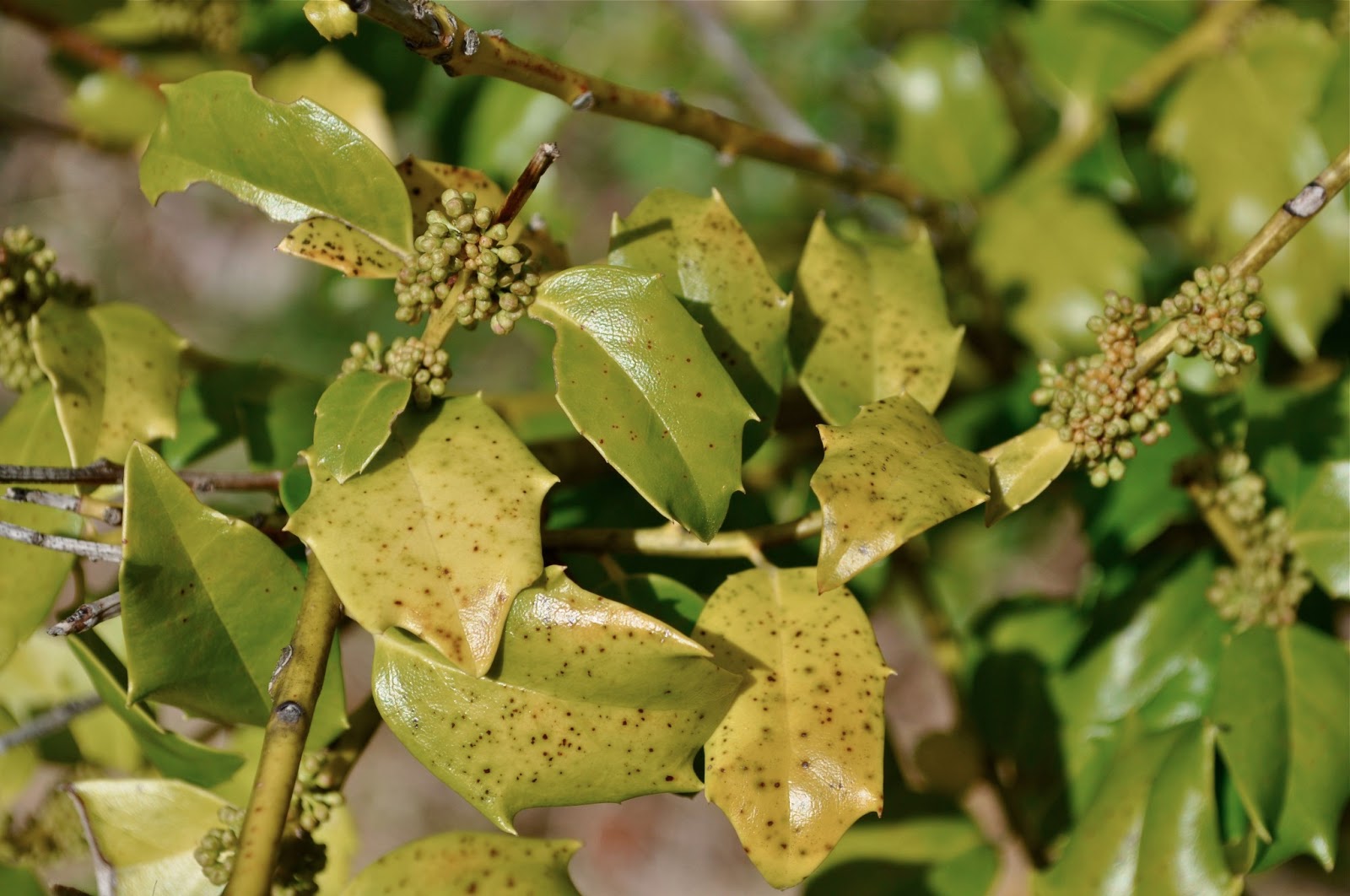
It can be readily detected, however, on the evergreen plants.  The older leaves have been damaged from absorbing pollution, and have fallen off, leaving shrubs that should be a solid, impenetrable lush green with only an upper shell of foliage.  When you look at the leaves directly, the classic speckled symptom of injured stomata is visible on what leaves remain.
In a matter of days, the inner leaves of the holly by the barn dropped to the ground.
 It is making fantastic clusters of buds, in a frantic effort to reproduce before it expires altogether.
In typical fashion the newest leaves at the tip of the branch, on the left, are in better condition, and they look progressively worse as you move to the older ones on the right.
Earlier this week, a link to a fascinating blogpost at Jungle Diary was contributed in comments, which anyone who is interested in trees should make a point of visiting.  Titled "Are the Trees Dying", the author was not familiar with ozone or its effects on vegetation, but he shares my dismay that so few people notice the increasing incidence of premature tree mortality - even in Malaysia where he lives - and writes me that:

I think the haze may have something to do with this, as the haze comes from open burning, and this is releasing a lot of methane and CO2 into the atmosphere, as well. With haze being an annual affair, it's definitely having an effect on the well-being of the forest.

And then, I read a post at Desdemona Despair that has rendered me so incredulous and sickened that I left the following comment:

Humans should be exterminated.  Eating monkey brains while they are alive?  Of all the many horrible things I have ever heard of people doing, to each other or to animals, this has to be the most macabre, closely followed by the bear paw soup.  Any species capable of producing members capable of this DESERVES its extinction.  It can't come soon enough.

The article is about a woman, Rebecca Tillbrook, who is trying to stop trafficking in endangered wildlife.  It begins:

Would you purchase an endangered tiger's tooth as a cure for acne?

Perhaps not, but in many Asian countries, you could.

The fact that the animal may be critically endangered can actually make the purchase more lucrative, as the rarer the animal, the more potent it's good fortune and healing properties.

Like the drug trade, wildlife trafficking is big business.

It continues with the part that left me so revolted:

When Ms Tilbrook first arrived in Cambodia more than a decade ago she was confronted with wild animals being tortured and sold on every street corner.  She says the practices have since moved underground, behind closed doors.

Bears are kept alive in restaurants waiting for customers to order bear paw soup, a delicacy at $300 a bowl. Chefs cut off each paw one at a time, leaving the animal alive, slowly bleeding to death, to ensure the meat remains fresh for the next order.

Other bears are sent to bile farms in China or Vietnam where they live in "crush cages" designed to squeeze every last drop of bile from their pancreas out through the needle of an old catheter, until they stop producing it and die.

Macaque monkeys are yet another culinary delicacy, served either screaming or drugged, strapped beneath the table with a hole for their head to poke through.

Their skull is then removed and their brains eaten alive.

The popular belief is that meat is the healthiest when the animal is alive, and that the more fear an animal experiences at death, the tastier its flesh becomes.

Almost every part of the endangered Asian Tiger can be used and are sold for a hefty fee, including the penis which is brewed as a tea to cure impotence.

After that sinks in, note what else she observes:

"My foundation For the Animals was a reaction to the waste and misuse of a lot of funds that I've [experienced] working in the conservation world for over 15 years," she said.

"Funds are being wasted on overheads like pedantic research, huge salaries, plush offices, business class travel, lavish parties; and things that I feel feed the ego instead of accomplishing the mission that's at hand."

There is much more about the work she is doing in the video below.  Donations can be directed to the Wildlife Alliance through the Australian based foundation For the Animals.

Closer to home, her critique of traditional conservation groups is echoed in this indictment of Sierra Club policies, written by Dr. Glen Barry.  The article is so revealing of what underpins the epic failure of climate and environmental activism, that I'll include only one paragraph here and let you peruse it in its entirety at Dr. Barry's site:

"Sierra Club doesn't really speak out much about protecting remaining large and connected old-growth globally, or working to end markets for FSC and other primary forest timbers. Sierra Club under Mr. Brune continues to support FSC on its web site and in public statements, without mentioning the majority of its products come from old-growth. And Sierra Club - and even 350.org - remain silent on the at least 18% of carbon emissions coming from old-growth forest logging, even as they take an important - yet at this time largely symbolic - stand on tar sands' 1% of global emissions."

Thursday, April 18, 2013

Crooked Trails and Pastoral Valleys


"Benedicto: May your trails be crooked, winding, lonesome, dangerous, leading to the most amazing view. May your mountains rise into and above the clouds. May your rivers flow without end, meandering through pastoral valleys tinkling with bells, past temples and castles and poets' towers into a dark primeval forest where tigers belch and monkeys howl, through miasmal and mysterious swamps and down into a desert of red rock, blue mesas, domes and pinnacles and grottos of endless stone, and down again into a deep vast ancient unknown chasm where bars of sunlight blaze on profiled cliffs, where deer walk across the white sand beaches, where storms come and go as lightning clangs upon the high crags, where something strange and more beautiful and more full of wonder than your deepest dreams waits for you ­beyond the next turning of the canyon walls."

~ Edward Abbey

Our laggard spring is threatening to hastily become early summer, and so I wanted to post some pictures of the season's first flowers before they wilt in the heat.  The apricot and Chinese honeysuckle don't look particularly spectacular, but their scent combined with the fragrance from the daffodils wafts across the garden, and is almost enough to persuade me that all is well with the world.  But what was once an unbroken deafening chorus of spring peepers has dwindled over the past few years to just a few isolated individuals, with long blank silences in between calls.  It is the intervals of quiet that keep me up at night.
The incident in Boston, though horrific, just goes to show, as if further proof were needed, that human stupidity reigns triumphant.  Michael McCarthy was right when he wrote his resignation as Environment Editor for the Independent.  In his swansong essay titled Man is Fallen and will destroy the Earth (by which of course he meant, LIFE on Earth), he observed disgustedly, that "...the Earth is under threat, as it has never been before, from the ever more oppressive scale of the human enterprise...".  And yet this goes almost unnoticed, while all eyes turn in unseemly fascination to the twisted work of one or two isolated madmen.

Take as one small example that crack-addled thieves are poaching 100-year old big leaf maples from the deep splendid forests of the Olympic Peninsula which, like other rural areas on the North American continent whether Alberta, Canada or West Virginia, are being exploited with the same ruthlessness as third-world countries.  Over $1billion worth of illegally harvested domestic wood is traded annually, most culled from public lands.  The figured big-leaf is especially valued for it's lustrous quilt and flame patterns, and the rich sound it delivers for acoustic instruments.


“What you have out here now is a gold-rush mentality,” says Freed. Referring to the maple-tree thieves, Freed postulates, “They’re society’s dropouts. They work without a net. The same guy who is taking down these trees is poaching salmon and killing elk out of season. But, I’ll tell you what—yeah, they got issues with meth and so on, but they are the greatest capitalists in the world.”

It can easily be predicted that virtually no attention will be directed towards a new study, briefly described by Fred Pearce in an article titled, "Extinction Debt Suggests Endangered Species are Doomed":


From dragonflies to bears, when it comes to lost species we ain't seen nothing yet.

Biologists are getting rattled about growing evidence of "extinction debt" – the idea that there is a delay of decades or even centuries between humans damaging ecosystems and the demise of species that live there.

In the largest extinction debt study to date, Stefan Dullinger of the University of Vienna, Austria, ranked 22 European countries according to the proportion of domestic species classed as endangered in the year 2000. He then ranked them for the amount of pressure put on nature in the years 2000, 1950 and 1900 – as measured by population density, per-capita GDP and intensity of land use.

He found that the countries with the most recent extinctions were the ones that put the most pressure on their ecosystems in 1900; pressures applied in 2000 had little bearing.
The upshot is that today's extinctions may be the result of damage we did in the early 20th century; our own extinction legacy could ultimately be far worse.

The ultimately cataclysmic outcome of overpopulation and overconsumption, habitat destruction and pollution should be so obviously inevitable - with only a modicum of introspection - that it highlights the disproportionate hysteria in reaction to casualties in Boston.  Most people think nothing of getting into cars KNOWING that 43,000 people die every year in accidents, while millions perish around the world annually from air pollution, not to mention the myriad costs of relentless wars...and nothing is done.  We pay our auto insurance and our taxes, and shrug our shoulders.

There's no telling how many will die from climate change-related disasters - extreme weather, crop failure, sea-level rise and the breakdown of society. And yet nothing is done to avert any of that either, it is rarely even discussed in polite company.  To a shocking degree, even academia shuns the terrifying implications of climate change.  It is just more evidence that humans are hard-wired to react to threats they perceive as immediate while remaining obliviously insouciant to very real and far worse but more distant dangers...when it suits them! - which is to say, when they are gaining current benefits while kicking the can down the road, preferably for the next generation to pay the piper.

I discovered to my dismay that even Edward Abbey, iconic environmentalist, protested US immigration policies to "protect the  remaining wilderness" - but had four children himself.  He loved the desert so much he spent most of his life cruising around it in a pick-up truck.  Well - we are none of us anything but hypocrites.

Politicians and media pundits proclaim that crises like Sandy or the Boston bombing bring out the best in people, and they pounce on whatever actions can be deemed heroic.  Meanwhile skimming through comments on the news articles, they are full of ignorant vitriol against blacks and Muslims, Obama and liberals.  I saw last week that one visitor came to Wit's End located right here in my village of Oldwick, because I had once posted on the outrageous shooting of Trayvon Martin.  The search words they used were: "Trayvon Martin practice shooting target".  Sweet, right?

It remains to be seen if there is anything approaching the news coverage and the extensive investigation in Boston by the FBI, Homeland Security, and local police regarding the explosion in Texas - an industrial accident with, so far, no evidence of a  crime, but worse damage and casualties.  Will anyone be held accountable?


A fiery explosion tore through a fertilizer plant and leveled dozens of homes in a small Texas town late on Wednesday, killing as many as 15 people, injuring more than 160 others and spewing toxic fumes that forced the evacuation of half the community, authorities said.

Police initially estimated that between five and 15 people had perished in the blast, which rocked the town of West, located about 20 miles north of Waco and 80 miles south of Dallas, shortly before 8 p.m. local time on Wednesday.

Public safety officials said they expected the death toll to climb as search teams combed through the rubble of the demolished plant and surrounding homes.

"I've never seen anything like this," McLennan County Sheriff Parnell McNamara said. "It looks like a war zone with all the debris."

Tuesday, April 16, 2013

Little or Nothing But Life

Wit's End exists mostly to educate people - to curate the information - about trees dying, everywhere, from pollution.  There is no lack of new research, articles, or evidence...but it is quite difficult to repeat it with much frequency and besides, other terrible things are happening in the world.  The last post was about birds and bees and other insects, which happen to have an intimate relationship with the plants that they pollinate.  Starting today, it is possible to watch a new release, The Wings of Life, online.  It will set you back about $15 to purchase it on Amazon, but go ahead - splurge!  - then you can watch it over and over.  Here's the trailer, which is followed by a short essay written by Virginia Woolf.  About a year before it was published, in 1942, she filled her coat pockets with stones and drowned herself in a river.  When her body was finally recovered, she was buried under an elm in her garden.  The essay is called, The Death of the Moth.


The Death of the Moth

~ Virginia Woolf

Moths that fly by day are not properly to be called moths; they do not excite that pleasant sense of dark autumn nights and ivy-blossom which the commonest yellow-underwing asleep in the shadow of the curtain never fails to rouse in us. They are hybrid creatures, neither gay like butterflies nor somber like their own species. Nevertheless the present specimen, with his narrow hay-colored wings, fringed with a tassel of the same color, seemed to be content with life. It was a pleasant morning, mid-September, mild, benignant, yet with a keener breath than that of the summer months. The plough was already scoring the field opposite the window, and where the share had been, the earth was pressed flat and gleamed with moisture. Such vigor came rolling in from the fields and the down beyond that it was difficult to keep the eyes strictly turned upon the book. The rooks too were keeping one of their annual festivities; soaring round the tree tops until it looked as if a vast net with thousands of black knots in it had been cast up into the air; which, after a few moments sank slowly down upon the trees until every twig seemed to have a knot at the end of it. Then, suddenly, the net would be thrown into the air again in a wider circle this time, with the utmost clamor and vociferation, as though to be thrown into the air and settle slowly down upon the tree tops were a tremendously exciting experience.

The same energy which inspired the rooks, the ploughmen, the horses, and even, it seemed, the lean bare-backed downs, sent the moth fluttering from side to side of his square of the windowpane. One could not help watching him. One, was, indeed, conscious of a queer feeling of pity for him. The possibilities of pleasure seemed that morning so enormous and so various that to have only a moth’s part in life, and a day moth’s at that, appeared a hard fate, and his zest in enjoying his meager opportunities to the full, pathetic. He flew vigorously to one corner of his compartment, and, after waiting there a second, flew across to the other. What remained for him but to fly to a third corner and then to a fourth?  That was all he could do, in spite of the size of the downs, the width of the sky, the far-off smoke of houses, and the romantic voice, now and then, of a steamer out at sea. What he could do he did. Watching him, it seemed as if a fiber, very thin but pure, of the enormous energy of the world had been thrust into his frail and diminutive body. As often as he crossed the pane, I could fancy that a thread of vital light became visible. He was little or nothing but life.

Yet, because he was so small, and so simple a form of the energy that was rolling in at the open window and driving its way through so many narrow and intricate corridors in my own brain and in those of other human beings, there was something marvelous as well as pathetic about him. It was as if someone had taken a tiny bead of pure life and decking it as lightly as possible with down and feathers, had set it dancing and zigzagging to show us the true nature of life. Thus displayed one could not get over the strangeness of it. One is apt to forget all about life, seeing it humped and bossed and garnished and cumbered so that it has to move with the greatest circumspection and dignity. Again, the thought of all that life might have been had he been born in any other shape caused one to view his simple activities with a kind of pity.

After a time, tired by his dancing apparently, he settled on the window ledge  in the sun, and, the queer spectacle being at an end, I forgot about him. Then, looking up, my eye was caught by him. He was trying to resume his dancing, but seemed either so stiff or so awkward that he could only flutter to the bottom of the windowpane; and when he tried to fly across it he failed. Being intent on other matters I watched these futile attempts for a time without thinking, unconsciously waiting for him to resume his flight, as one waits for a machine, that has stopped momentarily, to start again without considering the reason of its failure.  After perhaps a seventh attempt he slipped from the wooden ledge and fell, fluttering his wings, on to his back on the windowsill. The helplessness of his attitude roused me. It flashed upon me that he was in difficulties; he could no longer raise himself; his legs struggled vainly. But, as I stretched out a pencil, meaning to help him to right himself, it came over me that the failure and awkwardness were the approach of death. I laid the pencil down again.

The legs agitated themselves once more. I looked as if for the enemy against which he struggled. I looked out of doors. What had happened there? Presumably it was midday, and work in the fields had stopped. Stillness and quiet had replaced the previous animation. The birds had taken themselves off to feed in the brooks. The horses stood still. Yet the power was there all the same, massed outside, indifferent, impersonal, not attending to anything in particular. Somehow it was opposed to the little hay-colored moth. It was useless to try to do anything. One could only watch the extraordinary efforts made by those tiny legs against an oncoming doom which could, had it chosen, have submerged an entire city, not merely a city, but masses of human beings; nothing, I knew had any chance against death. Nevertheless after a pause of exhaustion the legs fluttered again. It was superb this last protest, and so frantic that he succeeded at last in righting himself. One’s sympathies, of course, were all on the side of life. Also, when there was nobody to care or to know, this gigantic effort on the part of an insignificant little moth, against a power of such magnitude, to retain what no one else valued or desired to keep, moved one strangely. Again, somehow, one saw life, a pure bead. I lifted the pencil again, useless though I knew it to be. But even as I did so, the unmistakable tokens of death showed themselves. The body relaxed, and instantly grew stiff. The struggle was over. The insignificant little creature now knew death. As I looked at the dead moth, this minute wayside triumph of so great a force over so mean an antagonist filled me with wonder. Just as life had been strange a few minutes before, so death was now as strange. The moth having righted himself now lay most decently and uncomplainingly composed. O yes, he seemed to say, death is stronger than I am.

Monday, April 15, 2013

The Way to Ruin

It would be some consolation for the feebleness of our selves and our works if all things should perish as slowly as they come into being; but as it is, increases are of sluggish growth, but the way to ruin is rapid.

~ Lucius Anneaus Seneca, Letters to Lucilius, 91


Until this spring I never had a bird feeder at Wit's End, because it would have simply made easy pickings for the barn cats, both relentless predatory prowlers even in their dotage.  But they died in the past year, so about a month ago I decided to hang a feeder on the Japanese maple outside the kitchen window.  An amazing variety visit, most of them several times each day.  The modest dark-eyed Junco (above) is always around, and I love hearing the sepulchral coo of mourning doves, who forage in a large flock on the ground, and whose wings make startled whistles as they rise in alarm whenever I step out onto the porch (here is a recording of them).
In great numbers I see the black-capped chickadee, the blue jay with his raucous derisory squawks, the beguiling tufted titmouse, purple finch, and the frenetically acrobatic white-breasted nuthatch, who makes me laugh with his wild swings and twirls as he hangs upside down.
 
There are several pairs of cardinals.
Most recently I saw this Eastern Towhee, which was lovely because they tend to hide shyly in the brush.
Of course there are the ordinary house sparrows, but also lately many white-throated sparrows that sport a jaunty bright yellow spot on their heads and sing the sweetest piercing trill (you can listen here) - and there are even downy woodpeckers and the pileated woodpecker...plus unfortunately the dreaded invasive cowbird.  There are actually many other species of birds around Wit's End as well, but they don't frequent the bird feeder.  Soon, I'm going to put out the hummingbird nectar.

So it was with particular dismay that I found an article on Wired.com about a new report commissioned by the American Bird Conservancy, which investigates the link between pesticides and the truly astounding decline of bird populations.  The birds can be killed either directly by eating even just one seed laced with systemic neonicotinoid, or by eating insects that have been poisoned while pollinating.  Unknown is how low-level ingesting might debilitate in more subtle ways, impacting immunities, reproduction, or essential survival skills.  The chemicals work their way from the treated seeds, into the grains, and flowers of crops.  From the roots, they bioaccumulate and contaminate the soil and then the waterways. For instance this is Sope Creek in Marietta, Georgia.  It looks charming, but has tested positive for high levels of neonicotinoids.  How disgusting and scary is that?
You can read more at the Conservancy website which has a link to the 100 page report.  I will just leave those links without further comment, because a little over a year ago I wrote a post - The Little Things that Rule the World - about disappearing insects, which of course affects the entire food chain, including aquatic life, and birds.  Things have simply deteriorated since then, and fresh evidence emerges, as detailed in the new articles, of corruption in the EPA which has been approving the widespread use of dangerous chemicals with almost no research or oversight.  Below is the preview for a movie about bee colony collapse, called Queen of the Sun.  If you like it, you can rent the full movie online at their website.  I plan to make some popcorn and watch it tonight.

Friday, April 12, 2013

The Moon Illusion


The Moon Illusion * has never been explained despite many studies from various disciplines of science and psychology.  I like to think of it as more evidence, as if any were needed, that our collective brains and behavior are overwhelmingly determined by ancient genetic codes so that, regardless of what we think we know, much of what we see, feel and do is beyond our intellectual control.  There are some relatively rare individual exceptions (mutations?) but together, our species overwhelmingly responds to the immediate over the future, regardless of the consequences.  Much appreciation to commenters at Nature Bats Last for linking to the video and this poem:

Thanks
~ W.S. Merwin
Listen
with the night falling we are saying thank you
we are stopping on the bridges to bow for the railings
we are running out of the glass rooms
with our mouths full of food to look at the sky
and say thank you
we are standing by the water looking out
in different directions.
back from a series of hospitals back from a mugging
after funerals we are saying thank you
after the news of the dead
whether or not we knew them we are saying thank you
looking up from tables we are saying thank you
in a culture up to its chin in shame
living in the stench it has chosen we are saying thank you
over telephones we are saying thank you
in doorways and in the backs of cars and in elevators
remembering wars and the police at the back door
and the beatings on stairs we are saying thank you
in the banks that use us we are saying thank you
with the crooks in office with the rich and fashionable
unchanged we go on saying thank you thank you
with the animals dying around us
our lost feelings we are saying thank you
with the forests falling faster than the minutes
of our lives we are saying thank you
with the words going out like cells of a brain
with the cities growing over us like the earth
we are saying thank you faster and faster
with nobody listening we are saying thank you
we are saying thank you and waving
dark though it is
(from his 1988 collection, Rain in the Trees)

Tuesday, April 9, 2013

Paradise Becomes a Nightmare

It's wonderful to see that ever more people are waking up to the dangers of pollution, and taking personal risks to stop it that would have seemed outlandish just a year ago - such as this gallant grandma in Oklahoma, who used a bikelock around her neck earlier today to halt excavation for the Keystone XL pipeline.  But while the article on the Great Plains Tar Sands Resistance website talks about the health effects in neighborhoods in the path of pipelines, from spills and emissions and chemicals, not once does it mention climate change - let alone the global trend of forest dieback from rising levels of tropospheric ozone pollution (oh but hey Ozonists are used to that, heh).  I love the way she brought a pillow to sit on!
Back in July, after writing an article for Grist about an action to shut down a mountaintop removal mine site in West Virginia, I earned the opprobrium of parties on every side, in part for articulating a schism that most prefer to sweep under the rug.  Apparently I wasn't supposed to delineate the uneasy alliance between outsiders with a broader climate agenda, and many of the Appalachian residents.  Most of the latter are up in arms because of habitat destruction and toxic contamination from the extractive processes that cause cancer and other diseases.  It was evident however that many of them have no objection to the emissions of burning coal, and no quibble with indulgences that are part of an industrial consumer society.  It's evidently okay with them when somebody somewhere ELSE is losing their clean land, water, and air.

After years of shunning any association with hippy "environmental" issues, the big, serious, sciency climate activist organizations are being eclipsed by the suddenly galvanized, genuinely grassroots groups who are rising up to fight the onslaught of corporate Goliaths.  In rejecting ecology for so long, the climate movement has relinquished the narrative and the result is that these burgeoning groups, newly formed particularly as the fracking menace spreads nationwide, are often oblivious or indifferent to the larger issues of climate chaos and ecosystem collapse (which happen to be rather more crucial to the survival of the biosphere, including us).

Does it matter?  Maybe through the process of engagement over local pollution issues, the participants will become educated about the truly existential threats that cross international borders.  It's likely that arrests and corporate control of spill sites will lead some to become radicalized about government and law enforcement and media collusion...but whether they will become enlightened about what my friend Steve Horn describes in TruthOut as "green illusions" is not so clear, since so far the promoters of "green solutions", if the hostile comments there are any indication, still haven't figured it out.

This video makes me laugh out loud every time I watch it...see if you can figure out why.  (hint: it starts at 1:50 minutes in, and the dialogue only gets funnier after that.)


Yep!  You guessed right!!

Monday, April 8, 2013

...a deceiver will never lack victims for his deceptions. ~ Niccolo Machiavelli

“You can't convince a believer of anything; for their belief is not based on evidence, it's based on a deep seated need to believe”.

~ Carl Sagan
You can call it religion.  You can call it ideology.  Either way, you will never be able to dissuade someone who needs to believe in constructs that define the core of their place in the world - whether that people are inherently good, or at least, make social progress...or that there is meaning to life, or some sort of spiritual anything...or that humans are too puny to change the climate, or destroy most - if not all - of life on earth.

Put another way, as I received in an email this morning:

Homer Simpson says, it takes at least two to lie.  One to speak the lie and the others to believe it.
Of course, it helps to understand how effective the lie can be in controlling the believers when deftly executed, if you consider Karl Rove's three rules [thanks to a poet for those pearls of Rovian wisdom], who clearly understood Machiavellian ruthlessness based on a determination of two crucial concepts, that human nature is 1.  immutable; and 2. driven by passions.  I'm sure he didn't invent these precepts, although he articulated them succinctly for our modern times of entrenched corporate media:


1) Attack your opponent’s strength from your weakness.
2) Accuse your opponent of doing what you’re doing.
3) Be worse than anyone can believe.

The effectiveness of those rules depends entirely on the other part of Homer's dictum - those who willingly believe the lie.

Cognitive dissonance arises when perceived reality is not in alignment with expectations.  This anxiety is provoked when people like me, who know, for example, that we are headed towards severe food shortages due to a variety of inexorable trends, go to a gourmet supermarket and find a surfeit of luxury food imported from around the world.

Cognitive dissonance also describes a mental/emotional response that arises when objective facts contradict deeply cherished belief systems that were formed early in life by the dominant culture.  Pain and fear arise when the fundamental basis of a world paradigm is challenged by reality, and a common - perhaps inherent - response is to reject the evidence, indeed to refuse to even look at it carefully, and go into denial or even hostility.

This is the explanation for why otherwise educated people deny and often ridicule the numerous examples of government false flag operations...because it undermines their confidence in justice and decency, security and predictability - as well as their own significance and status as a member of society with influence.  It's the explanation for why ignorant people deny climate change and, for the most part, cannot be influenced by any amount of evidence, even to the extent of distrusting scientists.
I think it shows how remarkably clever all people are that without needing to follow through for even a few moments the implications of trees dying from ozone, the blinkers are activated instantaneously.  We must have tremendous unconscious foresight to understand, in a viscerally intuitive if not instinctive response, that the death of forests heralds a death knell for humanity, because only the most miniscule number of people acknowledge the accelerating trend that is patently obvious.

So if it's hopeless to change the minds of true believers, the question is, why do so many people waste time refuting and quibbling with their inanities - and why do I waste time writing this blog?  Is it possible to reach SOME people?  Will it be possible to reach ENOUGH people in time to avert a major extinction event?

I think I know that the answers are Hope, Maybe, and No.

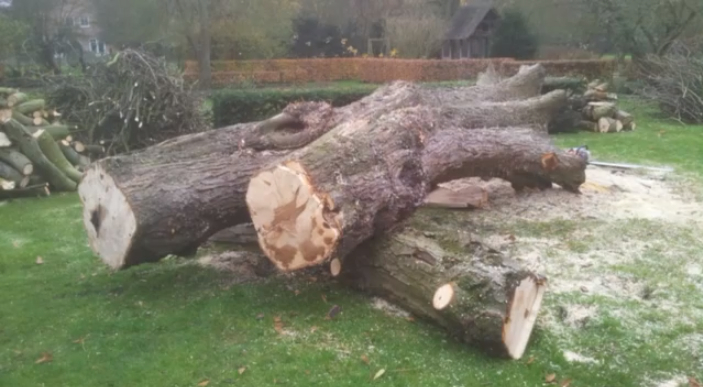
You'd think that nobody but an Ozonista like me would want to watch a half-hour movie of a dying chestnut being cut down in the Netherlands, with up-close views of fungus and lichen.  The only thing more amazing than how much tree workers love to film the dismemberment of especially large old specimens with cameras attached to their helmets, is how many thousands of views their videos receive.  I posted screen captures of this one because of the description (copied below), which is poorly translated but evocative nevertheless...particularly because it says that after removing and examining a core of the rings, the growth has been stunted for twenty-five years.  Hide the decline** anyone?

**“As for 'hide the decline,' Jones wasn’t referring to declines in temperature; he was referring to a drop seen in certain types of tree-ring data after 1960. And he wasn’t referring to Mann’s work—but to that of another scientist, Keith Briffa of the University of East Anglia. Pre-1960, Briffa’s tree-ring density records track the temperature records. Post-1960, there is a decline in the response of certain trees to temperature (possibly due to pollution): the actual recorded temperatures are consistently higher than what the tree-ring data would predict. The temperature records are the more important and reliable data, so Briffa had to discard the tree-ring “decline” records. But the decline wasn’t hidden. It was clearly discussed and labeled in Briffa’s paper. And Mann’s paper didn’t rely on any of those data.”


The shade of the big horse behind the house in the garden of Blankenburg in Rockanje, during previous cutting operations in recent years have shown that the tree continues to decline in vitality and there was large-scale dieback of the upper peaks in the Crown.

The tree was also severely affected by chestnut which he further weakened and other wood decay fungi more grip on the tree were Kandelaberen would be a temporary solution might have been, but it was the tree anyway eventually after some years died since at 4 years old pruning wounds, no recovery was more ..

Over 10 years ago, the trees are already inspected by a qualified tree consultant and there could be seen that they are approximately 8 to 12 years could remain without danger to the environment will cause.

After counting the annual rings showed that this monumental white horse 128 years has become (census was subsequently performed on a shaved strip wood from the rootstock where both the bark and the heart is still in it), the last 25 years only 5 cm diameter growth occurred.

Sunday, April 7, 2013

Hang on to your Tin Foil Hats!


Gosh, there really are conspiracies!  And the reluctance of people to admit they have been duped, and that they live in a sham Truman's World phoney, crumbling screen set, is one of the reasons that the oligarchs have been allowed to take over and are now plundering what little remains of the natural world while turning everyone who isn't as filthy rich as they are into brainwashed slaves.

I was 13 years old when Martin Luther King was killed on April 4, and life has never been the same since.  I guess in some deep way I started to get the inkling that things are not what they are supposed to be.

This short video is narrated by Barry Zwicker.  It is very informative about the coverup of King's assassination (which has steadfastly been, like so much else that is true but embarassing, obediently obscured by the corporate media).  I think it's essential to watch in order to understand the blatant duplicity and corruption that rules our so-called democracy, although it stops short of reminding us what an incredible, visionary, and revolutionary leader he was, with the potential for genuinely transforming our society.  It's a potential that died forever around then, and now it's too late.  The reptilian elite are in control, and the fate of the Earth is sealed.  All I know is I still cry every time I hear the dream speech.

As the drums of war are being banged over North Korea, it's worth revisiting a longer film made by Zwicker about the epic media failure to investigate 9/11 here...and, there's also an excellent documentary on youtube about the media failure to question the claims that were used to drag the US and its allies into the war with Iraq - Weapons of Mass Destruction or Deception.  Watch them before they shut the internet down!


Eco-Warriors


Coming soon - the story of Edward Abbey - and the contemporary heirs to his Monkey Wrench Gang, the pioneers of anarchic eco-activism...something to look forward to!

Friday, April 5, 2013

A Dream of Trees

There is a thing in me still dreams of trees. 
But let it go. Homesick for moderation, 
Half the world's artists shrink or fall away. 
If any find solution, let him tell it. 
Meanwhile I bend my heart toward lamentation 
Where, as the times implore our true involvement, 
The blades of every crisis point the way.

~ Mary Oliver, A Dream of Trees

Yesterday I went to have lunch with first daughter.  She and her husband live on a farm with several horses near Frenchtown, close to the Delaware River, a rural area which has its share of abandoned barns.
Alongside this cluster, crews are hard at work clearing an endless stretch for a pipeline to carry fracked gas from Pennsylvania to refineries on the other side of New Jersey, for refinement and export.
I don't know how to describe the sense of raw physical violation this scene engenders.
But hey, isn't it cute the way they string up colorful plastic flags as though this were some sort of festive carnival underway, rather than preparation for the transport of a fossil fuel that creates toxic emissions that are lethal to trees and people too?
First daughter agreed that at the rate we are destroying the last vestiges of the natural world, we're going to pave every inch of the earth that we can, squeeze every drop of fuel out of the ground, and then burn the last tree.  Then she added, "Yup, but it won't happen while I'm alive!"


She really seemed to believe it too. 

Last summer, Dmitri Orlov wrote an essay called Fragility and Collapse; Slowly at first, then all at once.  He points out that it is simple to predict collapse - say, that a bridge will someday fall.  Of course it will.  But to say exactly when is impossible.  However, it is possible to make an educated guess based on the rate of deterioration, particularly when a linear change becomes exponential....assuming it remains exponential when, theoretically, it could return to linear at least for a time.

In the case of trees dying from air pollution though, I think it's safe to say a linear decline has gone exponential over the past few years, which is highly unlikely to slow down.  Whatever synergy is fueling the deterioration - between ozone and pathogen attacks, especially fungus - it shows no sign of abating.  Unfortunately, simultaneously with the degradation of the landscape seems to be our ability to not look at it.  Any recent video - a movie, a commercial, a television show - that has trees in the background reveals visible symptoms of decay, and yet it goes unremarked upon.  Take for example the excellent new movie, Salmon Confidential.  In the very first opening moments, we see a leaf that has classic necrotic injury floating in the water with the fish.  For an Ozonista as immersed in the documented visible foliar symptoms of damage as me, this sort of bizarre coincidence can only be hysterically funny.

In virtually every scene that has a shot close enough to scrutize the woods, prematurely dying trees are present.
Mostly, we see pines that are bleached white and missing needles, but there are shots of deciduous trees with thin crowns and bare branches as well.
It's remarkable to me that people who are laboring to document the disappearance of wild salmon and determine the cause don't spare a glance at the collapsing terrestrial ecosystem.  Well, I guess you can't deal with everything all at once.
Salmon are described as a "keystone" species, one that is an essential component of the ecosystem, that every other species is dependent upon for survival.  Their influence extends beyond the water, as they are food for birds and bears, and minerals traced from their foray to the ocean have even been found in trees as they work through the hydrological cycle.
It's hard to think of a more keystone species than trees, however.  They provide food and habitat, regulate temperature, and create the rain.  Not to mention, they absorb carbon dioxide.
I highly recommend watching the film.  The courage, determination, and honesty of the individuals who are working so hard to inform the world of the travesty of factory-farmed fish is inspiring.
Contrast that with the crass dishonesty of the government stooges, caught on film, which is infuriating and profoundly disquieting.  Clearly, there exists pervasive, systemic, fetid collusion between industry and Canadian politicians.
We already knew that democracy in the US is hopelessly corrupted, but to see the dire consequences unfold in this one corner of the world, knowing that so many other facets of modern life are equally fouled, is daunting to say the least.
More information at efforts to save the wild salmon can be found at their website.  Enjoy the film!

 
Salmon Confidential from Twyla Roscovich on Vimeo.

Blog Archive

My Blog List

Search This Blog

Followers

counter