Wednesday, December 16, 2009

The Iconographic Image

Today, I turned rather randomly off the state highway with all the traffic, onto a local and quiet road, where I could pull over and document the condition of the trees. This road is on the east side of Route 206, an obscure old subdivision of rather ordinary, middle-class ranch houses.
Here is my favorite, iconic image. If you sincerely want to see the truth, CLICK on the photo! It is undeniable.
Here is the lichen laden branch.
Here is the peeling bark. From this vantage I just spent a few moments wandering down the street.
Next, I found a large deciduous tree, perhaps an oak?
Voila the trunk.
And a close shot.
Adjacent is a rather dead pine.
And surprise surprise, the bare branches are slathered with lichen!
Next door is a weeping cherry.
Oops, the branches are shedding bark.
And the bark is obscured by festering lichens.
Whatever is preying on trees is not limited to damage on older specimens. This recently planted pine is in horrible shape. And it leads me to speculate, that it can't be cumulative ozone over decades that is to blame for the recent rapid decline of trees. There has to be a new agent active in the mix!
This white pine, and the arborvitae are being gutted by rot.

WHY are these trees dying? Scroll down to the last two most recent posts for a plausible explanation.

Monday, December 14, 2009

aauuuuuggghhhh! no duh!

Am I dreaming or did I just read this?

Revelations from *The* Honest Forester

Here is an amusing clip from a group of Dutch performers. It has nothing to do with trees per se but it is about climate change, and it is included for comic relief in advance of the very serious information that follows.


      Today I was reading daviesand.com, a comprehensive compendium of forestry issues written by a professional forester. Excerpted below are two of the pages (there are quite a few, I've only just started to explore). The first is this page and I have to confess, it confuses me. Clearly, extensive tree decline has been ongoing for decades, which begs many questions. Did I just notice it, or has something fundamentally changed recently? Certainly, the lichen spread is recent, but what does that mean? There are other indications that nitrogen is at the root of sudden, rapid tree decline. If so, where is it coming from? And where are all the other foresters that should be shrieking warnings that we are in danger of total ecosystem collapse, widespread and long lasting power outages, and runaway wildfires in the suburbs?

      Never mind! Here's the content from the page I linked to, above. I'm making it all blue.

      RACHEL'S ENVIRONMENT & HEALTH WEEKLY
      January 11, 1996
      News and resources for environmental justice.
      ==========
      Environmental Research Foundation
      P.O. Box 5036, Annapolis, MD 21403
      Fax (410) 263-8944; Internet: erf@rachel.clark.net
      ==========

      THE DYING OF THE TREES

If you read newspapers or magazines looking for information about forests, what do you find? You find stories about the destruction of rain forests in South America, and about the logging battle raging in the Pacific Northwest over the spotted owl.Except for these two issues, forest problems don't make the news. But forest problems are pervasive, and are as important intheir own way as toxics problems. To put it bluntly, trees are sick and dying everywhere in the U.S. At first blush this seems like an extreme statement. But a new book, THE DYING OF THE TREES by Charles Little, will convince you it is true. [1]

This book gives a detailed picture --from New England to Oregon and California, from Alaska to Florida, across the uppermidwest, across the southern border states, and even into the desert southwest where the giant saguaro cactus is in majordecline --of trees sick and dying. It seems clear that the dying trees are one more sign of danger, one more omen warning us that something is terribly wrong.

Why are the trees dying? The reasons are many and varied. In New England, New York, North Carolina, Tennessee, Georgia, Ohio, Indiana and Kentucky it's a combination of acid rain and clear cuts; in California it's killer smog; in Arizona and New Mexico and elsewhere it's excessive ultraviolet light filtering through the earth's damaged ozone shield; other places, it's pesticides, or it's toxic heavy metals released by burning coal and oil; in Alaska and Florida it's rising temperatures and rising sea levels from global warming; in Colorado, Oregon, and Washington state it's destructive forestry practices (clearcut logging, and fire suppression) that leave forests weakened, unable to withstand extremes of weather or attacks by insects or funguses.

In most places, in truth, it's probably various combinations of all these factors. Scientists are playing catch-up now, conducting studies that may explain the complicated causes of widespread tree death. But, as with toxics problems, if we postpone action until the scientists have described the problems completely, we'll get the answers too late to do any good.

Answers come slowly. Hubert "Hub" Vogelmann, a botanist at the University of Vermont, wanted to study an undisturbed forest, so in 1965 he made a thorough survey of Camel's Hump, a 4083-foot peak in the Green Mountains. So far as he knew, he was describing a healthy ecosystem. He measured the types and sizes of the trees, and various other aspects of the ecosystem. He had no particular purpose in mind, other than to gather knowledge about nature.

Periodically, he re-surveyed Camel's Hump, and a pattern began to emerge. The trees were dying. His survey in 1979, compared to the baseline study of 1965, showed a 48% loss of red spruce; a 73% loss of mountain maple; a 49% loss of striped maple; and a 35% loss of sugar maple.

By examining tree rings, and by other studies, Hub Vogelmann was able to show that the health of Camel's Hump had begun to decline in the period 1950-1960. Similar studies in the Black Forest of Germany, and in southern Canada, revealed that the most likely cause was acid rain.

Acid rain occurs when coal and oil are burned, releasing sulfur which combines with rain (or fog or snow) to make acid precipitation. Acidity is measured in units called pH. Pure water has a pH of 7 --it is "neutral" --neither acidic nor alkaline. Pure rainwater has a pH of 5.6 --slightly acidic because, while in the air, rain absorbs carbon dioxide to form a weak solution of carbonic acid.

After World War II the U.S. saw a massive rise in use of fossil fuels, coal and oil. The resulting smoke was obvious, and obviously harmful; in Donora, Pennsylvania (south of Pittsburgh) in 1948, half the people in the town fell ill for 3 days because of coal smoke in the air. Twenty people died. In London, England, in 1952, coal smoke killed 4000 people during a pollution episode. [2]

The official response in the 1950s was to build smoke stacks hundreds of feet tall, to dilute the pollution. Today the Ohio River valley is still dotted by enormous coal-burning power plants with stacks as high as 700 or even 1000 feet. These tall stacks allow the sulfurous pollution to travel 1000 miles or more, where it forms acid rain across the Adirondack mountains of New York, and across northern New England and southern Canada.

In Vermont, the rain has a pH of 3.8 to 4.0. The pH scale is "logarithmic" so a change from normal (5.6) down to 4.6 means the rain has gotten ten times as acidic as normal; at 3.6 the rain is 100 times as acidic as normal.

It wasn't until 1972 that Eugene Likens (then at Cornell University) and F. Herbert Bormann at Yale discovered acid rain. But meanwhile acid rain had been falling on northern New York and New England and on southern Canada for about 20 years.

What Hub Vogelmann has been able to show by studying Camel's Hump for 30 years is that acid rain doesn't just affect the trees; it affects the soil and thus the entire ecosystem. Soil contains a large amount of aluminum, but it occurs in the form of aluminum silicates; in that form, aluminum is not available to the roots of plants. But acid rain dissolves the silicates, releasing the aluminum and making it available to plants. When plants get aluminum into their roots and their vascular system, the roots clog, which prevents the plant from taking up adequate nutrients and water. The trees are weakened, and may then fall prey to extreme cold, or to insects or pathogens.

Acid rain not only releases aluminum into the soil. It also releases other minerals --calcium, magnesium, phosphorus --which are fertilizer for the tree. Acid rain releases these fertilizers to be washed out of the soil, leaving the soil depleted of nutrients.

But that is not the end of the problem. The roots of many trees create a symbiotic (mutually beneficial) relationship with an orange-colored sponge-like fungus called mycorrhiza. The tree roots provide sustenance to the mycorrhiza, and the mycorrhiza help the tree roots gather water and nutrients from the soil. But acid rain kills mycorrhiza, thus further reducing the ability of trees to absorb water and nutrients from the soil.

But that is not all. Acid rain kills off portions of the detritus food chain. The detritus food chain is all the microscopic creatures that "compost" leaves, twigs, pine needles, dead branches and so forth, turning them back into soil. Because the detritus food chain is damaged by acid rain, forest "litter" builds up on the floor of the forest. The litter prevents new saplings from taking root --they cannot reach through the litter to make contact with the soil below. Furthermore, the litter promotes the growth of ferns, which give off substances that inhibit the growth of red spruce saplings, among others.

This is not a complete description of problems caused by acid rain, but it gives a sense of the complexity of ecosystems, and how they can become unbalanced by thoughtless human intrusions.

Given the high rates of tree death, and the widespread nature of the problem --it is occurring to one degree or another in every state in the union --one would think that the community of botanists, forest ecosystem specialists, and U.S. Forest Service employees would be up in arms, advocating change. But one would be disappointed.

Throughout the book, author Charles Little describes studies and statements by the U.S. Forest Service downplaying the importance of tree disease and death. For example, in 1991 the Procter Maple Research Center at University of Vermont pinpointed acid rain and other air pollution as an important cause of decline of sugar maples in Vermont: "We think we are looking at the early stages of an epidemic problem," the Center's report said. The following year the U.S. Forest Service issued a report saying that 90% of the sugar maples surveyed were healthy and the overall numbers and volume of sugar maples was increasing.

People in the maple sugar business were stunned --their own experience was telling them something that the U.S. Forest Service was officially denying. It turned out the Forest Service had used a tricky way of counting dead trees; only the standing dead were counted--those lying on the ground were not.

Here's David Marvin, who owns a commercial "sugarbush" --a maple sugar farm in Vermont: "I don't want to condemn our forest scientists as a group," says Marvin, "but I am very concerned that a great deal of forest research is funded by the federal government, by chemical companies, and forest industry companies --and it's very difficult for people who depend on that funding to stick their necks out or to help influence policy that might go counter to what the funders are interested in. Many scientists I talk to will not publicly say anything about the connection between air pollution and forest decline, but privately, to a person, they tell me, yes, we've got a problem."

Forest-protection activists in the Pacific Northwest have long considered the Forest Service a rogue agency, captured by the forest products industry. Under the Reagan and Bush administrations, the situation grew so extreme that when Jack Ward Thomas took over the leadership of the Forest Service in 1992, he immediately issued six "messages" to personnel throughout the agency. The first three messages were: (1) Obey the law; (2) Tell the truth; (3) Implement ecosystem management. That such orders had to be issued speaks volumes about the past performance of this federal agency.

In 1993 there was evidence of new candor in the Forest Service. A report issued that year said timber mortality [death], on a volume basis, had increased 24% between 1986 and 1991, "in all regions, on all ownerships, and for both hardwoods and softwoods." Hardwoods were particularly affected, and particularly in the south, where the mortality increase was 37%.

A new candor --and a continuing candor --among scientists and foresters will be essential. But also we need a new recognition that there are many causes of tree death, just as there are many causes of toxic poisoning. To fix these problems, whether tree deaths or toxics, will require us first and foremost to study and emulate nature, to learn to live within natural limits, and to respect the right of non-human species to inhabit the planet. For starters, we should cut waste, not trees. [3] If we don't take these lessons to heart, and soon, the trees will survive but probably we will not.

--Peter Montague

===============
[1] Charles E. Little, THE DYING OF THE TREES; THE PANDEMIC IN AMERICA'S FORESTS (New York: Viking/Penguin, 1995).

[2] Howard E. Hesketh, UNDERSTANDING & CONTROLLING AIR POLLUTION (Ann Arbor, Michigan: Ann Arbor Science Publishers, 1974), pgs. 48-49.

[3] See REHW #468 for ways to stop using wood.


Here's the second page:

From: Jennifer Tetterton
Date: Wednesday, April 14, 1999 2:03 PM
Subject: UPDATE: Air Pollution and Trees

Scientific Consensus on Air Pollution Impacts on Appalachian Forests

Background

On March 26-27, 1999, fourteen scientists and experts with diverse specialties came together for a conference at Duke University's Nicholas School of the Environment, entitled "Acid Rain, Ozone and the Great Eastern Forests". They reviewed relevant literature, gave presentations of their own work, and engaged in scientific debate and discussion on the relationship between air pollution levels and the health of Appalachian forest ecosystems. Their conclusions, based on consensus, were presented to the public on the second day and are summarized here.

*******

Participating Scientists/Experts

John Bachmann, EPA
Robert I. Bruck, North Carolina State University
Wade Davidson, University of Kentucky
Frank Gilliam, Marshall University
William Grant, NASA
Jillian Gregg, EPA
Orie L. Loucks, Miami University
Steve McNalty, US Forest Service
Niki Nicholas, Tennessee Valley Authority
Ram Oren, Duke University
Dan Richter, Duke University
William Sharpe, Penn State University
William Smith, Wake Forest University
David Weinstein, Cornell University

*****Summary of Consensus Findings********

1) Forest Effects of Soil Acidification

¨ In the late 20th century, many Appalachian highland soils are progressively being acidified by atmospheric deposition and by the regional regrowth of the eastern forest.

¨ Acid deposition contributes significantly to soil chemistry, and accumulated over decades, can both increase (nitrogen and sulfur) and decrease (nutrient cations) the chemical elements in soils.

¨ Soil acidification can be a predisposing stress contributing to the decline of forest plant species.

2) Forest Effects of Ground-level Ozone ("smog")

¨ Tree growth decreases under controlled ozone exposures for tree seedlings and saplings.

¨ Ozone effects on trees are cumulative, thus exposures to even small concentrations can have an impact over time.

¨ Reducing ozone levels to below ambient results in increased photosynthesis and growth in sensitive forest species.

¨ The Appalachian forests will, most likely, change significantly if ozone levels remain the same, or increase.

3) Forest Effects of Nitrogen Saturation

¨ A continuum of nitrogen saturation exists in the landscape, and the southern Appalachians represent an area where many factors leading to saturation come together.

¨ Nitrogen enrichment appears to inhibit winter hardiness for conifers and possibly for hardwoods.

¨ Nitrogen saturation affects trees through relative reduction of fine roots, which makes trees more susceptible to short term drought.

¨ Nitrogen saturation increases trees' susceptibility to insects/disease.

4) Air Pollution Effects on Forest Diseases and Pests

¨ Both acute and chronic episodes of acid deposition, ozone, and nitrogen can alter the incidence, epidemiology, and magnitude of tree insects and pathogens.

¨ Experimental and field studies have shown insects and diseases can be proximal causes of forest decline but they are also as an outcome of precursor stresses, including atmospheric deposition.

¨ Anthropogenic pollutant stress has been shown (in controlled experiments) to elicit plant biochemical and anatomical changes, leading to increased insect infestations and disease epidemics.

5) Summary Findings/Overview

¨ Evidence exists that, for the high deposition regions of the Appalachians, acidification of the soils, ozone effects on trees, nitrogen enrichment, and potential insect and disease interactions with the above and other stressors, place the broadleaf ecosytems of the region on a path to change of probable public significance.

¨ More research, including long-term field studies and modeling, is urgently needed to fully understand the interactions involved in forest decline in the Appalachians.

*******
For supporting references, the complete findings, or a more official hard copy contact:

Jennifer Tetterton, Clean Air Organizer
Appalachian Voices, 703 W. King St., Suite 105, Boone NC 28607
phone (828) 262-1500; jent@boone.net; www.appvoices.org

Jennifer Tetterton
Appalachian Voices
Professional Bldg.
703 W King St, Suite 105
Boone NC 28607
phone (828) 262-1500
fax (828)262-1540
www.appvoices.org

Sunday, December 13, 2009

taking down the sycamore

Here is a valuable survey of studies of ozone impacts on trees (thanks to Millard Filmore's Bathtub!). It's from 1987, and why this should still be an issue that is under the radar mystifies me. In the context of the descriptions of yellowing, falling needles indicating ozone damage, the following video is hysterically funny. Count how many times the narrater frantically assures the potential customer, er rather, viewer, that the yellowing, falling needles are normal, and nothing to worry about!

And for those with an appreciation for ghoulishness, here is a series of youtube videos of falling trees. Fun!


Saturday, December 12, 2009

The Rich Are...Different

There is the expected squabbling in Copenhagen between rich and poor nations about climate justice. This is going to intensify and extend to class warfare within nations as ordinary people finally start to realize the extent to which the extremely wealthy have compromised the environment that rightfully belongs to everyone in the world. This video is an hysterically funny illustration of the typical cluelessness of the inbred upper class. Lord Monkdon, are you watching?

Leland Palmer has a terrific comment on Climate Progress along these lines:
Leland Palmer says:
December 12, 2009 at 1:51 pm
About the food shortage biofuel connection, I’m not sure the global rise in food prices was any more spontaneous than the artificial rise in oil prices we saw under the Bush Administration.

In the U.S., for example, Goldman Sachs has been accused of massive commodities trading, which has been alleged to effectively decouple price from supply and demand:

http://www.rollingstone.com/ politics/ story/ 29127316/ the_great_american_bubble_machine

The bank’s unprecedented reach and power have enabled it to turn all of America into a giant pumpanddump scam, manipulating whole economic sectors for years at a time, moving the dice game as this or that market collapses, and all the time gorging itself on the unseen costs that are breaking families everywhere — high gas prices, rising consumercredit rates, halfeaten pension funds, mass layoffs, future taxes to pay off bailouts. All that money that you’re losing, it’s going somewhere, and in both a literal and a figurative sense, Goldman Sachs is where it’s going: The bank is a huge, highly sophisticated engine for converting the useful, deployed wealth of society into the least useful, most wasteful and insoluble substance on Earth — pure profit for rich individuals.

The energy sources that the fossil fuel companies fear the most, and privately are the most interested in, are biofuels, IMO.

Consider ExxonMobil’s recent investments in algae based fuels, and their 600 million dollar investment with Synthetic Genomics to develop algae based biofuels that can be substituted for gasoline.
What I want to know is, what are the emissions from these biofuels and how do they affect trees and food crops? Anybody else wondering about that?

Pasted below is my latest missive, to the authors of the report (which is of huge interest to me, definitely worth checking out) linked in the first sentence, at Nasa and the US Forest Service:

Dear Dr. Hargrove, Dr. Spruce, and Dr. Lee,

I am writing you having read this article in Science Daily about the EFETAC early warning system. I would very much appreciate information that will direct me to data from the MODIS satellite, specifically about recent conditions on the Eastern seaboard of the US.

I live in New Jersey and since the summer of 2008 have been extremely concerned about the rapid deterioration of the trees. Every single species in every location of any age exhibits symptoms of severe, irreversible decline, and many are completely dead. I mean this quite literally.

Having observed the same foliar damage in trees, annuals, and even aquatic plants I am quite convinced that some sort of atmospheric pollution related to greenhouse gas emissions has spiked and is now causing widespread ecosystem collapse.

This fall, the deciduous trees lost their leaves, which never turned bright colors but mostly turned brown, at least a month earlier than normal. The conifers continue to deteriorate, starting last winter, to turn yellow and drop needles at a prodigious and accelerating rate.

Part of the rapid and remarkable change occurring is a huge increase in the spread of lichens. Foresters will usually say that lichens do not harm their host trees and that their presence is a sign of clean air. However, there are according to European and Canadian scientists some types of lichen that thrive in high levels of nitrous oxide, which happens to be a product released from the enormous amounts of fertilizer being applied to grow corn for ethanol production.

I've been writing a blog on this topic with photographs and links to research. Here is a link documenting the premature loss of leaves. If you scroll down to the bottom of this post there are links tolichen websites that describe the process of collecting and analyzing them to detect pollutants, which they conveniently absorb and retain. Alas, I do not have a laboratory and since I'm not a scientist, I'm not qualified to conduct such work, but I think this would be an excellent pursuit for a researcher at the Forest Service.

It's quite critical that this be brought to light because although CO2 induced climate change poses a long term threat, the "other" greenhouse gases - ozone, carbonyls, nitrates and so forth - appear to be a much more immediate threat. If it turns out that ethanol, growing and/or burning it, is the primary culprit, we could fix it relatively quickly and painlessly compared to eliminating all fossil fuel burning.

Please feel free to contact me if you have any questions or suggestions. It's breaking my heart to see the landscape I love march towards inexorably towards extinction, and incredible to me that almost no one even notices. It's going to take some professional study and scientific proof for the public and policy makers to understand that we have to make radical changes if we are to save the trees that nourish and shelter us and ultimately all other terrestrial species. They are the foundation on land as coral reefs are in the sea - and we all know what is happening to them.

I am a part of the WWF climate witness program, should you be interested, my profile is here.

Sincerely,

Gail Zawacki

A Litany of Woe

A Decade of Climate Change from National Geographic Magazine. And it's not good change, either. And, it doesn't even mention the dying forests of the US Eastern Seaboard, because hardly anybody has noticed, incredible as that seems.

All of my life I have taken such delight and pleasure in the abundance of nature. It has been such a joy to gather wild morels and chanterelles, and so many berries - black raspberries, and mulberries, and strawberries - scrumptious free gifts, from earth. From my window this morning I am watching a deer wander slowly through the woods on the hill above Wit's End and I think, soon, the creatures outside - the deer, the bears, the squirrels and opossums and raccoons, will all go mad, because they won't be able to find food.

Friday, December 11, 2009

It was great knowin' ya!

Here's a slideshow of beautiful and exotic places around the world, which will likely become only memories, thanks to a changing climate.
Of course, it doesn't include any of the pastoral scenes around Wit's End, but I think it should. To my mind these views are just as lovely - and just as likely to be destroyed by our wasteful and dangerous stupid squandering of fuel as the more distant and famous tourist attractions in the link.
What is happening in plain view is the destruction of our woods, the habitat for so many forms of life. New Jersey doesn't have the biodiversity of Madagascar, we can't boast 200 varieties of tree frog. But what we do have is still precious and infinitely charming. Or rather, was.
Being eaten by pollution turns an ordinary tree into a stark testament of irreversible decline.
Looking at this specimen, chosen randomly along the roadside, it's impossible to believe anything other than that it will soon perish. It's simply incredible that it is almost entirely suffocated by lichen - and the lichen is still growing!
It covers the bark, from the ground to the tips of the branches. This is not at all unusual any more. Some trees don't yet have it, but many areas of the woods are inundated, and there is no indication the spread is slowing, au contraire.
I wasn't expecting to find this as well - but I wasn't surprised when I ventured closer and saw that this tree is dripping a liquid, which froze. This is something I have noticed before - perhaps, it's generally too warm for the tree to go dormant and a cold snap makes the sap leak - maybe! In the last few days the daily high temperature has gone from mid-60's to 24, today. This is like if you looked at your skin and it was oozing blood. Ouch!

And here thanks to Doc, is a picture from another slideshow, of the changing Arctic.

Thursday, December 10, 2009

A Slight Glimmer of Hope?

This tree was taken down recently, just across from the banks in Oldwick. A bit rotted in the center?
Oh and my my, just happens to be coated with a lichen. I wonder if this tree, across from the Post Office, has a similar interior?
Along Black River Road, these pines that were planted for privacy aren't doing their job - although it's certainly not their fault.
They are typical of conifers everywhere, that are becoming brown, yellow, thin, and ultimately of course, bare. Whatever is causing them to trend in this direction isn't about to lessen unless we humans, who are dumping 90 million tons of CO2 into the atmosphere EVERY DAY, and who knows how many other companion toxins, STOP IT!!!
And yet, even after severe cold, the hydrangea buds are swelling. The will to survive is so potent, in every form of life. How horrid if in our blindness we destroy so much.
This report about turning CO2 into a fuel using bacteria (!), found at Apocadocs, is the only ray of hope I have seen since I was first jolted out of my complacency and realized that climate change is going to end civilization, and quite likely rather soon, if we don't make a radical shift. I think is is still too late to stop serious sea level rise, because the melting at the poles has begun and will continue in its positive feedbacks. But maybe if we get smart quickly enough, we can stave off globally catastrophic warming, and avoid wars with the people who lose their homes to rising seas or desertification.

This technology however will not address the other greenhouse gases, and their destructive toxicity in the environment. So if there is a chance we may not all perish from runaway greenhouse warming, it makes it more important than ever to understand the effects of ozone, carbonyls, and the disrupted nitrogen cycle on trees and crops, so we will have food to eat while we power our cars with isobutanol.

So I guess I will continue my isolated crusade to point out to as many people as I can reach that we are wreaking havoc on the ecosystem and must stop for our own sakes. This blog is the least of it! I write dozens of letters every week.

Thanks for reading!

Enjoy Your Sushi

Oceans Away

It's high time this got more attention. It's harder for deniers to claim CO2 + H20 doesn't make carbonic acid, and that doesn't dissolve calcium-based shells.
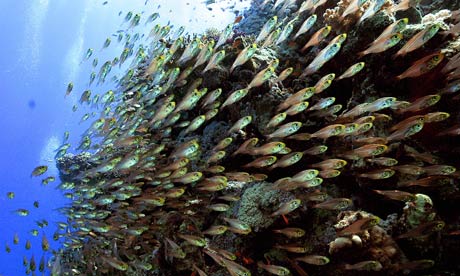
COP15 climate change and biodiversity : fishes swim over the coral reef at Sharm el-Sheikh in Egypt

Ocean Acidification Rates Pose Disaster

"A report by more than 100 of Europe's leading marine scientists, released at the climate talks this morning, states that the seas are absorbing dangerous levels of carbon dioxide as a direct result of human activity. This is already affecting marine species, for example by interfering with whale navigation and depleting planktonic species at the base of the food chain.

Ocean acidification – the facts says that acidity in the seas has increased 30% since the start of the industrial revolution. Many of the effects of this acidification are already irreversible and are expected to accelerate, according to the scientists."


Al Gore Does Not Mince Words

Here is an interview from Slate Magazine, by John Dickerson. Below is an excerpt from Al Gore, who has become a master of brevity:

"We face the gravest threat that civilization has ever confronted. It's global in nature and requires a global solution. Increased CO2 emissions anywhere, whether from China or the United States or from one of the countries that is burning its forests like Brazil or Indonesia—from wherever the emissions come, they have the same effect: They trap much more heat from the sun, melt the ice, raise the sea level, cause stronger storms, floods, drought, bigger fires, generate millions of climate refugees, destabilize political systems, threaten the growing of food crops and cause a number of other catastrophic consequences which, taken together, threaten the basis for the future of human civilization on the Earth. Because these consequences are distributed globally, the problem masquerades as a distraction. Because the length of time between causes and consequences stretches out longer than we're used to dealing with, it gives us the illusion that we have the luxury of time. Neither of those things is true. The crisis is a concrete threatening reality today. It stands to get catastrophically worse unless we take action before the accumulation [of] this global warming pollution reaches such toxic levels that the problem becomes bigger than we can solve."

Wednesday, December 9, 2009

I have arrived!

Amazing! All this time writing about climate change and not ONE denier trolled by to leave a comment. It has been so humiliating I've never even mentioned it, to anybody. Other blogs get piles and piles of denier comments, there's even a little cottage industry around analyzing their more classic denier points. Yet I was ignored as though my observations are too wild to be taken seriously.
All that changed late last night though, with this!
Anonymous said...

Checking in from a link, I'm not sure where you are going.
If you're a global warmer, you should be ashamed of the exposure of the despicable so-called "scientists" who have bought into and sold this stupid crap. Do you realize how great the economic impact can be from psuedo-science from shit-for-brains guys like Al (I have a 20,000 SF mansion and a boat the size of your whole yard Gore?

Get a life, get a brain. Do you want to live in caves? You will have to kill animals to get their fur to stay warm. Especially since the 1970'-80's next Ice Age might come back. Stop pretending you know things that you don't have a clue about.

I am so flattered by this, I hardly know where to begin. First, a disclaimer - in a very short space it contains so many of the designated traits of a denier post that I am a bit suspicious the whole thing is nothing but a prank from someone over at Denial Depot. But assuming it is legitimate, let's examine this epistle.

*Every denier point has to include Al Gore, usually mentioning his weight and/or his house. They NEVER mention how much money he has spent to green his house, how he gives everything he makes from the movie and investments in green technology to a green foundation to educate morons, and how, the theory (theory, like evolution, gravity, and plate tectonics, not a wild proposition) of global warming is grounded in scientific research, not Al Gore. Click here for an excellent interactive graph from the NYT about the long history of climate science.

*Deniers like to claim that the reason thousands of scientists and every major scientific organization agree that humans are causing climate change is because they have a financial motivation and have thus engaged in a vast global conspiracy to hoodwink the public and legislators so they can buy Ferraris with their enormous government-funded research grants. As with other denier points, this is ludicrous. Why don't they compare a university professor's annual salary of, say, $40,000 with the millions, nay billions, earned by oil, gas and coal companies and the hundreds of thousands to pay shills and lobbyists to confuse the public?

*Deniers love to bring up the long-ago and oft-debunked ice age prediction in the '70's. It was Time Magazine that made that prediction, once, based on the slimmest of scientific research. Here's a very entertaining video explaining what really happened.

*Deniers are famous for straw man arguments. That is, they invent a point you never made and then say or imply that it's false. They do that because they can't really argue the facts. In this case, Anonymous asks if I want to live in a cave and kill animals for their fur - as if that is the result, or only alternative to acknowledging climate change and converting to clean energy!

*Deniers dread change. They are so afraid someone is going to pry the teevee remote from their desperate fingers they can't even see how absurd it is to claim legislation to curb greenhouse gases will "cost too much." Aside from the fact that new industries building solar plants, electric cars, etc. would be good for the economy, this approach completely ignores the cost of NOT converting to clean energy - costs like cancer, a despoiled ecosystem, crop failures and famine, and foreign wars, not to mention rising seas and the collapse of life in the acidifying oceans.

*Deniers are frequently rude and make ad hominem attacks. In this instance, I am advised to get a life and a brain, obviously inferring I currently posses neither, and also, that I pretend to know things I haven't a clue about. This sort of random insult and the straw man are all deniers can offer by way of information, because they can't address the real issue. Note in this case, Anonymous doesn't even bother to refute one single empirical observation I have made on this blog, and claims to be unable to "see where I'm going". It's quite lazy really, because I have posted over and over several recurring themes - and frequently admitted I'm not qualified to make scientific explanations.

What I have said, is that trees are dying at an alarming rate. Other vegetation shows the same damaged foliage. Only a very large component of the environment can drive such a vast impact. I've speculated as to possible causes, from drought to ozone to ethanol emissions to the disruption of the nitrogen cycle, and tried to weigh the likelihood of each factor. Does Anonymous dispute that any of those effects from greenhouse gas emissions are harmful to vegetation? I hope not, because it's well established that they are!

*Probably forever more, there must inevitably reside in every Denier comment a reference to the infamous hacked emails. Sigh. This has been revealed, by so many writers, as nothing but a criminal theft and desperate attempt to smear all of science. But try this post at Climate Progress and do a little search there while you're at it, for more on the subject. And go to Greenfyre. Or straight to RealClimate.

*Of course everyone makes spelling and grammatical mistakes, especially on the intertubes. Nevertheless, and last but not least and almost universally true, deniers find punctuation a challenge. (I have a 20,000 SF mansion and a boat the size of your whole yard Gore?

Where, oh where is the missing parenthesis? Thank you for that, Anonymous!

And please, please don't return and tell me I've been duped according to Poe's Law!

Why does any of this matter? Because this is something humans want to avoid:

Starving polar bears turn to cannibalism

Scientists say they are aware of eight cases of bear cannibalisation so far this year  Photo: REUTERS

Tuesday, December 8, 2009

Nitrogen Cascade

This morning I heard a great rushing sound and ran to the door to see if perhaps some enormous truck was hurtling down the drive, or a helicopter landing on my roof.
Instead I was greeted by a scene right out of Hitchcock. The Birds.
Wave after wave of them flew tumultuously through the trees.
I think they are starlings - clever, invasive species, decimating native birds as though they haven't got enough to contend with from pollution and climate change already. I fear there are very few left, and like the lichen and the jellyfish this part of the ecosystem will inherit a world dominated by harsh predatory, metallic black starlings. Welcome your new ornithological overlords!

From an article linked to earlier today found at Science Daily, I have discovered the website of the International Nitrogen Initiative, where this information and much more is to be found. Excerpts follow, and most noteworthy, this is a relatively recent concentration of nitrogen in the atmosphere, which increases ozone. And it hasn't been on the radar of most climate change science.

The Problem

There are two major problems with nitrogen: some regions of the world do not have enough reactive nitrogen to sustain human life, resulting in hunger and malnutrition, while other regions have too much nitrogen (due mainly to the burning of fossil fuel and to the inefficient incorporation of nitrogen into food products) resulting in a large number of major human health and ecological effects. The rate of change of the problem is tremendous, probably greater than that for any other major ecological problem. For example, half of the synthetic nitrogen fertilizer ever used on Earth has been used in just the last 15 to 20 years. Opportunities to reduce these problems are plentiful. A prerequisite to reducing these problems is the development of a sound scientific base on which to begin to discuss policy options.

As nitrogen moves along its biogeochemical pathway, the same atom can contribute to many different negative impacts in sequence: as NOx it can increase ozone concentration in the atmosphere, decrease atmospheric visibility, and increase acidity of precipitation; following deposition it can increase soil acidity, decrease biodiversity, lead to coastal eutrophication, and then emitted back to the atmosphere as nitrous oxide it can increase greenhouse warming, and decrease stratospheric ozone. Nitrogen can be transported to any part of the Earth system, no matter where it was introduced. This sequence of effects has been termed the nitrogen cascade.

Blog Archive

My Blog List

Search This Blog

Followers

counter