Since it's a holiday weekend, I figure hardly anybody is going to be interested in learning about how trees are dying from air pollution, or that climate change is going to render most if not all of our planet uninhabitable - so I'll save the newest evidence for later. Meanwhile, this totally adorable video literally made me cry, so get out the hanky and enjoy!
Sunday, May 27, 2012


Make A Racket!
On Thursday when I brought my tambourine to the Occupy protest at Goldman Sachs in Jersey City, I was awarded the highest accolade - an official, silkscreened Occupy Guitarmy armband!


The first time I joined the Drum Circle, I learned that it's ever so much more fun to make noise in a protest than just walk quietly, even if I haven't got any musical talent to speak of - so I was delighted and honored to have finally passed the audition. This wonderful video from Quebec, where people are demonstrating against emergency law Bill 78, is in the finest tradition.
Thursday, May 24, 2012
The Great Vampire Squid Has Tentacles Everywhere

Photos of the imminent threat to security and commerce posed by the sodden but spirited protesters are from Joe Colchic.

From Gayle Price, before the deluge:

Outside on the waterfront promenade below, dozens of Wall Street Occupiers protested the Great Vampire Squid Goldman Sachs shareholders' meeting, by peacefully playing music and chanting in support of low-wage slaves - oops, sorry, workers. When a sudden, heavy outburst deluged the assembly they ran for refuge under the portico of Barclay's Bank.
Even though it was raining so heavily not a single person was to be seen attempting to gain access to the entrance, Barclay's complained to the Jersey City Police, who were forced then to also become drenched and inform the sodden citizens that, with umbrellas, or sans (the new version of sans-culottes!), they would have to wade out into the flooded streets and seek shelter elsewhere. That included media with unprotected equipment, despite their objections.
Barclay's would be justifiably denounced for treating dogs so callously but then again, if the right wing 1% is anything like their chosen silver-spooned leader, Romney, that's nothing new.
Shame on these vicious, paranoid oiligarchs.
Update! From the HuffPo, and if you're not familiar with how this works the explanation is here.
Wednesday, May 23, 2012
Baffled and Also Helpless
I feel repentent because I shouldn't have let this happen again - but once more, evidence of what Craig Dilworth calls the "Vicious Circle Principle" (from Amazon, Too Smart for Our Own Good - The Ecological Predicament of Humankind) has outpaced my ability to absorb, let alone post links - so there will ensue far too many. Actually, I first have to backtrack to last weekend, when I stopped along my way home from Philadelphia. Despite the poor quality light and constant drizzle, I could not resist tracking back to take a picture of this enormous fallen tree, before all evidence of its long and no doubt splendid lifespan is forever eradicated.


 I didn't want to tread further on his hospitality so I refrained from mentioning to him, that the bark of the standing trees is exhibiting the corrosion and deterioration that is typical now for trees that are expiring from air pollution.
 We discussed why so many others, and not just that oak, have fallen in recent years - two on his rooftop, collapsing the chimney. He mentioned climate change and volunteered that the wooly adelgid is killing hemlocks. "We don't even plant them anymore around here," he said, "the zones have changed and it's too warm for them now."


 Outside the kitchen window, a robin built her nest in the clematis, a vine that is using the remaining structure of a dead purple cotinus as a trellis. It's a sweet spot - the babies are bathed in a pink light, and the mohter scolds me whenever I try to get close enough for a picture of them.


 I came upon a signs taped to trees that I've never seen before, advising visitors not to be concerned if they smell acrid burnt wood.
 When I got home, I called the Forest Service and asked why they were doing prescribed burns at the Kay Center, and a fellow in the Northern district informed me that it had been requested by the Morris County Park Service to "reduce fuel loads". So, I called the Park Service and was informed by them that in fact, the Fire Service had first approached them with a plan implemented in 2010, which they went along with because they believe it will help their goals to control invasive species and encourage "forest regeneration".
Leaving aside the incredible idiocy that you can make forests healthier by producing even more toxins the air, I called the Forest Service back to see if there had ever been a fire at the Kay Center before. "Not that I'm familiar with", was the answer. So what could warrant this risky prescribed burning? Apparently, it's being done at other county parks as well, and the responsibility for making the decision is being shuffled from agency to agency. Here's the NJ Forest Service map of major wildfires. It doesn't rule out smaller incidents elsewhere, but certainly it begs the question why there is so much concern about the potential for fires in Northern New Jersey when there haven't been any before, particularly in a recession with scarce resources to be allocated to other essential services.

 There is so much large wood on the ground that they aren't attempting to remove that, the intention is to eliminate dried leaves and brush.
 The rest of the trip was a little shocking and rather difficult.
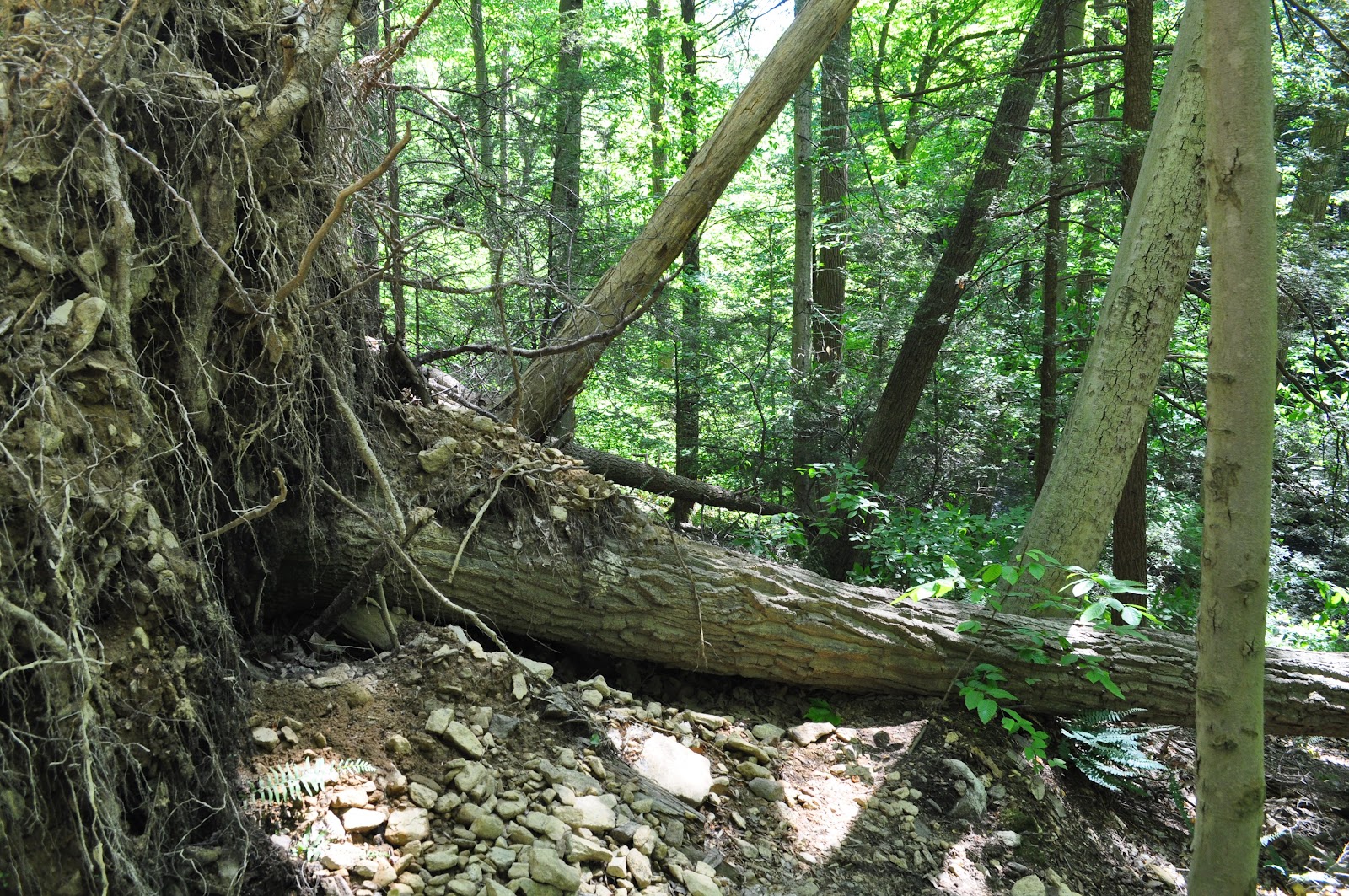
 Since I was there in September, at least a dozen massive trees have crashed across the trail, blocking travel.
 The hike is very steep, making some of them were quite difficult to climb over.
 Not one of them was on the ground last fall, when the hike was unimpeded. Now you look ahead and see one log after the other.
 I only took photos of the trunks lying across the trail.
 One either side, up and down the slopes were countless others.


 Meanwhile, everyone (didn't we all?) just celebrated "World Biodiversity Day", yesterday. Here's the WorldWatch description of this event, which is a chilling assessment, frankly:
 "This World Biodiversity Day (May 22), Worldwatch Institute is raising awareness of biodiversity losses worldwide and what individuals and institutions can do to confront these trends. The current rate of species extinction is up to 1,000 times above the Earth’s normal extinction rate, a level of loss that has not occurred since the extinction of the dinosaurs 65 million years ago. The Worldwatch Institute, in its recently released report State of the World 2012: Moving Toward Sustainable Prosperity, highlights the threats to biodiversity and methods for combating the exploitation and degradation of ecosystems and their services."
 "From 1980 to 2008, an average of 52 species per year moved one category closer to extinction on the International Union for Conservation of Nature’s Red List of Endangered Species—a rate that shows no signs of slowing. Although mass extinctions have occurred on Earth throughout geologic time, the current loss of biodiversity is the first to be caused overwhelmingly by a single species: humans. The five principal pressures causing biodiversity loss are habitat change, overexploitation, pollution, invasive alien species and climate change, all of which are almost exclusively human driven."


In a HuffPo article, "G8 Deaf to Climate Change Warnings by International Energy Agency", our world leaders are accused of "speaking in platitudes" which are, surprise surprise, echoed in the very limited and timid "solutions" offered by the author to "keep that door to 2C open" which are: 1) More Renewables, 2) Displace Fossil Fuels and 3) Conservation and Efficiency. So for all the good it would do, I contributed my two cents:
In this instance "new eco-devastation" refers to the mining of silica in Wyoming, mountains of which are required for the process of fracking for natural gas, which is proceeding at a frantic rate. Imagine, if this is how American citizens are treated, just how helpless the landless, indigenous people in third-world countries are when multi-national corporations come sniffing around for resources.

Those are my keys looking so teeny on the stump.

I was caught out spying by the owner of the antique brick farmhouse when he came up the drive in his pickup truck. Luckily, although he looked a little bewildered, instead of ordering me off the premises or, worse, shooting me, he explained it was at least a century-and-a-half year old oak that had split in two...and even though he is in the landscaping business, it's so enormous that it has been taking him months to gradually carve it up and remove it piecemeal with heavy equipment.

He also pointed out several other stately trees of significant age and size on the property, which must have been owned and planted with exotic species by a tree lover who was emulating nearby Longwood Arboretum.

He had handsome specimens of sassafras, monkey puzzle tree, a rare large magnolia, and ginko. He pointed to the big trees still remaining and said mature as they are, they had been dwarfed, underneath that oak's canopy, which was seventy feet in diameter.


This is the sort of well-intentioned but nonsensical absurdity that I constantly encounter. One of the habitats famously known for lush hemlock growth has traditionally been Georgia where their loss is deeply mourned - but Pennsylvania has a way to go before those temperatures are rivaled. I mentioned air pollution as perhaps the primary source encouraging insect infestation, but like most people he brushed it aside without pausing to consider it, even though his yellowing mahonia has all the classic symptoms of exposure to ozone - stippling of stomata, chlorosis followed by necrosis, and then complete loss of inner leaves.

It is slightly better well-known that air pollution is unhealthy for people, however - which doesn't deter the politicians from wanting to force the EPA to begin to consider cost to polluters when determining safe levels, a outrageous notion. An article in The Arizona Republic from last year is, if anything, more pertinent than it was then - as precursor emissions increase globally and travel, and combine with ever-rising temperatures, higher levels of ozone result even in rural places. Here's the story:
Phoenix-area heat wave ushers in ozone season; residents urged to take steps to curb pollution
"Maricopa County's ozone season starts today with a fresh burst of heat and sunlight, two key ingredients needed for unhealthful levels of the smog to form. Temperatures could rise to nearly 100 degrees today as a strong high-pressure system creates the ideal conditions for ground-level ozone. The other elements - vehicle exhaust, power-plant emissions, gasoline, paint and industrial solvents - are always in abundant supply."
"Ozone levels already were climbing late Thursday as the heat wave developed, and officials predicted the pollutant would reach moderate levels later today, although no ozone-related health advisories are expected."
"The county has tried to reduce ozone pollution for years but has struggled to meet the federal standards. The desert's heat produces more ozone, and weather conditions trap it in the air. But much of the problem can be traced to the region's rapid growth, which has increased the number of vehicles on the road and added to other pollution-contributing activities."
"Although state and county officials have submitted a plan to reduce pollution levels, the region is in violation of the existing standard of 75 parts per billion, as measured over an eight-hour period. The county exceeded that standard on 10 days during 2010."
"The U.S. Environmental Protection Agency is reviewing a proposal to further reduce the allowable ozone levels to between 60 and 70 ppb. At the highest level in that range, Maricopa County would exceed the standards even more frequently; at some of the lower levels in the range, many areas of rural Arizona, including Yuma, Gila, La Paz and Navajo counties, could fail to comply based on three-year averages the EPA uses to compute ozone levels."
"Vehicle-exhaust and power-plant emissions contribute to ozone levels in some of those areas, but rural officials say some of the pollutants are carried to their communities by the wind, a factor the EPA acknowledges. Those smaller counties say they could not afford to monitor ozone or impose programs such as emissions testing for cars and trucks."
"Elected officials and business lobbyists nationwide have urged the EPA not to adopt such strict standards, and the agency has postponed its final decision several times. A new limit is now set to be announced in July, but opponents are fighting to further delay any action." [Update: the opponents won that last fall when the Obama administration caved in to industry pressure.]
"'Each time the standard is lowered, you have to put more controls in place,' Ward said. 'We are having a hard time meeting the current standard. So, should that go lower, we know we could be in trouble.'"
"If an area consistently exceeds limits and fails to reduce pollution levels, the EPA can impose a federal plan and withhold highway funding. Scientists say the evidence is clear that ozone can cause health problems, making it more difficult for people to breathe. It can cause coughing and shortness of breath and can increase the frequency of asthma attacks. It also can increase health risks among people with heart and lung ailments. New research released by the EPA last month suggested that long-term exposure to ozone could result in more premature deaths."
"Ozone also can interfere with the ability of some plants and trees to produce and store food and can make some plants more vulnerable to disease, insects or harsh weather."
I love the way that last sentence is slipped in at the end. Does anyone ever read all the way through and think about the implications of vegetation losing its immune defense against disease, insects and harsh weather? It's important to note that the threshold level at which plants are damaged by ozone is 40 ppb, far below current standards of regulation.
Thanks to my friend Tenney who publishes the famously excellent aggregate blog of all things climate, I can share this link to an interactive toy that can be used at any hour to determine just how much poison you and all the trees and plants and animals are inhaling within the contiguous United States. Just mouse over the various categories and you can have it measured every which way. Below is a map with the forecast for this coming Friday (and it's only May!). It's obvious that the ENTIRE COUNTRY, even remote places, exceeds 40 ppb.

Upon my return, I have been chasing birds like this Baltimore Oriole.


I hadn't realize how cleverly I planted a succession of enchantingly fragrant plants - right now, the Japanese Fringe tree is blooming, following months with contributions from the winter honeysuckle, flowering apricot, and wisteria. It is magical to sit on the porch and breathe it in.

I decided to let the entire lawn go. I can't afford the mowing service, and I loathe the noise and fumes. The copper beach and variegated willow I planted are big enough now that they can grow above a wild meadow without being squelched by vines and multiflora.

The first sunny day, I decided to take a hike through a nearby park, the Kay Environmental Center. When I saw several of these peculiar growths on little white oak saplings, I thought excitedly - perhaps I had finally for real discovered the source of all our problems - invasive alien pods from outer space!

But it turns out to be Calliphytis seminator - a growth that is stimulated by a wasp laying eggs, also called a wool sower gall.

The field along the drive into the park has been planted not too long ago with hollies, but they are exactly as dismal as all the others struggling for survival in New Jersey - just like the mahonia pictured at the top of this post. It's a pity, because a verdant glossy green holly, with it's brilliant berries, is a majestic thing to behold on a snowy winter day.

Their leaves cannot photosynthesize, so they turn yellow, and the oldest, inner leaves that have had seasons of cumulative exposure have fallen off entirely.
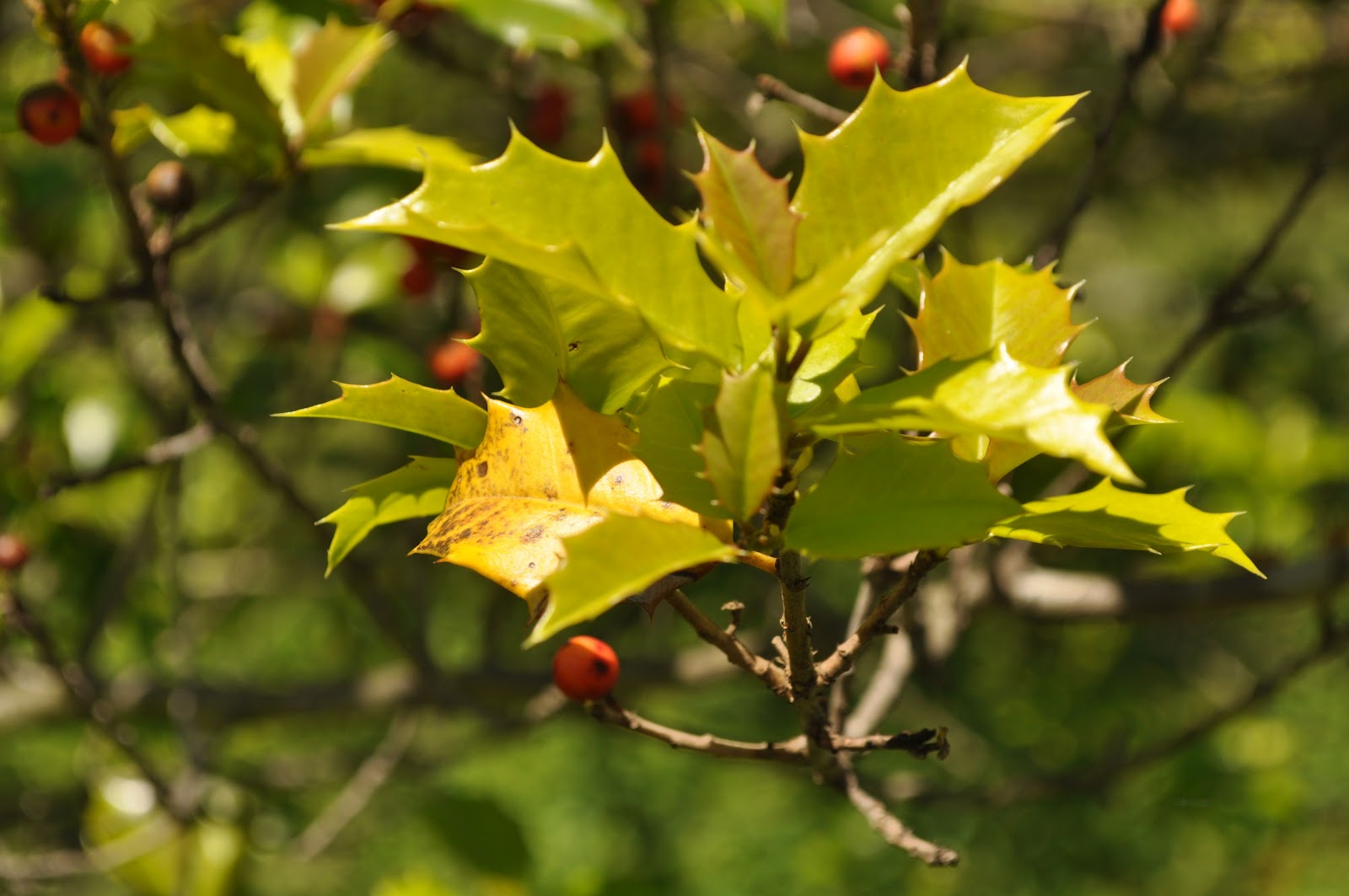
Before I started to hike down the trail to the river, symptoms of interior rot were to be found on every tree.

It would be very hard to exaggerate how prevalent these kinds of bare branches are this spring.

The usual signs of lethal fungus are ever more common sights.

But there are still lots of bluebirds!

Already, oak leaves that have barely emerged are turning black on the edges.

Some others on the forest floor have the typical interveinal fading that will progress to a worse loss of pigmentation.

The top of the trail is lined with privets shrubs, all of which have yellowing leaves.

These beech leaves are showing problems early this year. If anyone wants to compare, there are pictures of leaves in the park from last September, in considerably worse condition then as the growing season progressed, in this post.


Leaving aside the incredible idiocy that you can make forests healthier by producing even more toxins the air, I called the Forest Service back to see if there had ever been a fire at the Kay Center before. "Not that I'm familiar with", was the answer. So what could warrant this risky prescribed burning? Apparently, it's being done at other county parks as well, and the responsibility for making the decision is being shuffled from agency to agency. Here's the NJ Forest Service map of major wildfires. It doesn't rule out smaller incidents elsewhere, but certainly it begs the question why there is so much concern about the potential for fires in Northern New Jersey when there haven't been any before, particularly in a recession with scarce resources to be allocated to other essential services.

Indeed as I ventured further down the path it became obvious that burning had taken place, sometime over the winter.



Where a deep green canopy shaded this forest just a few years ago, bright sunlight was pouring through the empty spaces recently vacated above.

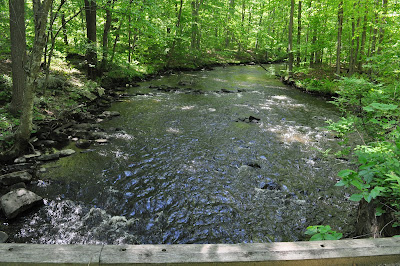
Looking upstream from this little bridge you could almost think that this sylvan glade is perfect...and perfectly normal.

The water sparkles downstream too, in sun that should be obscured by the cool dark fronds of evergreen hemlocks and laurels, all reduced to bare sticks now.


“'The current model of consumer societies is destroying the planet and its resources,' said Bo Normander, director of Worldwatch Institute Europe and a contributing author to State of the World 2012. 'This must change in order for the planet to sustain future generations.'”
"At the 1992 United Nations Conference on Environment and Development in Rio de Janeiro, Brazil, leaders made a commitment to preserve biological resources by signing the Convention on Biological Diversity (CBD), but there remains a fundamental lack of political will to act on biodiversity threats. In 2002, the CBD promised 'a significant reduction of the current rate of biodiversity loss' by 2010, yet within those eight years, most countries failed to meet their targets.
To combat the loss of Earth’s natural capital, scientists strive to assign concrete values to natural resources with the hope that an economic appreciation of ecosystem services may facilitate improved planning and management of Earth’s systems. Yet progress on developing accurate, straightforward and widely accepted measures for assessing ecosystem values remains slow."

And as if to punctuate this on a local scale, Scientific American tells us that "Rapid Climate Changes Turn North Woods Into Moose Graveyard" even though there is absolutely no proof - especially since moose thrive in warmer climates, such as Eastern Canada, than the area under study in Michigan - that rising temperatures are to blame - when it could just as well be a lack of food from tree death:
"Meanwhile, annual surveys taken from helicopter overflights show that the state's primary moose population, in the state's northeastern Arrowhead region, has been halved in just six years, dropping from 8,840 animals in 2006 to just 4,230 this year. The decline mirrors a similar collapse a decade ago in the state's northwest corner, where moose plummeted from an estimated 4,000 animals in the mid-1980s to less than 100 by the mid-2000s."
They list all sorts of maladies affecting the population - parasites and insects - but the only mention they make of the food supply is this:
They list all sorts of maladies affecting the population - parasites and insects - but the only mention they make of the food supply is this:
"...what moose need to thrive. That includes large, contiguous forest tracts with dense stands of fir, spruce and pine trees that provide cover against harsh weather conditions, along with a healthy mix of birch and aspen trees whose bark and tender saplings are the original "'moose munch.'"
And then they conclude: "The biologists are baffled and also helpless". Haven't they heard of the mysterious "SAD - sudden aspen decline"?
Well, animals that have to spend more time foraging - and/or, if their source of food is delinquent in nutritive content - will likely fall prey to all sorts of other stressors.
And then they conclude: "The biologists are baffled and also helpless". Haven't they heard of the mysterious "SAD - sudden aspen decline"?
Well, animals that have to spend more time foraging - and/or, if their source of food is delinquent in nutritive content - will likely fall prey to all sorts of other stressors.
Another report worthy of consideration is a WorldWatch link to a thought-provoking piece in the New York Times about meat consumption, We Could Be Heros:
"Five years ago, the United Nations Food and Agricultural Organization published a report called
'Livestock’s Long Shadow,' which maintained that 18 percent of greenhouse gases were attributable to the raising of animals for food. The number was startling."
"A couple of years later, however, it was suggested that the number was too small. Two environmental specialists for the World Bank, Robert Goodland (the bank’s former lead environmental adviser) and Jeff Anhang, claimed, in an article in World Watch, that the number was more like 51 percent. It’s been suggested that that number is extreme, but the men stand by it, as Mr. Goodland wrote to me this week: 'All that greenhouse gas isn’t emitted directly by animals. But according to the most widely-used rules of counting greenhouse gases, indirect emissions should be counted when they are large and when something can be done to mitigate or reduce them.'”
"The exact number doesn’t matter. What does is that few people take the role of livestock in producing greenhouse gases seriously enough. Even most climate change experts focus on new forms of energy — which cannot possibly be effective quickly enough or produced on a broad enough scale to avert what may be the coming catastrophe — and often ignore the much easier fix of adjusting our eating habits."
"It’s good that we’re eating somewhat less meat, but it still amounts to something just shy of a
staggering 200 pounds per person per year. And no matter how that number changes domestically,
on the world scale there’s troubling movement in the wrong direction. Meat consumption in China is now twice what it is in the United States (in 1978 it was only one-third). We still eat twice as much per capita as the Chinese, but when they catch up they’ll consume more than four times as much as we do."
"But the Chinese don’t need to eat like us; we need to eat like them. Or, rather, like they did until
recently."
"If you believe that earth’s natural resources are limitless, which maybe was excusable 100 years ago but is the height of ignorance now, or that “technology will fix it” or that we can simply go mine them in outer space with Newt Gingrich, I guess none of this worries you. But if you believe in reality, and you’d like that to be a place that your kids get to enjoy, this is a big deal."
Well, all I can say is that a quick view of this video, which I can't embed but is highly instructive, will give a pretty good idea of how seriously humanity is taking potential shortages of anything. It's titled "Helium Shortage is No Laughing Matter" and then procedes to make a joke of it. It's really funny, it made me laugh! Especially because all those stupid balloons end up being nothing but wasted, dangerously poisonous trash anyway. But they don't mention that.
In a HuffPo article, "G8 Deaf to Climate Change Warnings by International Energy Agency", our world leaders are accused of "speaking in platitudes" which are, surprise surprise, echoed in the very limited and timid "solutions" offered by the author to "keep that door to 2C open" which are: 1) More Renewables, 2) Displace Fossil Fuels and 3) Conservation and Efficiency. So for all the good it would do, I contributed my two cents:
This article minces around the point, too. Those three things alluded to won't be nearly enough to spare the earth from catastrophic climate change without drastic, deep, dramatic sacrifices by the biggest energy hogs. That means, no more flying on vacations or business, local food production - cut back on global shipping and other long distance transport, an end to single-passenger and gas guzzling cars, no more wasting energy for unnecessary things like snow-mobiling, lawn mowing and Christmas tree lights. Energy should be rationed.
Articles that shirk from pointing out the necessity of this radical curtailment simply enable the delusion that industrial civilization can ever be made sustainable. No matter how many windmills you put up, it will never be enough to replace the concentrated power of fossilized fuel and furthermore, the level of resource extraction and pollution are all by themselves in overshoot.
Furthermore, the human population is well beyond the planet's carrying capacity. If we were rational we would immediately curtail family size but it's far more likely, unfortunately, that Mother Nature will figure out a less pleasant way of reducing our rampant growth.
Out of curiosity I followed up on the author's credentials and saw she is head of the TCKTCKTCK campaign, a loose coalition of green organizations. One of the links on their webpage led to a recent post by David Suzuki, "Environmentalism Has Failed" which seems to be a popular notion lately and one that irritates me no end. A young woman put a similar sentiment on facebook a couple of days ago, complaining that her parents' attempts had been useless. She proclaimed that she's not an environmentalist, she's for clean energy! which strikes me as about the same as those young women who like to proclaim proudly that they are "not feminists" while ignoring the very real struggles and sacrifices historically made by their predecessors so that they can enjoy the rights and freedoms they now take for granted. Grrr.
Admittedly, Suzuki could have a legitimate point when he says: "...we were so focused on battling opponents and seeking public support that we failed to realize these battles reflect fundamentally different ways of seeing our place in the world," if by "seeking public support" he means "securing corporate financing" and by the failure to realize these battles "...reflect fundamentally different ways of seeing our place in the world" he means that too many Big Greens never challenged the industrial system and just nibbled around the edges, preserving a few acres (and their own jobs and prestige) here and there....temporarily...until some precious resource was discovered under that protected ground, like the Tar Sands.
There were comments made to that post, about the financial crisis impeding progress in conservation which to me, is as much as anything a conveniently manufactured excuse to frighten the public into accepting the dismantling of old and prevention of new regulations, as well as shred the social safety net. Anyway, this comment from "Weary of Hypocrites" sarcastically quoted:
"During the 20th century, our numbers increased fourfold..." and "When we believe the entire world is filled with unlimited 'resource' provided for our use, we act accordingly." Totally - Mr FIVE KIDS!
Seriously? I googled that and found out, it's true, Suzuki had five children with two different wives. Now, it's a fact that I had three myself but the point is, I wasn't contemporaneously offering myself as a leader preaching for environmentalism and against overpopulation! [As an aside, that search came up with a Canadian denier site where the most recent entry was an explanation as to why the writer had decided to not speak at the Heartland conference after all, following the ill-fated billboard advertisement linking climate activists to terrorists. Ha! Small world...]
The Telegraph and others reported, however, that the G8 conference endorsed a baby step towards acknowledging the dangers of those "other" emissions in their article, G8 Leaders Open Up Vital New Front in the Battle to Control Global Warming:
"It seems to have gone virtually unnoticed, but the world leaders at the weekend's G8 summit look as if they have taken the biggest step in years in tackling climate change. And it's quite apart from anything to do with carbon dioxide."
"The summit's final communiqué, the Camp David Declaration, supports “comprehensive actions” to reduce “short-lived climate pollutants”. These substances – including black carbon (soot), methane, ground-level ozone, and hydrofluorocarbons – are responsible for about half of global warming. Straightforward measures to address them, a report by the United Nations Environment Programme concluded last year, would delay dangerous climate change by more than three decades, buying crucial time for the much more difficult process of slashing carbon dioxide emissions."
"More important still, the measures would save some 2.4 million lives a year, mainly by cutting the inhalation of soot, chiefly emitted by vehicle diesel engines and by the inefficient wood and dung burning cookstoves used by most of the world's poorest people – and increase grain harvests, at present hit by pollution, by 52 million tons a year."
"While the international climate negotiations drag on, these pollutants can be reduced through existing national laws and regulations, using technologies that are already available. And many climate sceptics agree on the importance of doing so: Senator James Inhofe, who pioneered Republican rejection of action to curb carbon dioxide, supports it on black carbon, while Canada – which caused controversy this winter by quitting the Kyoto Protocol – has been in the forefront of countries urging an assault on such the short-lived agents of climate change."
"While the international climate negotiations drag on, these pollutants can be reduced through existing national laws and regulations, using technologies that are already available. And many climate sceptics agree on the importance of doing so: Senator James Inhofe, who pioneered Republican rejection of action to curb carbon dioxide, supports it on black carbon, while Canada – which caused controversy this winter by quitting the Kyoto Protocol – has been in the forefront of countries urging an assault on such the short-lived agents of climate change."
"The G8's endorsement of action at the weekend is a triumph for the small Institute for Governance and Sustainable Development (IGSD), which has been campaigning for action on the pollutants while most climate scientists and green pressure groups have ignored them. In just a few short years it has brought the issue from invisibility to the agendas of the world's most powerful leaders. In February six governments – including the US, Canada and Mexico – launched a five year programme to tackle them, and the rest of the G8 has now signed up to it. And it commissioned the World Bank to produce a report on how it can integrate ways of reducing them into its activities..."
"It will remain important to continue this international effort. But as Durwood Zaelke, the IGSD president puts it 'the solution-orientated approach' of the programme to address the short-lived pollutants can 'show the world it is possible to start meeting the climate challenge.'”
I, for one, welcome this approach and commented:
I, for one, welcome this approach and commented:
It's a pity that most climate activists and scientists are blinded by CO2. It's a terrible mistake in strategy because it's far more likely that the public and policy makers, if they were educated about the damage from pollution, would be prepared to make the drastic sacrifices required to reduce it.
Ozone for instance, not only reduces annual crop yield and quality as mentioned glancingly in this article, but cumulative damage is literally killing forests all over the world, by compromising the ability of trees to fend off naturally occurring insects, disease and fungus that they once coexisted with. Repairing ozone injury to leaves and needles reduces root mass, making trees (and other plantlife) more fragile in times of drought and to wind. We ignore this at our peril.I suppose we can expect to be hearing much more about another emerging scandal as reported at TomDispatch, "...The New Eco-Devastation in Rural America". It's amazing how there is never a dearth of fresh shining examples that reveal our insatiable lust for energy and concurrent willingness to destroy Nature to get it.
In this instance "new eco-devastation" refers to the mining of silica in Wyoming, mountains of which are required for the process of fracking for natural gas, which is proceeding at a frantic rate. Imagine, if this is how American citizens are treated, just how helpless the landless, indigenous people in third-world countries are when multi-national corporations come sniffing around for resources.
"Frac-sand corporations count on a combination of naïveté, trust, and incomprehension in rural hamlets that previously dealt with companies no larger than Wisconsin’s local sand and gravel industries. Before 2008, town boards had never handled anything beyond road maintenance and other basic municipal issues. Today, multinational corporations use their considerable resources to steamroll local councils and win sweetheart deals. That’s how the residents of Tunnel City got taken to the cleaners."
"There was also no need for jumping the hurdles zoning laws sometimes erect. Like many Wisconsin towns where a culture of diehard individualism sees zoning as an assault on personal freedom, Greenfield and all its municipalities, including Tunnel City, are unzoned. This allowed the corporation to make deals with individual landowners…"
"There was no time for public education about the potential negative possibilities of frac-sand mining: the destruction of the hills, the decline in property values, the danger of silicosis (once considered a strictly occupational lung disease) from blowing silica dust, contamination of ground water from the chemicals used in the processing plants, the blaze of lights all night long, noise from hundreds of train cars, houses shaken by blasting."
ClimateCrocks published a couple of very intriguing maps about the "cooling hole" over the eastern US from sulphate pollution. Since emissions have been greatly reduced in this country, that effect is almost nullified - but it makes you wonder why foresters blame the trees dying on the eastern seaboard and Appalachian mountains on global warming - doesn't it? Recall that, for no scientific reason at all, the reduction in maple syrup production, and loss of fall color, has been blamed on temperature and now, even a "yucky taste"! This is from the post:


At the end is a brief video that also has a great depiction of the global dimming - oh and wish me luck tomorrow! OWS is going to confront the tentacled Great Vampire Squid at Goldman Sachs HQ in Jersey City first thing in the morning...because, why not?

ClimateCrocks published a couple of very intriguing maps about the "cooling hole" over the eastern US from sulphate pollution. Since emissions have been greatly reduced in this country, that effect is almost nullified - but it makes you wonder why foresters blame the trees dying on the eastern seaboard and Appalachian mountains on global warming - doesn't it? Recall that, for no scientific reason at all, the reduction in maple syrup production, and loss of fall color, has been blamed on temperature and now, even a "yucky taste"! This is from the post:
"Temperatures are increasing on a global scale, but at the regional level, the story gets complicated. In the central and eastern United States, for example, warming has not kept pace with other parts of the world over much of the last century."
"As shown in the lower map, which is based on data from NASA’s Surface Temperature Analysis (GISTEMP), parts of the United States even cooled between 1930 and 1990. Areas of the greatest cooling are blue; those that warmed are red. Climate scientists have taken to calling the large area of cooling a “warming hole” because the areas surrounding it have warmed at a faster rate."


"For more than a decade, researchers have puzzled over what’s causing the warming hole over the United States. Previous research has suggested natural variations in sea surface temperatures might be responsible, but a new study puts the focus on sulfates, a type of aerosol produced by coal power plants that’s known for causing acid rain. Sulfates are light-colored, and they cause cooling by scattering and reflecting sunlight. They also lower temperatures indirectly by making clouds more reflective and long-lasting."
"The researchers, led by Eric Leibensperger when he was at Harvard University, used global climate models to estimate the cooling effect sulfates have had on the climate of the United States since 1950. As seen in the top map, they found that between 1970 and 1990—the period when sulfates were at their highest levels—average temperatures were nearly 1°Celsius (1.8°Fahrenheit) cooler in a core area centered on Arkansas and Missouri and about 0.7°Celsius cooler in a larger tear-drop region throughout the Midwest and Mid-Atlantic. The cooling effect extended into the North Atlantic Ocean as well; sulfate pollution lowered sea surface temperatures there by 0.3°Celsius."
"Leibensperger’s research also shows that the cooling effect from sulfates is diminishing. The amount of the pollutant in the atmosphere has declined significantly in the last few decades due to the Clean Air Act. According to Environmental Protection Agency estimates, the amount of sulfur dioxide (a precursor to sulfates) released into the atmosphere fell by 58 percent between 1980 and 2010. Satellites have confirmed the decrease; the Ozone Monitoring Instrument (OMI) on the Aquasatellite observed a sharp decline in sulfates over the eastern United States between 2005 and 2010."
"As a response to the declining sulfate levels, Leibensperger’s modeling shows temperatures over the central and eastern United States have increased by 0.3°Celsius between 1980 and 2010. How much more warming can we expect as sulfate concentrations continue to decline? Not much, according to Leibensperger. Sulfate concentrations have declined so much already that the impact of future decreases won’t be nearly as substantial."
At the end is a brief video that also has a great depiction of the global dimming - oh and wish me luck tomorrow! OWS is going to confront the tentacled Great Vampire Squid at Goldman Sachs HQ in Jersey City first thing in the morning...because, why not?

Monday, May 21, 2012
Sinking Deeply into Chronic Disaster
This blog is mostly about ecosystem collapse and more specifically, trees dying from ozone. Other sorts of collapse (and they are myriad) are well-covered elsewhere. But a couple of purely economic items seemed worthy of noting here, because the innately rapacious system of profit-driven capitalism is in many ways driving our relentless pollution, destruction, and extraction of resources.

In Island, Aldous Huxley wrote: “Armaments, universal debt, and planned obsolescence - those are the three pillars of Western prosperity. If war, waste, and moneylenders were abolished, you'd collapse. And while you people are overconsuming the rest of the world sinks more and more deeply into chronic disaster.”
So, I invite you to read a chilling undercover accounting that imparts a visceral impression of what it's like to be a wage-slave in modern America, at Mother Jones. It's a wonderful companion to pair with this brief but pointed TED talk, which has been censored. The transcript is here. There's been a lot of discussion about why TED refused to post this talk on their site. Their curator, Anderson, who has scrambled for plausible explanations offered this one in an email:
That seems like a thin excuse, because the speaker, Hanauer, takes a broad swipe at both parties. Personally, I think it's simply his painfully cynical and apt observation that it's no coincidence that "job creator" is only one word away from "The Creator", with all the irreverence for BOTH types that implies. For an American audience that's a giant No-No.

So, I invite you to read a chilling undercover accounting that imparts a visceral impression of what it's like to be a wage-slave in modern America, at Mother Jones. It's a wonderful companion to pair with this brief but pointed TED talk, which has been censored. The transcript is here. There's been a lot of discussion about why TED refused to post this talk on their site. Their curator, Anderson, who has scrambled for plausible explanations offered this one in an email:
"...But even if the talk was rated a home run, we couldn't release it, because it would be unquestionably regarded as out and out political. We're in the middle of an election year in the US. Your argument comes down firmly on the side of one party. And you even reference that at the start of the talk. TED is nonpartisan and is fighting a constant battle with TEDx organizers to respect that principle...."
That seems like a thin excuse, because the speaker, Hanauer, takes a broad swipe at both parties. Personally, I think it's simply his painfully cynical and apt observation that it's no coincidence that "job creator" is only one word away from "The Creator", with all the irreverence for BOTH types that implies. For an American audience that's a giant No-No.
Saturday, May 19, 2012
A Dangerous Illusion
The normally circumspect Yale Forum on Climate Change and the Media posted an ill-advised link to TVMOB's latest mumbo-jumbo. With enormous discretion and restraint, I limited my response to the following: "I waste no time rebutting creationists or alchemists, either. Monkton’s blather is garbage, not science, and not worthy of my comment – and no more worthy of space than witchcraft or voodoo on this site either."
I've been stricken with unwarranted sadness since I got home from Pennsylvania and found an adorable little dead bird on the porch. I had no luck identifying it myself so finally I sent a photograph of the corpse to the Cornell Lab of Ornithology, and a helpful person on the other side of the computer screen told me it was an ovenbird.
What? I never heard of an ovenbird, but apparently it is so named because it builds its nest on the forest floor. It's a very pretty, tiny thing, and why it strayed from its habitat and felt like flying head-on into the glass door, no doubt breaking its neck, I don't know. I feel pretty terrible about it though. It seems impossible to live anymore without knowing that my very existence is causing other things not to.
So it's been a rough week between that and all the trees that can't manage to leaf out any more (but I'll hold off on pictures), even though I found a terrific blog, 22 billion energy slaves, by a wonderful writer in Denmark that I have enjoyed reading. The first thing I saw there was this cartoon, which brilliantly encapsulates the blind inanity of what passes for human intelligence, and reminds me that we really, truly, fully deserve the multiple self-induced disasters that are coming our way.

One of the manifestations of the above are those scientists who refuse to be frank about the severity of problems we face, whether it's from climate change or from pollution. (I don't even expect economists to be honest, why is that?) Going back in the time machine, a 2005 New Scientist article by Fred Pearce, Climate Change Warning Over Food Production, describes a meeting attended by Steve Long, which is reproduced after the picture. These photos of the Tar Sands were taken by Robert Johnson from Business Insider, during an unauthorized fly-over of restricted areas. There are many more at his site, with captions, which are interesting because the size of the equipment is mind-boggling. I suggest sharing that excellent essay the next time somebody mentions that windmills kill birds, or solar panels spoil the view. The first step at the Tar Sands is to flatten the forest. How's that for habitat destruction?
 "'We need to seriously re-examine our predictions of future global food production,' said Steve Long, a crop scientist at the University of Illinois at Urbana-Champaign, US. Output is 'likely to be far lower than previously estimated'."


 Then again, everyone has their comforting - if dangerous - illusions. Another nice website new to me this week is Deep Green Resistance News Service, where an interesting discussion ensued around the review of a book by the reliably annoying Archdruid, John Michael Greer. JMG, as he is fondly known to his acolytes, is smugly certain that he has a handle on how to survive peak oil. Owen Lloyd, the reviewer, pointed out that "...just as you can’t end rape by not raping anyone, and you can’t end genocide by not killing anyone, you can’t stop global capitalism by simply ending (or more likely, reducing) your participation in it. I find that just another example of magical thinking."
Which I quite liked, and added for my part:


Indeed there were many stories of active fires provoking evacuations in the news this week, one of which predicts a "Summer of Flames", a prospect which, being as how Wit's End is located in the middle of the woods, frankly terrifies me.


Yes! Plant forests so they can absorb pollution - that's been working out quite well so far!
Who knew that there is an entire independent publication devoted to stalking the EPA? I discovered it's possible to register and read all the articles at InsideEPA for one month, for free. My plan is, to get a new subscription under a different email address every single month, because hey, I just can't get enough of these pearls of wisdom.
Take for example this article dated May 14, titled "EPA Tightens Ozone Control Requirements After Scrapping Bush-Era Rule", which begins:


That last link refers to a story from last September about legal wrangling between environmental groups such as EarthJustice, and industry groups over EPA fees for non-attainment of ozone standards:

EXACTLY! Did we all catch that? That emphasis was in the original letter to EPA. Industrial processes are incompatible with clean air, duh. But wait!
 Who is the Regulatory Flexibility Group? I looked it up for you:
"...RFG members include numerous essential public services, and a variety of small businesses as well as aerospace and electronics manufacturers, electric utilities and independent electric generating facilities, natural gas utilities, oil and chemical companies, metal finishing operations, and other regulated entities. RFG members operate major sources in the San Joaquin Valley and would be directly impacted by Rule 3170."
What exactly are they whining about?
 "As we have previously stated during proceedings before the EPA and California air districts, we believe that Congress originally enacted section 185 as part of the 1990 Clean Air Act Amendments as a backstop to the potential failure of states to adopt and implement stringent stationary source control measures in nonattainment areas. The $5,000 per ton original fee level was approximately twice the average cost estimated at that time (i.e., during the legislative debates) to be required for areas to attain the ozone standard. Congress believed that the threat of section 185 fees at that level would ensure that states adopt and sources implemented control strategies sufficient to attain the standards. There is no evidence, however, that Congress intended to impose fees on stationary sources that already had incurred comparable costs or even higher costs than anticipated. The program was intended as a backstop to failure, not as a punishment on top of the expected controls."
 Allow me to translate, if I may. Many people in the US are under the impression that the Clean Air Act fixed the pollution problem. Nobody anticipated how impossible it would be to maintain the American lifestyle of high energy consumption and production of stuff while simultaneously lowering emissions...never mind the transboundary pollutants from fast-developing countries, all around the world but particularly, as far as the US is concerned, in Asia. All those precursors are blowing across the Pacific and raising the background levels in the western states, which literally can't meet even the overly indulgent regulations currently imposed by the EPA, let alone stricter standards, without as they say, "ceasing operations altogether" and so their solution is to impose fees on "mobile" sources which would be mostly cars and trucks. The solution promoted by the BCCA Appeal Group is slightly different, as we shall see, while still diverting an emphasis away from reducing the emissions of precursors by regulated industries and utilities. But first, who is the BCCAAG?
The letter from a law firm with offices in places like Houston, Abu Dhabi, Riyadh, Moscow and Washington DC says they are "...a non-profit corporation organized under the laws of the state of Texas. Its members include owners and operators of stationary sources, such as refineries and chemical plants, regulated under the federal Clean Air Act and associated State Implementation Plans (SIPs)".
 I threw up a little in my mouth when I googled them and found the acronym stands for "Business Coalition for Clean Air" (how stupid do they think we are?) and is composed of members like Reliant Energy, ExxonMobil and Shell. (And by the way, if you're not quite sure how evil, say, ExxonMobile is, you might want to watch this DemocracyNow interview with the author of Private Empire: ExxonMobil and American Power which demonstrates with documents obtained through the Freedom of Information Act how the US government enables the corporation now at the top of Forbes Fortune 500 list to, well, Pillage, Plunder and Pollute, which has these fascinating nuggets:
 "But the exception to that was the very personal relationship between Lee Raymond, the chairman of ExxonMobil, and Dick Cheney, the vice president. They were friends and neighbors in Dallas before Cheney went to Washington. When Cheney ran Halliburton and Raymond ran ExxonMobil, they were business partners. But more important, they were hunting friends, and they came from a similar background in the Midwest, and they sort of saw the world—they had the same kind of outlook on the world. And so, when Cheney was in Washington, Raymond had his own channel to the U.S. government that was very efficient. He found lobbying at the State Department or going through the bureaucracy very frustrating, and he tried to stay away. And he could afford to stay away, because he had a one-call relationship with the Vice President, where they could exchange views about what was happening in the world. And on occasion, he asked Cheney to intervene to support ExxonMobil’s, you know, oil deal making in the Middle East.")
Getting back to BCCA - What do they say they want in their comments?
"However, EPA's final action should clarity that the field of potential 'not less stringent' programs that could serve as alternativs to section 185 fee programs is not necessarily limited to the types of fee-equivalent, emissions-equivalent, and hybrid programs described above. For example, a fee program might be 'not less stringent' even if the revenue it raises is devoted to environmentally beneficial purposes other than directly reducing NOx or VOC emissions, or other purposes, because section 185 does not require fees assessed under it to be devoted to any particular purpose."
So that's just...great. They don't have to directly reduce ozone precursors, they could maybe...I don't know...plant some trees or something instead.
Following is a column published April 28, 2012 in the New York Times by Margaret Atwood. I include it because it is so grimly droll in it's depiction of these here exceptional United States of America. And last, there's a short sweet video at the end. Enjoy them both!
Hello, Martians. Let Moby-Dick Explain
Other comments that followed protesting his fatuous drivel became so unruly that the thread was closed by the editor. It caused me to think about the idiocy of the perpetual debate between climate activists and deniers, and compare it to all the palaver and bombast over religion. Does anybody any longer debate Thor's existence - or that of the many deities of ancient Egypt, or Rome? Surely there have been a greater number of gods invented than all the myriad tribes which have existed throughout human history...and no doubt the adherents of those hundreds, maybe thousands of obsolete religions believed just as fervently in the omnipotence of their gods as Christians, Muslims, and Jews do today.
Doesn't that mere fact make it beyond obvious that belief in gods is utterly specious, and invented by humans for their own purposes (usually nefarious)? Frankly, it amazes me that otherwise intelligent, educated contemporaries can profess a belief in any sort of god when it's so abundantly clear that people just make that shit up.
I've been stricken with unwarranted sadness since I got home from Pennsylvania and found an adorable little dead bird on the porch. I had no luck identifying it myself so finally I sent a photograph of the corpse to the Cornell Lab of Ornithology, and a helpful person on the other side of the computer screen told me it was an ovenbird.
 |
| All About Ovenbirds |
So it's been a rough week between that and all the trees that can't manage to leaf out any more (but I'll hold off on pictures), even though I found a terrific blog, 22 billion energy slaves, by a wonderful writer in Denmark that I have enjoyed reading. The first thing I saw there was this cartoon, which brilliantly encapsulates the blind inanity of what passes for human intelligence, and reminds me that we really, truly, fully deserve the multiple self-induced disasters that are coming our way.


"Most researchers believe that higher temperatures and droughts caused by climate change will depress crop yields in many places in the coming decades. But a recent consensus has emerged that rising atmospheric concentrations of carbon dioxide could come to the rescue. The gas thought to be behind global warming could also speed up photosynthesis, counteracting the negative effects of warming and even ushering in an era of bumper crops."

"But Long told the two-day meeting on crops and future climate that this conclusion was a dangerous illusion. It was, he said, based on results from tests in gas chambers and small greenhouses known to be unreliable."
"Long reported instead on the findings of four studies in the US, China and Japan that all test crops in open fields. In these Free-Air Concentration Enrichment experiments, gases such as CO2 were piped into the air around plants - a world first."

"Ozone-unfriendly
The FACE experiments showed that for all four of the world's main food crops - maize, rice, soybean and wheat - the real-world fertilization effect was only half as great as predicted by the contained experiments."
"Meanwhile, in some FACE experiments, Long added a new variable not factored into previous studies. He puffed doses of ozone into the fields to simulate the expected rise in ozone smogs due to higher temperatures - and yields crashed. A 20% increase in ozone levels cut yields by 20%, he said."
"Increases in ozone levels of this level are predicted for Europe, the US, China, India and much of the middle east by 2050. If Long's findings prove correct, even CO2 fertilisation will not prevent the world's crop yields from declining by 10% to 15%."


"Profound implications
The implications for some of the world's most populous countries could be profound. Xiong Wei of the Chinese Academy of Agricultural Science in Beijing presented data at the meeting suggesting that the country of 1.3 billion people could expect 'more positive than negative impacts on China's food production'."
"He said CO2 fertilisation would more than counteract crop losses from rising temperatures. But Long said his new findings suggest China's food production might fall rather than rise. Long's research is partly sponsored by the US government's department of agriculture, which has previously been confident in its predictions of farmers' ability to withstand climate change."
This is the same Steve Long that refuses to answer my letters asking about the study he co-authored with his graduate student, Victoria Wittig, indicating that trees are dying all over the world from ozone. Why? Why was he warning of dangerous illusions in 2005 and now he won't answer emails on the topic? Well, a look at his webpage gives more than one clue. What's he studying? "Biomass energy crops including Miscanthus and switchgrass". What are among his lab's objectives? "2) Establish the potential of mitigation of atmospheric change through the development of herbaceous energy crops."
I detect a distinct abandonment of concerns about energy emissions causing ozone, to energy production from biofuels - which are quite likely causing more NOx and worse ozone than fossil fuels. But hey. Get those research dollars and burn, baby, burn.
I detect a distinct abandonment of concerns about energy emissions causing ozone, to energy production from biofuels - which are quite likely causing more NOx and worse ozone than fossil fuels. But hey. Get those research dollars and burn, baby, burn.

Which I quite liked, and added for my part:
"Owen, thanks for a thoughtful review. JMG has some good points about climate activists and their delusion that we can do anything about it while maintaining industrial civilization. He’s also correct that the big green organizations have largely sold out for funding from foundations sponsored by corporations.
But it’s kind of funny to read his attacks on environmental demagogues when he is kind of a magician himself. He wants to believe that peak oil is going to lead to a gradual winding down of modern society, and people like himself and his followers who have learned to live off the grid will be the survivors. In fact, he moderates out comments on his blog that don’t conform to his view, including suggestions that we are in for a series of abrupt ecological catastrophes, from extreme violent weather due to climate change, sea level rise, ocean acidification and – my personal favorite – ecosystem collapse from forest deaths due to pollution (which I discuss on this week’s broadcast of Radio Ecoshock)".

"The natural world is far too permanently degraded for anything like the number of people now on earth to survive without industrial agriculture – and that is a fragile trail dependent upon stable supplies of fertilizer, pesticides and oil for transport that is going to end suddenly leading to unpredictable social unrest. JMG doesn’t want to hear about that though…or maybe he just wants to sell books.
It seems like this “wrangling” is an example of the usual rift between groups that have surprisingly little overlap – the environmentalist/ecology types, the peak oil types, the overpopulation types and last but not least the climate change types. I’m leaving out the really fringe conspiracy theorists – you know, contrails, New World Order, and the cultist Mayan prophecy types – and the financial doomers who don’t seem to understand that the economy depends upon the biosphere and the goods and services it provides".

"All the former groups are also divided between those who expect a fast crash and those who are wedded (like JMG) to the notion that it will be gradual and can be prepared for (and even profited from). To me, that underestimates the very real prospects – no, I should say now they are inevitabilities – that disasters will soon ensue that are simply unsurvivable for the vast majority of humanity and the other species who share this Earth, especially when you factor in the likely response people will have to widespread catastrophes, especially violent weather, food shortages and no power. I’m expecting enormous wildfires engulfing towns and cities, for example, which we’ve already had a taste of. There’s a lot of tinder out there, and hot weather coming".
Indeed there were many stories of active fires provoking evacuations in the news this week, one of which predicts a "Summer of Flames", a prospect which, being as how Wit's End is located in the middle of the woods, frankly terrifies me.
"After a year without winter, U.S. forecasters predict an unrelentingly hot summer rampant with wildfires."

"The warmth is expected south of a line stretching from middle New Jersey to southern Idaho.
Only tiny portions of northwestern U.S. and Alaska are predicted to be cooler than average and that's only for June, not the rest of the summer."
"Last May until April was the hottest 12-month period on record for the nation with records going back to 1895. This year so far has seen the hottest March, the third warmest April and the fourth warmest January and February in U.S. weather history. And it was one of the least snowy years on record in the Lower 48. Some people called it the year without winter."
"And the outlook for summer is ‘more of the same,’ said Jon Gottschalck, head of forecast operations at NOAA's Climate Prediction Center in Camp Springs, Maryland."
"One of the reasons is that much of the country's soil is already unusually dry. So the sun doesn't use as much energy evaporating water in the soil and instead heats up the air near the ground even more, Mr Gottschalck said."

"Forecasters say the combination of the heat and dryness will only make western wildfires worse.
The fire season has already gotten off to a dramatic start. Wildfires in northern Arizona and northern Colorado forced residents to flee their homes on Thursday. Fires in those areas could be even worse on Friday, said Greg Carbin, the meteorologist who coordinates warnings at the Storm Prediction Center in Norman, Okla."
"‘To see fires to the extent that they are this early isn't a good sign,’ he said. And the summer forecast is for ‘a pretty significant wildfire season developing across the western United States.’"

It's no surprise to readers of Wit's End that the basic premise of this blog is that rising levels of background tropospheric ozone are killing trees at a rapidly accelerating rate - and a regular feature is stories that once were rare - almost unheard of - but lately are becoming more common, of people sustaining injuries or even dying due to spontaneously falling trees and branches.
Apparently this problem is far worse than previously suspected as the New York Times reveals in a three-part series of articles that the city has been quietly settling lawsuits out of court, spending millions of dollars to placate victims who blame the parks department for not pruning diseased and dying trees. They even included a helpful slide show of symptoms of decline for people to watch out for, neglecting to mention that now, virtually every single tree exhibits similar indications of deterioration. It was surprising how many people wrote comments who are furious that the city isn't maintaining the trees, and not one of them questioned why the trees have become so dangerous. Naturally, I wrote a letter to the editor which will almost certainly never be published, with my usual Ozonista missive, in which I pointed out that trees are rotting because they are damaged from absorbing air pollution, and can no longer fend off lethal attacks from insects, disease and fungus.


Sheesh!
 New research as reported in Science Daily has detected the influence of tropospheric ozone on expanding the tropics by warming the midlatitudes, driving precipitation northward"


The tropical belt is the red band. "...accompanied by an increase in precipitation in higher mid-latitudes." So can we stop blaming global drought from climate change for dying trees in the northern US, across Canada, Asia and Europe, pleeze?
And in answer to Allen's question - "...how far must the tropics expand before we implement policies to reduce emissions..."? I'd say, if the next story is any indication, probably to the poles, wouldn't you?


It's no surprise to readers of Wit's End that the basic premise of this blog is that rising levels of background tropospheric ozone are killing trees at a rapidly accelerating rate - and a regular feature is stories that once were rare - almost unheard of - but lately are becoming more common, of people sustaining injuries or even dying due to spontaneously falling trees and branches.
Apparently this problem is far worse than previously suspected as the New York Times reveals in a three-part series of articles that the city has been quietly settling lawsuits out of court, spending millions of dollars to placate victims who blame the parks department for not pruning diseased and dying trees. They even included a helpful slide show of symptoms of decline for people to watch out for, neglecting to mention that now, virtually every single tree exhibits similar indications of deterioration. It was surprising how many people wrote comments who are furious that the city isn't maintaining the trees, and not one of them questioned why the trees have become so dangerous. Naturally, I wrote a letter to the editor which will almost certainly never be published, with my usual Ozonista missive, in which I pointed out that trees are rotting because they are damaged from absorbing air pollution, and can no longer fend off lethal attacks from insects, disease and fungus.

In a possibly related story, research has revealed that trees aren't removing as much CO2 as had been projected in climate models, indicating there is two billion metric tons more in the atmosphere than previously assumed. Imagine that! This conclusion was derived from studying real trees for the past seven years, and is exactly what has been predicted at Wit's End which, unlike this study, does take into account the well-known fact that ozone interferes with photosynthesis. Since absorbing ozone compromises the ability of foliage to produce chlorophyll - which is why all those leaves and needles lose their natural color - you would have to expect that they are retaining less CO2. As far as I can tell, the scientists attribute the slackening of CO2 absorption to dwindling light after summer solstice, without factoring in cumulative damage to leaves as the season progresses, and the generally higher levels of ozone in higher temperatures:
"A new Colorado State University study of when and how trees absorb carbon could have far-reaching effects on years of previous and current climate change research."
"The culmination of seven years of research has revealed that trees trap in their leaves less carbon dioxide than once thought. This means that there is an estimated 2 billion more metric tons of the greenhouse gas in the air that scientists say has, with others, contributed to a rise in the Earth’s temperature."
“'We’re not taking the CO2 out of the air as fast as we thought we were,' said Bill Bauerle, a CSU ecophysiologist and lead author on a study published Monday in the 'Proceedings of the National Academy of Sciences.'"

"Bauerle and a team of researchers from CSU, Duke University and Tennessee’s Oak Ridge National Laboratory have, since 2005, tested more than 23 species of trees in South Carolina and Colorado to see how much and how often in each type of tree photosynthesis occurred….'
"Scientists previously assumed that as the climate warms, growing seasons would lengthen, more plants would grow and forests would absorb more carbon dioxide, Ram Oren, a professor at Duke University’s Nicholas School of the Environment, said in the release."
The article says planting trees is still recommended to "clean the air' which elicited the sole comment, by an extremely cantankerous reader:
"Planting trees is not a good thing unless you enjoy paying for 75-250 gallons of water that each tree sucks out of your lawn every day. Many residents have large brown circles in their yards because of a tree. Trees also cost taxpayers more to maintain and repair streets that have been damaged by the winter shade from trees on the south side of a street. And for sewer lines plugged by leaves. And for cleanup after a wet snow or ice storm."
Sheesh!

"...Allen further explained that with an expansion of the tropics, wind patterns also move poleward, dragging other aspects of atmospheric circulation with them, such as precipitation."
"'For example, the southern portions of the United States may get drier if the storm systems move further north than they were 30 years ago,' he said. 'Indeed, some climate models have been showing a steady drying of the subtropics, accompanied by an increase in precipitation in higher mid-latitudes. The expansion of the tropical belt that we attribute to black carbon and tropospheric ozone in our work is consistent with the poleward displacement of precipitation seen in these models.'"
"Allen further explained that with an expansion of the tropics, wind patterns also move poleward, dragging other aspects of atmospheric circulation with them, such as precipitation."
"'Greenhouse gases do contribute to the tropical expansion in the Northern Hemisphere,' Allen said. 'But our work shows that black carbon and tropospheric ozone are the main drivers here. We need to implement more stringent policies to curtail their emissions, which would not only help mitigate global warming and improve human health, but could also lessen the regional impacts of changes in large-scale atmospheric circulation in the Northern Hemisphere.'"

"Thomas Reichler, an associate professor of atmospheric sciences at the University of Utah, noted that the new work by the Allen-led team represents a major advance in climate dynamics research.
'For a long time it has been unclear to the research community why climate models were unable to replicate the observed changes in the atmospheric wind structure,' said Reichler, who was not involved in the study. 'This work demonstrates now in very convincing ways that changes in the amount and distribution of tiny absorbing particles in the atmosphere are responsible for the observed changes. Since previous model simulations did not account properly for the effects of these particles on the atmosphere, this work provides a surprisingly simple but effective answer to the original question.'"
"Allen, who conceived the research project and designed the study, was joined in the research by Steven C. Sherwood at the University of New South Wales, Australia; Joel Norris at the Scripps Institution of Oceanography, San Diego; and Charles S. Zender at UC Irvine."
"Next, the research team will study the implications of the tropical expansion from a predominantly hydrological perspective."
"'The question to ask is how far must the tropics expand before we start to implement policies to reduce the emissions of greenhouse gases, tropospheric ozone and black carbon that are driving the tropical expansion?' said Allen, who joined UCR in 2011."

And in answer to Allen's question - "...how far must the tropics expand before we implement policies to reduce emissions..."? I'd say, if the next story is any indication, probably to the poles, wouldn't you?

"China's worsening air pollution, after decades of unbridled economic growth, cost the country $112 billion in 2005 in lost economic productivity, a study by the Massachusetts Institute of Technology (MIT) has found. The figure, which also took into account people's lost leisure time because of illness or death, was $22 billion in 1975, according to researchers at the MIT Joint Program on the Science and Policy of Global Change."
"The study, published in the journal Global Environmental Change, measured the harmful effects of two air pollutants: ozone and particulates, which can lead to respiratory and cardiovascular diseases."
"'The results clearly indicate that ozone and particulate matter have substantially impacted the Chinese economy over the past 30 years,' one of the researchers, Noelle Selin, an assistant professor of engineering systems and atmospheric chemistry at MIT, said in a statement."
"Ground-level ozone is produced by chemical plants, gasoline pumps, paint, power plants, motor vehicles and industrial boilers. Inhaling it can result in inflammation of the airways, coughing, throat irritation, discomfort, chest tightness, wheezing and shortness of breath."
 |
| A view of downtown Shanghai on a hazy day is seen on May 15, 2012. The U.S. consulate in Shanghai began posting hourly air quality readings for the city this week, with data showing "very unhealthy" conditions Tuesday afternoon. The consulate's classification reflects U.S. pollution standards, but operates on a different scale than the Shanghai Environmental Protection Bureau, which called conditions "slightly polluted". REUTERS/Carlos Barria |
"MORE DAMAGING THAN THOUGHT
The researchers made their calculations using atmospheric modeling tools and global economic modeling, which were useful in assessing the impact of ozone, that China started monitoring only recently. Using this methodology, they were able to simulate historical ozone levels."
"Kelly Sims Gallagher, an associate professor of energy and environmental policy at Tufts University's Fletcher School, who was not involved in the study, said the findings revealed the problem was even worse than thought."
"'This important study confirms earlier estimates of major damages to the Chinese economy from air pollution, and in fact, finds that the damages are even greater than previously thought,' Gallagher said..."
"This month, authorities announced plans to reduce air pollution by 15 percent in the capital, Beijing, by 2015, and 30 percent by 2020 through phasing out old cars, relocating factories and planting new forests."

Who knew that there is an entire independent publication devoted to stalking the EPA? I discovered it's possible to register and read all the articles at InsideEPA for one month, for free. My plan is, to get a new subscription under a different email address every single month, because hey, I just can't get enough of these pearls of wisdom.
Take for example this article dated May 14, titled "EPA Tightens Ozone Control Requirements After Scrapping Bush-Era Rule", which begins:
"EPA in a new final rule is tightening requirements for states to impose strict ozone emission controls on industry by scrapping a Bush-era rule that allowed states to impose less-stringent controls, while setting tighter deadlines for states to submit plans for meeting the agency's ozone standard and to achieve attainment than some states support."

"The rule, published in the May 14 Federal Register, addresses several shortcomings identified by the U.S. Court of Appeals for the District of Columbia Circuit with the Bush EPA's rule for implementing the agency's 1997 eight-hour ozone national ambient air quality standards (NAAQS), set at 80 parts per billion (ppb). The court in a 2006 ruling in South Coast Air Quality Management District, et al., v. EPA, vacated the rule and remanded it to EPA."
It goes on and on in the same inscrutable vein about all the machinations of states and polluters to evade regulations, and then ends with this:

"In the final rule, the agency says that areas that have met the 1997 ozone standard can pursue re-classification as attainment through regular air act processes, but cannot remove anti-backsliding measures."
"Among the additional measures that Subpart 2 imposes to prevent backsliding are fines on polluters for excess emissions beyond a prescribed baseline, required by section 185 of the Clean Air Act."
"Industry and California air regulators have sought to use alternatives to these fees, but the D.C. Circuit in a ruling last year required that the fees be imposed as specified in the air law. EPA says that in the final rule issued May 14 it is only removing regulatory language from the Bush-era rule that exempts states from the fee requirement and other contingency measures, and will address the section 185 fees in a separate rulemaking."

"EPA in a rule proposed last July sought to allow alternatives to the section 185 fees, provoking opposition from environmentalists who insist the fees must apply even if the one-hour ozone NAAQS they apply to has been revoked. It is unclear when the agency plans to issue a final version of that rule."
That last link refers to a story from last September about legal wrangling between environmental groups such as EarthJustice, and industry groups over EPA fees for non-attainment of ozone standards:
"Industry Backs EPA Plan
Meanwhile, industry groups in the San Joaquin Valley and elsewhere are pushing for EPA's proposed approval of the district's rule. An industry coalition under the banner of the BCCA Appeal Group, and the American Petroleum Institute (API), are backing EPA's decision to approve flexible alternatives to section 185 fees."
"For example, API in Aug. 29 comments says it “endorses the finding that the rule provides an equivalent alternative program for fees” under section 185, and supports EPA's basis for doing so in the proposal."

"The BCCA Appeal Group agrees in its Aug. 29 comments, but calls on EPA to include even more flexibility in the fee alternative programs by allowing revenue-raising initiatives that do not necessarily reduce ozone precursors, but provide other environmental benefits, to count as acceptable alternatives to imposing the section 185 fees."
"Another industry organization, the Regulatory Flexibility Group, says that imposing section 185 fees is unfair to industrial sources in the San Joaquin Valley. In Aug. 29 comments, the group supports EPA's proposed approval of the district's plan and says that as most stationary sources in the Valley have taken steps to curb emissions, 'most sources would be unable to avoid the fee without curtailing operations or ceasing operations altogether.'"
"...most sources would be unable to avoid the fee without curtailing operations or ceasing operations altogether."
EXACTLY! Did we all catch that? That emphasis was in the original letter to EPA. Industrial processes are incompatible with clean air, duh. But wait!

"...RFG members include numerous essential public services, and a variety of small businesses as well as aerospace and electronics manufacturers, electric utilities and independent electric generating facilities, natural gas utilities, oil and chemical companies, metal finishing operations, and other regulated entities. RFG members operate major sources in the San Joaquin Valley and would be directly impacted by Rule 3170."
What exactly are they whining about?


The letter from a law firm with offices in places like Houston, Abu Dhabi, Riyadh, Moscow and Washington DC says they are "...a non-profit corporation organized under the laws of the state of Texas. Its members include owners and operators of stationary sources, such as refineries and chemical plants, regulated under the federal Clean Air Act and associated State Implementation Plans (SIPs)".

"But I think, to answer your question about what was surprising, you know, I sort of assumed that the relationship between ExxonMobil and the United States government would be more complicated than I thought or that it wouldn’t be easy to just sort of describe it in one sentence, but what surprised me was the extent to which ExxonMobil really sees itself, proudly, as an independent sovereign, as its own government, in effect, and that it has its own foreign policies, its own economic policies...."

Getting back to BCCA - What do they say they want in their comments?
"However, EPA's final action should clarity that the field of potential 'not less stringent' programs that could serve as alternativs to section 185 fee programs is not necessarily limited to the types of fee-equivalent, emissions-equivalent, and hybrid programs described above. For example, a fee program might be 'not less stringent' even if the revenue it raises is devoted to environmentally beneficial purposes other than directly reducing NOx or VOC emissions, or other purposes, because section 185 does not require fees assessed under it to be devoted to any particular purpose."
So that's just...great. They don't have to directly reduce ozone precursors, they could maybe...I don't know...plant some trees or something instead.

Hello, Martians. Let Moby-Dick Explain
LAST night the Martians touched down in the backyard. They were oval and bright pink, with two antlike antennae topped by eyes fringed with sea-anemone lashes. They said they’d come to study America.
“Why ask me?” I said. “America is farther south.”
“You are an observer,” they said. “Please tell us: Does America have a different ‘flavor’ from that of other countries? Is it the center of the cultural world? How does it look to outsiders?”
“America has always been different from Europe,” I said, “having begun as a utopian religious community. Some have seen it as a dream world where you can be what you choose, others as a mirage that lures, exploits and disappoints. Some see it as a land of spiritual potential, others as a place of crass and vulgar materialism. Some see it as a mecca for creative entrepreneurs, others as a corporate oligarchy where the big eat the small and inventions helpful to the world are stifled. Some see it as the home of freedom of expression, others as a land of timorous conformity and mob-opinion rule.”
“Thank you,” said the Martians, after looking up “thank you” on translate.google.com™. “How may we best discover the essence of America?”
“Through its literature, would be my choice,” I said, “but I’m biased.”
“O.K.,” said the Martians. “What should we read first? Can we have marshmallows?”
“Let’s start with two stories by Nathaniel Hawthorne,” I said. “ ‘The Maypole of Merry Mount,’ and ‘Young Goodman Brown.’ Here are your marshmallows.”
Their pink antennae waved excitedly. They stored away the marshmallows as rare American artifacts. Then they read the stories, very quickly, as Martians do. “What do these mean to contemporary America?” they asked.
“In ‘The Maypole of Merry Mount,’ ” I said, “some people having a fun party in the woods are disrupted by the Puritans, who consider them immoral. Both groups have come to America in search of ‘freedom.’ The Merry Mounters interpret ‘freedom’ as sexual and individual freedom, the Puritans as freedom to practice their own religion while outlawing the behavior of others. This fight is still going on in America: the same issues come up in every election. In my novel ‘The Handmaid’s Tale,’ ” I added modestly, “I’ve included them as ‘freedom to’ and ‘freedom from.’ ”
“We took that in high school,” said the Martians. “What about ‘Young Goodman Brown?’ ”
“So, in ‘Young Goodman Brown,’ ” I said, “this Puritan goes for a walk at night and discovers that all his neighbors and relations — including his young wife, Faith — are members of a satanic witchcraft group. He wakes up in the morning wondering if he’s had a bad dream. But ever afterward he distrusts the neighbors; and so do all Americans, because how do you know whether the neighbors are who they claim to be? Every once in a while America has a Salem-style witch hunt, during which hysteria takes over and people are tagged with the satanic label of the moment. Right now it’s mostly ‘terrorism,’ though in some quarters it’s ‘liberalism’ or even ‘evil-green-dragon environmentalism.’ ”
The Martians decided to eat one marshmallow each to see what it tasted like. Their mouths were underneath: they dealt with food by hopping onto it. “Can we have popcorn now? Orville Redenbacher’s?™ they said. “And a Coke?™”
“How do you know about those things?” I said.
“We watch American TV and Internet,” they said, “like everyone else in the universe. Though American cultural hegemony is slipping, we perceive: newly rich countries such as India and Brazil have developed their own mass media. Also, America’s promise of democracy and egalitarianism — the mainstay of its cultural capital, widely understood — is being squandered. America is viewed as riddled with internal contradictions, what with vote suppression, the economic inequality protested by Occupy Wall Street, the impact of the mortgage meltdown, and the public’s loss of confidence in political institutions. So, the popcorn? We can do the microwaving.” They took out their ray guns.
“After you’ve read the next book,” I said. “It’s Melville’s ‘Moby-Dick.’ ”
The Martians riffled through Moby-Dick at top speed. Then they consulted translate.google.com™ for an expression that would best convey their reaction. “Holy crap!” they said. “Does this mean what we think it means?” they said.
“What do you think it means?” I said. “I’ll do the popcorn myself: you might get the wavelength wrong.”
“ ‘Moby-Dick’ is about the oil industry,” they said. “And the Ship of American State. The owners of the Pequod are rapacious and stingy religious hypocrites. The ship’s business is to butcher whales and turn them into an industrial energy product. The mates are the middle management. The harpooners, who are from races colonized by America one way or another, are supplying the expert tech labor. Elijah the prophet — from the American artist caste — foretells the Pequod’s doom, which comes about because the chief executive, Ahab, is a megalomaniac who wants to annihilate nature.
“Nature is symbolized by a big white whale, which has interfered with Ahab’s personal freedom by biting off his leg and refusing to be slaughtered and boiled. The narrator, Ishmael, represents journalists; his job is to warn America that it’s controlled by psychotics who will destroy it, because they hate the natural world and don’t grasp the fact that without it they will die. That’s enough literature for now. Can we have popcorn?”
After inhaling the popcorn, they slurped up their Cokes™, then asked me to take an Instagram™ on their cellphones of them with the bottles.
“Now we are going to Las Vegas to do some gambling,” they said, “because it’s a very American thing. After that we will buzz the Grand Canyon, and then we’ll go to the Boot Hill Museum in Kansas and get pictures of ourselves dressed as Wild West cowboys and honky-tonk floozies.”
“I think you should be careful,” I said.
“Why?” the Martians asked.
“Forgive me for pointing this out, but you look a lot like diagrams of the human female uterus,” I said. “Complete with fallopian tubes and ovaries.”
A human being might be insulted to be told this, but it didn’t seem to bother the Martians. Having looked up “uterus” on translate.google.com™, they said, “Isn’t the uterus a good thing? The life force and so on?”
“In some parts of America,” I said, “the men are obsessed with uteri. They feel that having one is potentially demonic. It’s a hangover from ‘Young Goodman Brown.’ If they saw you hopping around — worse still, eating popcorn — they’d go completely berserk, and pronounce you pregnant, and put you in jail.”
“Maybe we will go to Radio City Music Hall instead,” the Martians said.
“Good choice,” I said. “You won’t stand out in New York, or not much. If anyone bothers you, accuse them of being specist. Throw in that you’re vegans.”
“O.K.,” they said. “When we get back to Mars, we will start an American book club. We wish to read David Foster Wallace, not to mention Edith Wharton and Raymond Carver and tons of others. It is the writers who convey the inner truth about a nation, despite themselves, yes? Will you join us on video?”
“A pleasure,” I said. “Any reader is a friend of mine.”
~ Margaret Atwood
 I can't help but wonder what the carbon footprint of this little item is, an exhibition made possible by Bloomberg. Maybe next time I'm in the city to Occupy, I'll make a detour to the top of the Met, and see how the trees look from the roof.
~ Margaret Atwood

Subscribe to:
Posts (Atom)
My Blog List
-
-
-
-
-
-
-
The Vineyards of Vostok10 years ago
-
-
-
Make US Great Again8 years ago
-
-
May Flowers4 months ago
-
Apex Predator Irony3 years ago
-
Our motto.7 years ago
-
-
-
-
-
Here’s Your Proof9 years ago
-
Signs Posted In December 20257 months ago
-
Stunning recovery of Arctic Sea Ice13 years ago
-
-
-
-
-
-
Moderate PM 2.5 along West Coast7 years ago
-
-
-


