Tuesday, December 8, 2009

The Short Version

Everything copied below was found at this post from Market Skeptics:

The USDA is struggling with two competing objectives:

A) The USDA aims to downplay agricultural disasters to prevent panic, food hoarding, and higher prices.
B) The USDA needs to declare disaster areas to offer aid to struggling farmers.

These contradictory objectives make for some interesting disaster declarations.

Updated chart showing ALL USDA Ag disaster areas

The chart below includes presidential disaster declarations as well as disaster declarations issued since November 17.

Conclusion: The USDA is not basing its disaster declaration on the real disasters areas, but on its desire to manipulate public perception. As such, individual USDA releases are nearly useless. The way to figure out how bad problems are is to look at the total number of counties which are considered disaster areas and eligible for low-interest emergency loans.

Bingo.


An international group of scientists say there is an immediate need for a global assessment of the nitrogen cycle and its impact on climate.
"The nitrogen cycle is changing faster than that of any other element. In addition, the effects of reactive nitrogen are not limited to a single medium. A single molecule of reactive nitrogen may transition through many forms -- ammonia, nitrogen oxide, nitric acid, nitrate and organic nitrogen -- and may successively lead to a number of environmental, health and social impacts, including contributing to higher levels of ozone in the lower atmosphere."


Monday, December 7, 2009

A Small but Significant Victory

Today I found myself with a little time at the Dillon Library in Bedminster, and I was happy because I have been planning to take pictures there, of the young pines surrounding.
It is one of many plantings that are indescribably sickly. They are so brown, stunted, listing and thin, it's astonishing that people go by them every day without remark.
It was a very dark and grey day so no matter what, the pictures wouldn't be of any quality. But then, my battery gave out, so this is all I captured. No matter - had I taken pictures of every single specimen, it would just be repetitive. And of course, the most lifeless branches had the heaviest coating of lichen.
On a cheerier note...
Hurray! Climate Progress has as usual an excellent analysis of a most welcome EPA ruling, that greenhouse gases, AND NOT JUST CO2, are a danger to human and ecosystem health and can be regulated! Thank you Obama for giving us Lisa Jackson and policy based on science and not oil coal and gas corporate profits!!!

This is hardly going to save us from climaticide, but it sure is a step in the right direction!

Aside from the general recognition of the role EPA may have to play to regulate CO2 emissions because of climate change, this finding includes two crucial points, from my perspective anyway: 1. the recognition that the "other" greenhouse gases such as ozone, nitrous oxide etc. must also be curbed for their contribution to climate change and 2. much of this chemical soup comes from vehicular travel, and thus that is also within the jurisdiction of EPA to regulate.

WooHoo! Of course, this will make certain people suffer exploding heads. Tant Pis.

An explanation for the Fermi Paradox

Inspiring Quotation

I was reading about how countless species are being pushed toward extinction by man's destruction of forests. ... Sometimes I think the surest sign that intelligent life exists elsewhere in the universe is that none of it has tried to contact us. -- Bill Watterson

Found at Desdemonadespair.blogspot.com

The science is finally going mainstream!

Are you listening, scientific experts?

This quote is priceless, from a story about decline in sea life (dead fish and birds) and a concurrent explosion of algae, but it could just as well be about the terrestrial ecosystem (dead trees and land creatures, and a concurrent explosion of lichen):

"The bias among investigators, myself included, is that we tend to look for just one factor. But what we have these days is a jumble of events, and we're left asking, 'What the heck is going on?'"

Sunday, December 6, 2009

I'm Called Little Buttercup, Dear Little Buttercup!

What is the relevance of this?? Well, I started out looking for a link to the famous Gilbert & Sullivan number...
but instead found this clip, which so much more precisely epitomizes the astonishment and incredulity that I felt when I discovered this absurdly incongruous flower outside the chicken coop this morning, after a snowy night - so here is the youtube, for amusement!
I mean, it is December. Anyway, I stopped by the famous Magic Shop, and had to think about this maple there. How quickly can such rot occur? Have things been decaying for far longer than I suspected? Is there something new-ish going on in the atmosphere, or have we just suddenly and recently surpassed a tipping point, long in the making...or both?
After that, I stopped to check out my favorite tree for over 30 years, the gracious and noble copper beech. I was simply horrified to see the trunk.
That gaping hole is home to this festering obscure fungus.
Last summer, the crown was worrisomely thin, but I don't recall seeing any such extreme damage or I think, I would have taken a picture. I love beech trunks, and their thick gnarled roots, that look like the sturdy grey wrinkled legs of elephants.
It was disconcerting that the leaves were being consumed by aphids, insects that thrive in polluted air.
Today, it appeared to be weeping. I have speculated before that it's so warm the trees and perennial shrubs don't go dormant, and so when we get a cold snap, like last night, the sap freezes and then expands, cracking bark and oozing out from any breaks.
I don't know if that is true and I don't have the capacity to prove anything. All I can say is, things are not right in my beloved little village. Most recently, I have seen more bare earth, muddy spots in lawns, empty banks...and look how bereft of any life it is beneath the beech. Nature abhors a vacuum! So why is so much of the surface occupied by nothing?

I've been slogging through another lengthy survey report on research about effects of biofuel emissions. I realize I'm missing a lot because I'm just not well versed in chemistry. But even so, I have to say the take away message is, as usual, we don't know enough, more study is needed! Here's a link to the pdf for anyone who wants to torture themselves - and if you glean anything more useful than I have, please enlighten me.

The Sources of Cancer

Nicholas Kristof had another thoughtful column today, this time about plastics and other carcinogens found in common products. Here's my comment:

Dear Mr. Kristof,

There are many sources of cancer-causing chemicals but one of the most ubiquitous is the most ignored - our atmosphere. We are putting tons of toxins in the air by burning fossil and biofuels, even though it has been proven in many scientific studies that the resulting ozone and other volatile organic compounds cause asthma, emphysema and cancer.

In addition, an even more neglected facet of the complex reactions between fuel emissions and UV radiation is the impact they have on vegetations. Ozone, peroxyacetyl nitrates, acid rain, and nitrous oxide are poisonous to plantlife, destroying the foliar stomata and crippling the ability to photosynthesize and produce chlorophyll. In effect, our trees and plants are being starved to death.

Trees on the east coast, and quite likely elsewhere, uniformly exhibit the symptoms of irreversible decline. This fall, deciduous trees lost their leaves over a month earlier than normal, and coniferous trees are turning yellow and losing needles. This past summer season was an agricultural disaster, literally, according to the USDA.

I have been posting photographs and links to scientific research on this topic at http://www.witsendnj.blogspot.com.

It’s all well and good to avoid carcinogens in plastics, eat organic food, and exercise. But compared to the lethal gases we are breathing, that is all but a fetish to avoid the elephant in the room that no one wants to acknowledge, because it’s going to require a lot more than recycling to begin to make a dent in the source.

We have to switch to clean energy before we push our ecosystem towards mass extinctions, which will likely include us humans.

Gail in Oldwick, NJ

Friday, December 4, 2009

'Tis the season!

Yes, time for holiday displays, for wreathes and ribbons, for table arrangements celebrating an abundance of nature's bounty, and fresh greenery brought indoors for the fireplace mantle. An elegant contrast to the lacy textures of coniferous needles are the leaves of Southern Magnolia. They are wide and smooth, a glossy deep green, with a magnificent fuzzy underside of a rich auburn color. These leaves were stored, accidentally left over, in a jumble of dried and artificial fruit decorations from last year, and they still look pretty good today - paler, and the veins stand out a bit, but considering they date from 2008, not badly preserved.
They were put up before Thanksgiving last year, and served through Christmas in much the same condition. This year, compare the difference. The leaves below also were purchased just before Thanksgiving - but within days revealed this mottled damage, and became hard and brittle.
There remain few that are flat enough to photograph the top surface - most of them are curled up, resembling large mahogany colored cinnamon sticks. Below are a couple other holdouts from 2008.
And a trio from the current crop.
Here is a closeup of a leaf left over from 2008.
And the rest are all 2009.
Obviously, the difference could just be anecdotal and attributable to other factors, relating to weather, insects, or disease. And that's just what every professional forester will tell you!
But remember - presuming it's true that some toxin in the atmosphere is suddenly and universally poisoning vegetation, exactly this divergence in foliar condition would be expected. The visible symptoms of damaged stomata precisely match the prediction of a greenhouse gas influence.
Coincidence? I think not! Oh, and all the needles are spilling off the roping, with weeks still to go to Santa's visit. It will be interesting to observe how many consumers start complaining when their Christmas trees are naked of needles even before the presents are opened. You read it here first!
This is a photo of the troposphere that I saw, and liked, so here it is.

Wednesday, December 2, 2009

Lichen Bonanza!

I will get to the lichen topic, and some splendid links to research, but first a few detours around a little park:
Valiently, this rose and many others were still blooming today.
And the hydrangeas, having lost all their leaves to frost, have begun to leaf out anew.
Sweet Alyssum persists, filling gardens with its scent!
Now, warning, what follows may not be suitable viewing for children or the faint of heart:
One lichen predominates but others are appearing. Above is a photo of a poison ivy vine attached to a tree, with what I think is a different lichen than the usual, thriving around its roots. There are apparently many different species.
The conifer in the center is almost bare - the trunk to the right is a deciduous tree, but the one on the left is a pine, completely bare of needles.
Both are hosting a strange lichen, and oozing sap. Aren't these the most fascinating formations?
I think in the above crust, I can see the face of Jesus! If enough readers click on it, Sarah Palin will read my blog and I will be saved in the coming Rapture!
In a wander around the pond, there are many fallen branches, rotted inside, and covered with lichen on the outside.
This is the most ubiquitous, but there are others.
This horrifically nasty green is spreading as well.
Although the flowery blue is more prevalent.
Another delightful aspect of the condition of trees is the rapidly accelerating loss of bark.
In the specimen above it's possible to discern where the bark is separating from the trunk.
And it's really obvious here. That would be the equivalent to finding patches of your skin falling off. Not normal!
Areas bare of bark like this branch are common.
On the trunk of the sycamore, below, is a strange and spreading blackness, and the yellow areas are where the bark has dropped off. Makes a nice abstract, no? I can just see it, in MOMA.
This pair of dogwoods have it all! Covered with lichen, and patches of no bark - not to mention a backdrop of pines with about 25% of the needles they should have.
I'm taking pictures of particular trees on a regular basis, for comparative purposes.
For now, these samplings will have to suffice.
But before going on to the truly mesmerizing links on the lichen significance, let us just take a moment to wonder with awe, WHY THE FUCK ARE DAFFODILS EMERGING IN DECEMBER??
I did state this wasn't suitable for children.
This magnolia tree was the most gorgeous thing ever when blooming last spring - I am so annoyed I didn't take a picture.
It came to mind at a lunch in May when oldest skeptical daughter pointed out that many flowering trees were especially lovely, as though that indicated my concerns were unfounded. I pointed out that actually, it likely meant they were probably doing the same thing coniferous trees do, when they sense their own demise - throw all their energy into reproduction.
The magnolia was covered with seed pods for the past several weeks, which now litter the ground beneath, along with broken branches. I've never seen magnolia seeds, anywhere, before. Here's one close up, it's a fascinating image if you click on it:
Now, on to the significant science:
In the past few days, thanks to the miraculous nimbleness of the intertubes, I have found several studies that are riveting to read, in the context of my interest in the visible, irreversible decline of trees.

Here is a link that has this, and much more, to say:

Acid rain does not usually kill trees directly. Instead, it is more likely to weaken the trees by damaging their leaves, limiting the nutrients available to them, or poisoning them with toxic substances slowly released from the soil. The main atmospheric pollutants that affect trees are nitrates and sulphates. Forest decline is often the first sign that trees are in trouble due to air pollution.

Due to an unfortunate lack of funding to continue this excellent site, this is the message I got when I tried to follow through on references - but there is still much information to be found there, for instance this page about how toxins in the air from emissions translate into depletion of nutrients in the soils...leading to the death of trees.

Next and more interesting still is the question of lichens, which are turning the trees into pillars of mottled greyish growths. In more advanced cases the bark is splitting and peeling from branches and trunks. It's quite apparent to me that the rampant spread of lichen is in directly opposite proportion to the decline of trees - although whether it is a cause or a symptom, I can't say.

I discovered a Canadian site which has this rather complicated method to collect samples of lichens and more importantly, an economical way to analyze the pollution they have absorbed. This has been used as a technique to determine the source of emissions and the extent of concentrations.

Most thrilling, with terrific photographs and loads of links to other research, is this Irish site which states unequivocally, on a page about lichens as biomonitors of pollution, that

"Lichens traditionally have the name of indicating that the environment is clean. This is a simplistic view however. Some lichens will only survive in a clean environment, while others flourish with certain pollutants.
For example, some species of the genus Xanthoria establish and grow abundantly in nitrogen rich areas, such as near farms or chemical factories, while species of the genus Usnea are sensitive to the amount of sulphur in the air and will only grow in areas where the air sulphur content is low.
Lichens, unlike most living organisms, are unable to ‘refuse’ entry to many chemicals into their bodies. This means that chemicals can freely invade them and interfere with their metabolic processes, often killing the lichen, but sometimes increasing their growth rate. Also, lichens are unable to excrete or secrete these chemicals and so they accumulate within the thallus. The lichen is therefore an excellent bioaccumulator. Lichenologists can monitor pollution levels in a habitat by looking at the species present and analyzing specific species to see which toxins have accumulated...

...Thus lichens can be used to give a description of the state of an ecosystem without having to employ the use of expensive (and error prone) scientific equipment."


ocean acidification

This should be enough to explain why we must stop burning fossil and biofuels!


But just in case it's not, go back to this earlier video.

And while you're at it, take a gander at this stunner - not exactly art imitating reality, but more like disaster movie imitates reality - flabberghastingallidociousness!

Which explains why this ludicrous propostion, to yank CO2 from the atmosphere, assuming that were possible, which it probably isn't, is just a desperate proposal. It would do nothing to save the chain of life in the oceans, which just so happens to be essential for terrestrial life, such as us, people, not to mention plants.

It's just one of many indications of how desperate the scientists have become, and how insanely oblivious the rest of the world is to how dire an emergency we must confront.

Climate Chaos is Coming to You

Copenhagen: The era of climate stability is coming to an end
After 400 generations of stable weather, the world is on the brink of violent climate change. But there is good news too

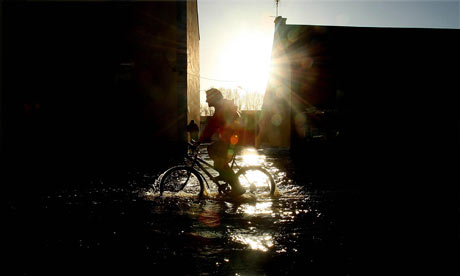
Cop15 climate change: cyclist in Ballinasloe, County Galway, Cumbria  during floods
Fred Pearce has a very readable explanation of why it is so critical and urgent that the human race stop burning fossil and biofuels, in this Guardian article.

Add another state to the list of those declaring disastrous crop losses this season, Rhode Island.

Cool weather and rain? Riiiiggghhht. Does that explain all of this?:

Updated chart showing USDA disaster areas (chart found here at MarketSkeptics)

Tuesday, December 1, 2009

Never underestimate the ruthless duplicity of the powerful elite

I generally try to stay focussed on trees and so forth - but the greed for endless energy underlies much of what is evil in this world, including invisible lethal pollution, and war.

Blog Archive

My Blog List

Search This Blog

Followers

counter